
ModelScope
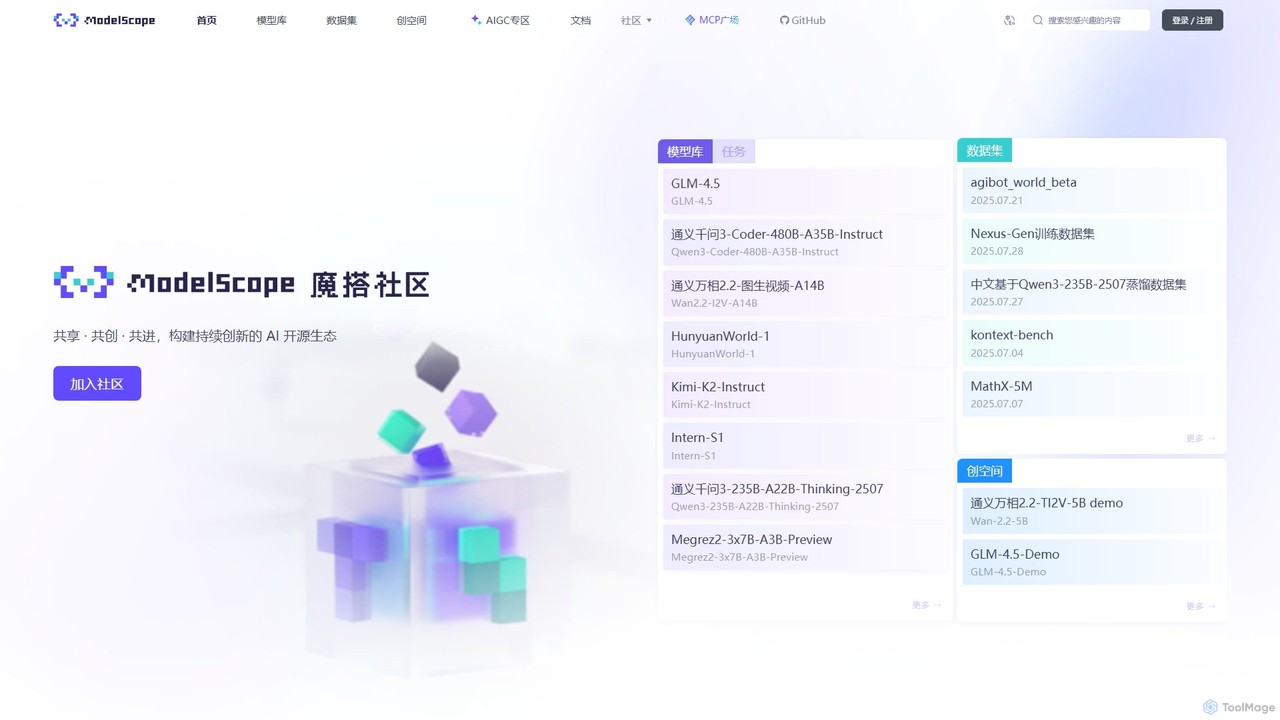
ModelScope is an open-source AI model community and platform, offering a vast library of models and datasets. It …
ModelScope is an open-source AI model community and platform, offering a vast library of models and datasets. It provides a "Model-as-a-Service" (MaaS) ecosystem with tools for easy model training, inference, and application development, supported by free computing resources.
About Model Hub
A Model Hub is a centralized platform offering access to a vast library of pre-trained AI models. These hubs function as a critical resource within the developer toolkit, allowing users to discover, download, and integrate models for tasks like natural language processing, computer vision, and audio analysis. By providing ready-to-use models, they significantly accelerate the development lifecycle, enabling developers and researchers to build sophisticated AI applications without the need to train models from scratch. This approach saves substantial time and computational resources.
Core Features
- Model Discovery and Search: Find models based on task, framework (like TensorFlow or PyTorch), dataset, or popularity.
- Version Control and Hosting: Access different versions of a model, ensuring reproducibility and tracking updates.
- API for Inference: Many hubs provide simple APIs to run predictions directly, facilitating rapid prototyping and integration.
- Fine-Tuning Resources: Offer code snippets, tutorials, and environments to adapt pre-trained models to specific datasets.
- Community and Documentation: A space for users to share models, discuss performance, and access research papers.
Applicable Scenarios
Model Hubs are essential for AI developers, data scientists, and academic researchers. They are used for rapidly prototyping new application features, such as adding text summarization to a news app. In academia, they facilitate benchmarking and comparison of state-of-the-art models. Companies also use them to fine-tune foundational models on proprietary data to create specialized internal tools.
Selection Criteria
When choosing a Model Hub, consider the variety and quality of its model library, ensuring it covers your required domains. Evaluate its compatibility with your preferred machine learning frameworks and deployment environments. It is also crucial to carefully review the licensing terms of each model to ensure compliance for commercial use. Finally, assess the quality of documentation and the vibrancy of the user community for support.
Model HubUse Cases
Rapid Prototyping of an NLP Feature
A startup developer needs to quickly build a sentiment analysis feature for their new customer feedback platform. Instead of spending months training a model, they browse a Model Hub and find a well-documented, pre-trained sentiment analysis model compatible with PyTorch. Within hours, they integrate the model's API into their application. This allows them to launch a functional prototype to investors and early users in days instead of months, significantly accelerating their product validation cycle.
Academic Research in Computer Vision
A university researcher is working on a paper comparing different object detection algorithms. They use a Model Hub to access several state-of-the-art models like YOLO, SSD, and Faster R-CNN. The hub provides standardized access to these models and their pre-trained weights on common datasets like COCO. This saves the researcher significant time in implementation and setup, allowing them to focus directly on running experiments, benchmarking performance on their specific dataset, and analyzing the results for their publication.
Fine-Tuning a Model for a Specific Domain
A healthcare technology company wants to build a chatbot that understands medical terminology. General-purpose language models are not sufficient. Their data science team selects a powerful open-source foundational model from a Model Hub. They then use the hub's provided scripts and tutorials to fine-tune this model on their proprietary dataset of medical journals and patient inquiries. The result is a highly specialized model that accurately understands and responds to complex medical questions, forming the core of their new product.
Integrating Speech-to-Text into a Mobile App
A mobile app developer wants to add voice command functionality to their productivity app. Building a speech recognition system from scratch is complex and resource-intensive. They find a Model Hub that offers a high-accuracy, low-latency speech-to-text model via a simple REST API. By making API calls from their app, they can transcribe user voice commands into text on the fly. This allows them to implement a sophisticated feature quickly, enhancing user experience without needing deep expertise in speech processing technology.
Exploring State-of-the-Art Generative Models
An AI enthusiast and content creator is curious about the latest advancements in generative AI. They use a Model Hub as a playground to explore and experiment with new text-to-image and large language models as soon as they are released. Through web interfaces or simple code notebooks provided by the hub, they can test different prompts, compare the outputs of various models, and understand their capabilities and limitations. This hands-on exploration helps them stay current with AI trends and create informed content for their audience.
Benchmarking Model Performance for Production
A data science team at an e-commerce company is tasked with choosing the best image classification model to categorize product photos. They select five promising models from a Model Hub. Using the hub's standardized framework, they download each model and run a benchmark test on their internal dataset of 100,000 product images. They evaluate each model on accuracy, inference speed, and resource consumption. The clear, comparable results allow them to make a data-driven decision and confidently deploy the most efficient model into their production environment.