Templa8
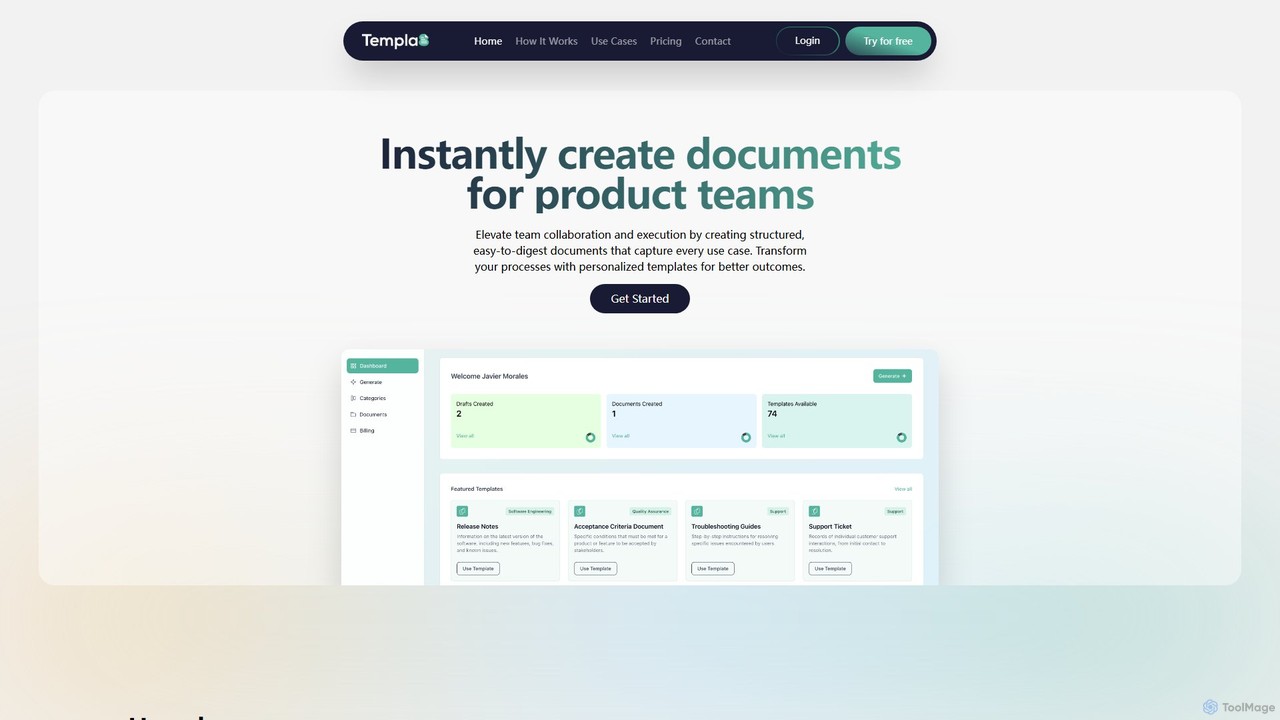
Templa8 is an AI-powered platform designed to streamline document creation and enhance team collaboration. It generates intelligent, structured …
Templa8 is an AI-powered platform designed to streamline document creation and enhance team collaboration. It generates intelligent, structured templates for various professional needs, from technical specs and API docs to project plans and business reports, accelerating workflows and ensuring consistency across all team documentation.
About Technical Writing
AI Technical Writing tools are specialized applications designed to assist in creating, managing, and optimizing technical documentation. These tools leverage natural language processing (NLP) and machine learning to automate tasks like generating API references, enforcing style consistency, and simplifying complex jargon. Their primary value lies in improving the accuracy, clarity, and maintainability of documents such as user manuals, SDK guides, and internal knowledge bases. By integrating directly with code repositories and development workflows, they help ensure documentation remains synchronized with the software it describes.
Core Features
- Documentation Generation: Automatically creates structured documents like API references or tutorials from source code comments, specifications (e.g., OpenAPI), or other data sources.
- Style and Terminology Enforcement: Analyzes text to ensure it adheres to a predefined style guide, maintaining consistent tone and terminology across all documents.
- Content Simplification: Rewrites complex technical sentences into clearer, more accessible language suitable for a broader audience.
- Code Snippet Management: Helps generate, validate, and update code examples within documentation to prevent them from becoming outdated.
- Structural Analysis: Provides feedback on document structure, logical flow, and completeness to enhance readability and user comprehension.
Use Cases
These tools are primarily used by software developers, dedicated technical writers, and product managers within technology companies. Common applications include generating and maintaining API documentation for external developers, creating comprehensive user guides for SaaS products, and building searchable internal knowledge bases to support engineering teams. They are essential in agile environments where software and its documentation must evolve rapidly and in parallel.
How to Choose
When selecting an AI Technical Writing tool, consider its integration capabilities with your existing toolchain, such as Git repositories, CI/CD pipelines, and IDEs. Evaluate its support for the specific programming languages and documentation formats (e.g., Markdown, AsciiDoc) you use. Also, assess the sophistication of its AI features, such as the accuracy of its content generation and the flexibility of its style guide customization. Finally, consider collaboration features and the overall user experience for your team.
Technical WritingUse Cases
Automating API Reference Documentation
A backend developer working on a new microservice needs to provide clear API documentation for the frontend team. Instead of writing it manually, they integrate an AI Technical Writing tool into their CI/CD pipeline. The tool automatically scans their OpenAPI (Swagger) specification file upon every code commit. It then generates a complete, interactive HTML documentation site with endpoint descriptions, parameter details, and request/response examples. This process ensures the documentation is always 100% synchronized with the latest code, saving the developer hours of manual work per week and eliminating discrepancies that could slow down frontend development.
Creating Clear Step-by-Step User Guides
A technical writer for a complex SaaS platform is tasked with creating a new user guide for a feature with a steep learning curve. They use an AI technical writing tool to structure the content. By inputting a list of user actions, the tool suggests a logical flow, generates consistent headings, and rewrites jargon-filled developer notes into simple, action-oriented steps. It also flags ambiguous phrases and suggests clearer alternatives, ensuring the final guide is easy for non-technical users to follow. This reduces user support tickets related to the new feature by an estimated 30% and improves the overall user onboarding experience.
Maintaining a Consistent Internal Knowledge Base
An engineering team at a fast-growing startup uses a shared knowledge base to document internal processes and system architecture. As the team grows, the documentation becomes inconsistent in tone, terminology, and format. They implement an AI technical writing tool that integrates with their wiki software. The tool provides real-time suggestions to engineers as they write, enforcing the company's style guide. It automatically corrects inconsistent terms (e.g., changing 'user ID', 'User ID', and 'userid' to the official 'UserID') and suggests rephrasing for clarity. This leads to a more professional, searchable, and reliable knowledge base, reducing the time new hires spend searching for information by 40%.
Generating SDK Documentation from Code Comments
A mobile development team is releasing a new Software Development Kit (SDK) for third-party developers. To ensure high adoption rates, the SDK needs excellent documentation. The team uses an AI technical writing tool that parses source code comments (like Javadoc or Swift's documentation comments). The tool extracts class descriptions, method parameters, and return values, then structures this information into a professional-looking HTML documentation portal. It also generates navigation and cross-references automatically. This automates over 80% of the documentation effort, allowing the developers to focus on writing high-quality code and comments, knowing the documentation will be generated consistently from them.
Localizing Technical Manuals for Global Markets
A hardware manufacturer needs to translate its product installation manuals into five new languages. Before sending the text to human translators, a product documentation manager uses an AI technical writing tool to 'pre-flight' the English source text. The tool identifies culturally specific idioms, overly complex sentences, and ambiguous phrasing that could lead to poor translations. It suggests simplified, globally-neutral alternatives. This pre-editing step improves the quality of the source text, resulting in faster, more accurate, and less expensive translations. The final localized manuals are clearer and lead to fewer customer support calls from international markets.
Validating and Updating Code Snippets
A documentation team for a popular open-source library manages hundreds of pages containing code examples. Keeping these snippets up-to-date with each new library version is a major challenge. They deploy an AI technical writing tool that continuously scans their documentation portal. The tool is configured to lint and test each code snippet against the latest version of the library in a sandboxed environment. It automatically flags snippets with deprecated functions or incorrect syntax and, in some cases, suggests the correct updated code. This proactive validation prevents developers from copying broken code, improves the library's reputation, and significantly reduces the manual maintenance burden on the documentation team.