Swiftask
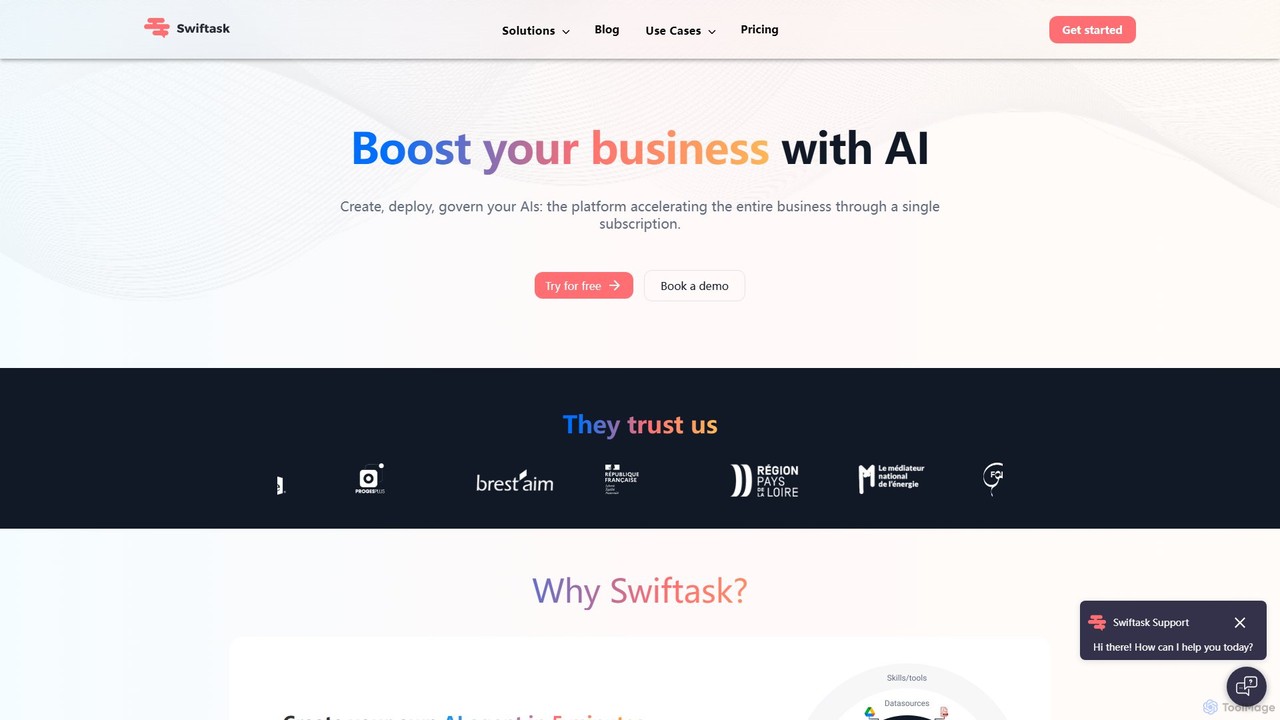
Swiftask is an all-in-one AI workspace designed for businesses to create, deploy, and govern custom AI agents without …
Swiftask is an all-in-one AI workspace designed for businesses to create, deploy, and govern custom AI agents without any coding. It integrates over 80 leading AI models, allowing teams to automate workflows, enhance productivity, and leverage company data securely through a single, cost-effective subscription.
About Agent
AI Agent tools are frameworks and libraries for building autonomous entities that perceive their environment, make decisions, and take actions to achieve specific goals. These tools provide the architecture for creating agents that can reason, plan, and execute complex tasks with minimal human intervention. They are fundamental in the Development category for creating sophisticated, goal-oriented applications that can interact intelligently with digital systems or the real world. This enables the development of systems that can automate workflows, manage resources, or simulate complex behaviors.
Core Features
- Autonomous Operation: Enables agents to function independently to complete assigned tasks without continuous human input.
- Goal-Oriented Planning: Allows agents to break down a high-level objective into a sequence of executable steps.
- Tool Integration: Provides capabilities for agents to use external APIs, scripts, and other software as tools to perform actions.
- Environment Perception: Equips agents with the ability to gather and interpret information from their digital or physical surroundings.
- Memory and Learning: Supports short-term and long-term memory to retain context and learn from past interactions to improve future performance.
Use Cases
AI Agent tools are widely used by developers and AI engineers to build advanced applications. Common scenarios include creating autonomous customer service representatives that can handle complex queries, developing intelligent NPCs (Non-Player Characters) in video games that react dynamically to player actions, and building personal assistants that can manage schedules and automate multi-step digital tasks like research and reporting.
How to Choose
When selecting an AI Agent tool, consider the complexity of the framework and your team's programming skills. Evaluate its integration capabilities with large language models (LLMs) and external APIs, which are crucial for agent functionality. Assess the tool's support for memory management and learning mechanisms. Finally, consider the scalability of the framework for deploying single or multi-agent systems and the level of community support available.
AgentUse Cases
Automate Complex Customer Support Workflows
A customer support manager aims to reduce response times and handle complex queries without immediate human intervention. Using an AI Agent framework, their development team builds an autonomous agent connected to the company's knowledge base, CRM, and order management system. This agent can understand user intent, retrieve order information, process return requests, and even troubleshoot technical issues by guiding users through steps. When a problem exceeds its capabilities, it intelligently gathers all relevant context and escalates the ticket to the appropriate human agent, significantly improving efficiency and customer satisfaction.
Develop Dynamic NPCs for Video Games
A game developer wants to create more immersive and unpredictable game worlds. Instead of using traditional scripted behaviors for Non-Player Characters (NPCs), they use an AI Agent framework. Each NPC is an agent with its own goals (e.g., survival, wealth accumulation) and the ability to perceive the game world and player actions. These agents can dynamically create plans, form alliances with other NPCs, or react to the player in novel ways. This results in emergent gameplay where the game world feels alive and constantly evolving, providing a unique experience for every player.
Create an Autonomous Research and Reporting Assistant
A market analyst needs to compile weekly reports on industry trends, a task that involves browsing multiple news sites, analyzing data from various sources, and summarizing findings. They use an AI Agent tool to build a personal assistant. The analyst provides a high-level goal: 'Create a report on AI trends this week.' The agent then autonomously searches the web, uses API tools to pull financial data, identifies key themes, synthesizes the information into a coherent summary, and drafts a report. This automates hours of manual work, allowing the analyst to focus on strategic interpretation rather than data collection.
Automate Software Development and Testing Tasks
A DevOps engineer wants to streamline the development lifecycle. They deploy an AI agent to monitor a code repository. When a new bug report is filed, the agent analyzes the report, locates the potentially problematic code sections, and attempts to generate a code fix. It then creates a new branch, applies the fix, runs a suite of automated tests to validate the solution, and if the tests pass, it creates a pull request for human review. This agent acts as an autonomous junior developer, handling routine bug fixes and freeing up senior developers to focus on more complex architectural challenges.
Simulate Economic Markets with Multi-Agent Systems
An economist wants to understand the potential impact of a new policy on market behavior. Using a multi-agent system framework, they create a simulation where thousands of individual agents represent consumers and businesses. Each agent is given a set of rules and goals (e.g., maximize profit, maximize utility). The economist can then introduce a policy change into the simulation, such as a new tax, and observe the emergent, macro-level effects as the agents interact. This provides a powerful tool for policy testing and economic forecasting that goes beyond traditional statistical models.
Build a Proactive Personal Productivity Assistant
A busy professional uses an AI agent tool to create a personalized assistant that goes beyond simple reminders. This agent has access to their email, calendar, and project management tools. It can proactively identify scheduling conflicts and suggest resolutions, summarize long email threads into actionable points, and remind them of upcoming deadlines with relevant documents attached. By observing the user's habits, the agent learns to prioritize tasks, automatically draft routine email responses, and even suggest blocking off focus time in their calendar before important meetings, acting as a true executive assistant.