Kerno
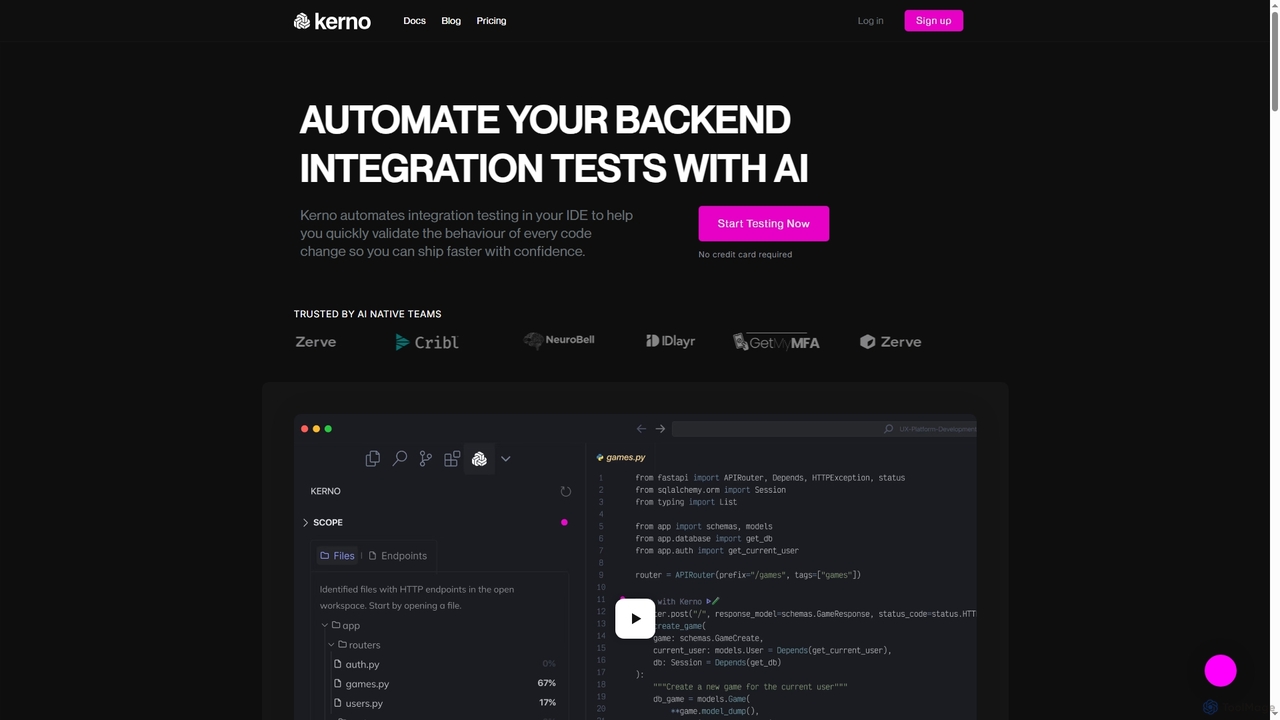
Kerno is an AI-powered co-pilot for backend developers, autonomously generating, running, and maintaining exhaustive integration test suites. It …
Kerno is an AI-powered co-pilot for backend developers, autonomously generating, running, and maintaining exhaustive integration test suites. It understands your code, dependencies, and business logic to deliver reliable, high-quality testing at scale, directly within your IDE.
About Backend Development
AI Backend Development tools are a class of software that leverages artificial intelligence to automate and accelerate the creation, management, and optimization of server-side applications. These tools utilize models like LLMs to generate code, design databases, and create APIs from natural language prompts or high-level specifications. They significantly reduce manual coding, allowing developers to focus on complex business logic and architecture. This approach streamlines the entire development lifecycle, from prototyping to deployment and maintenance.
Core Features
- AI Code Generation: Automatically create boilerplate code, API endpoints, and business logic in various programming languages.
- Automated API Creation & Documentation: Generate RESTful or GraphQL APIs with corresponding interactive documentation from data models.
- Intelligent Database Management: Design database schemas, generate migration scripts, and optimize queries using AI suggestions.
- Automated Testing & Debugging: Generate unit tests, identify potential bugs, and suggest code fixes to improve software quality.
- AI-Powered Security Analysis: Proactively scan code for common vulnerabilities and suggest security hardening measures.
Use Cases
These tools are ideal for startups and teams aiming for rapid prototyping and quick market entry. They are also valuable in enterprise environments for modernizing legacy systems, building microservices architectures, and automating repetitive coding tasks, freeing up senior developers for high-impact work.
How to Choose
When selecting a tool, consider its supported programming languages and frameworks, the depth of its integration with your existing CI/CD pipeline and cloud services, its code generation quality and customizability, and its security features. Also, evaluate the pricing model—whether it's based on usage, seats, or features—to align with your project's budget and scale.
Backend DevelopmentUse Cases
Rapid API Prototyping for a New Mobile App
A startup developer needs to build a backend for a new social media app. Instead of writing hundreds of lines of boilerplate code for user authentication, profiles, and posts, they use an AI Backend Development tool. By providing a simple data schema in plain text, the tool generates a complete set of REST API endpoints, a connected database, and user authentication logic in minutes. This allows the frontend team to start development immediately, reducing the time-to-market by weeks.
Automating CRUD Operations for Internal Tools
An enterprise IT team is tasked with building an internal inventory management system. For each new item type, they need to create standard Create, Read, Update, and Delete (CRUD) functionalities. Using an AI tool, they define the data model for 'Warehouse,' 'Product,' and 'Shipment.' The tool automatically generates all the necessary backend logic, database tables, and API endpoints, eliminating hours of repetitive and error-prone coding for each module.
Generating Microservices from Business Logic
A large e-commerce company is migrating from a monolithic architecture to microservices. A backend architect defines the requirements for a new 'Payment Processing' service in a specification document. An AI Backend Development tool parses this document, understands the logic for handling different payment gateways and currencies, and generates a self-contained microservice with the required APIs and data models. This accelerates the decomposition process and ensures consistency across services.
AI-Assisted Database Schema Migration
A developer is evolving an existing application and needs to add new features that require significant database changes. They describe the new requirements, such as 'add a user role system with permissions.' The AI tool analyzes the existing schema, suggests the necessary new tables and column modifications, and generates the database migration scripts. It also highlights potential data integrity issues, preventing production database errors.
Enhancing Code Security with AI Audits
A DevOps engineer integrates an AI Backend Development tool into their CI/CD pipeline. Before any new code is deployed, the AI automatically scans it for common security vulnerabilities like SQL injection, cross-site scripting (XSS), and insecure API endpoints. It not only flags the issues but also provides concrete code suggestions to fix them, improving the application's security posture without manual intervention from a security expert.
Optimizing Performance with AI Query Analysis
A backend team notices performance degradation in their application during peak hours. They use an AI tool to analyze application logs and database query patterns. The AI identifies inefficient database queries that are causing bottlenecks and suggests optimized versions of the SQL queries or recommends adding specific database indexes. This helps the team resolve performance issues proactively before they impact a large number of users.