Unity
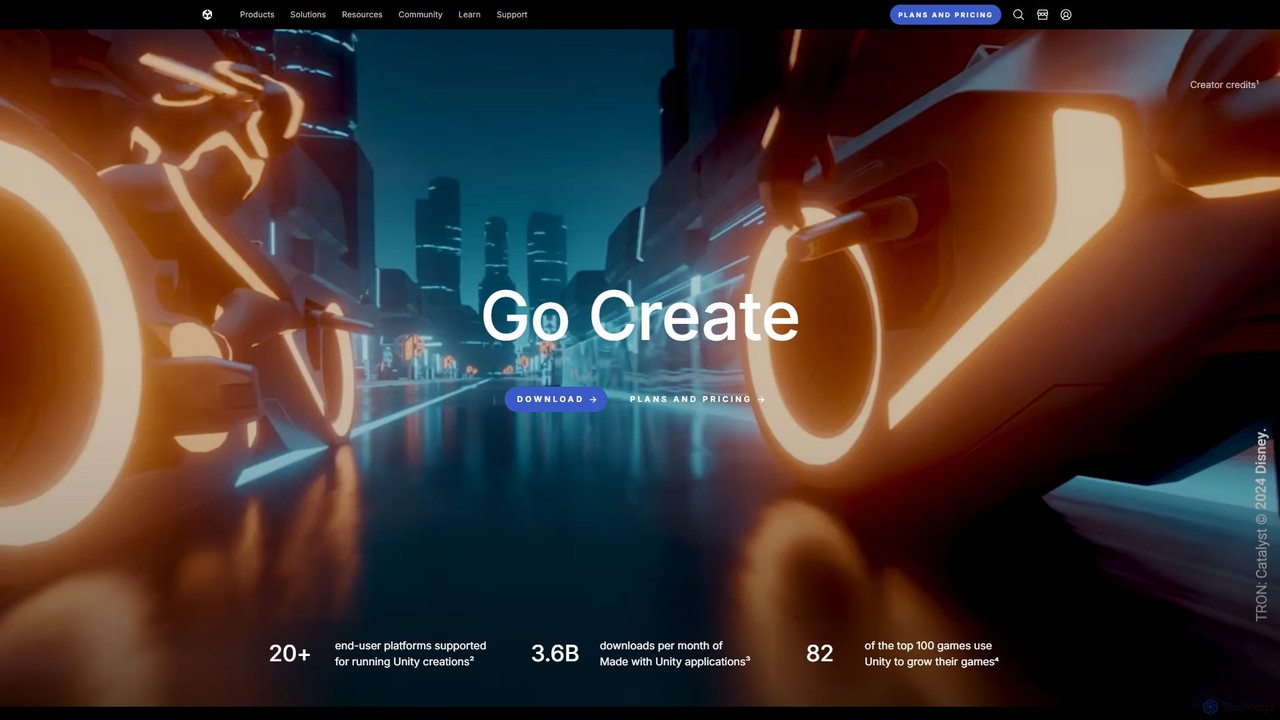
Unity is the world's leading real-time 3D development platform for creating and operating interactive content. It empowers creators …
Unity is the world's leading real-time 3D development platform for creating and operating interactive content. It empowers creators across industries, from gaming and film to automotive and architecture, to build immersive experiences for over 20 platforms, including PC, mobile, console, VR, and AR.
About Game Engine
A Game Engine is a comprehensive software framework designed for creating and developing video games and other real-time interactive content. It integrates core components like a rendering engine for 2D/3D graphics, a physics engine for object simulation, audio processing, and scripting tools into a unified development environment. These platforms streamline complex processes, enabling creators to build immersive virtual worlds, design intelligent character behaviors, and implement dynamic gameplay mechanics. Modern game engines increasingly incorporate AI functionalities for procedural content generation, advanced NPC AI, and optimizing development workflows.
Core Features
- Real-time Rendering: Manages the rendering of 2D and 3D graphics, including lighting, shadows, and post-processing effects to achieve visual fidelity.
- Physics System: Simulates realistic physical interactions such as collision detection, gravity, and material properties for objects in the game world.
- AI and Scripting: Provides tools, including visual scripting and APIs, for creating game logic, character behaviors, and complex AI systems like pathfinding.
- Asset Management Pipeline: Facilitates the import, organization, and optimization of various digital assets like 3D models, textures, animations, and sound files.
- Cross-Platform Deployment: Allows developers to build and publish their projects on multiple platforms, such as PC, consoles, mobile, and web, from a single codebase.
Use Cases
Game engines are the primary tool for game developers, from solo indie creators to large AAA studios. Their application has expanded into other industries, including film and television for virtual production and pre-visualization, architecture for creating interactive real-time walkthroughs, automotive for developing driving simulators, and education for building immersive training modules.
How to Choose
Selecting a game engine depends on project scope, target platforms, and team expertise. Key factors include the engine's primary programming language (e.g., C++ for Unreal, Cfor Unity), its strengths in 2D versus 3D development, the quality of its documentation and community support, the availability of assets in its marketplace, and its specific licensing and revenue-sharing model.
Game EngineUse Cases
Rapid Prototyping for Indie Games
An indie game developer with limited coding experience wants to test a new game concept quickly. Using a game engine's visual scripting system, like Unreal Engine's Blueprints or Unity's Bolt, they can create core gameplay mechanics, character controls, and level logic without writing extensive code. By leveraging pre-made assets from the engine's marketplace, they assemble a playable prototype in days instead of months. This allows for early playtesting and feedback, enabling rapid iteration on the game design before committing significant resources to full production.
Creating Realistic Architectural Visualizations
An architecture firm needs to present a new building design to a client in an immersive way. They import their 3D CAD models into a game engine like Unreal Engine or Unity. Within the engine, they apply photorealistic materials, set up dynamic lighting that simulates the time of day, and add environmental elements like foliage and weather. The result is a real-time, interactive walkthrough that allows the client to explore the virtual space freely, understand the scale and feel of the design, and request changes instantly. This is far more impactful than static renders or pre-recorded videos.
Developing Advanced NPC AI Behavior
A development team for an open-world RPG needs to create believable, non-repetitive behaviors for its Non-Player Characters (NPCs). An AI programmer uses the game engine's built-in AI tools, such as behavior trees and environment query systems. They design complex logic where NPCs react to the player's actions, changes in the environment (like weather), and their own internal states (like hunger or fear). The engine's pathfinding system allows NPCs to navigate complex terrain intelligently. This results in a dynamic and immersive world where NPCs feel like living inhabitants rather than simple scripted robots.
Virtual Production for Film and Television
A film production studio utilizes a game engine for virtual production, replacing traditional green screens. They build digital sets within the engine and display them on massive LED walls behind the actors. The engine renders the scene in real-time, and the camera's position is tracked, allowing the virtual background to shift its perspective perfectly with the camera's movement. This technique enables directors and actors to see the final visual effects live on set, leading to better performances and creative decisions. It also significantly reduces post-production time and costs associated with compositing.
Procedural Content Generation for Open Worlds
A game designer is tasked with creating a massive, diverse game world but lacks the resources for manual creation. They use AI-powered procedural content generation (PCG) tools integrated with a game engine. By defining a set of rules, parameters, and asset libraries (e.g., types of trees, rocks, buildings), the PCG system automatically generates vast landscapes, complex cave systems, or entire cities. This not only saves thousands of hours of manual work but also allows for the creation of unique worlds for each player or playthrough, significantly enhancing replayability.
Building Training Simulators for Professionals
A company specializing in industrial training needs to create a safe and cost-effective simulator for operating heavy machinery. They use a game engine to build a realistic 3D environment that mirrors the actual worksite. The engine's physics system is configured to accurately simulate the machinery's weight, movement, and interaction with materials. Trainees can practice complex procedures in this virtual environment without any real-world risk to themselves or expensive equipment. The engine can also track performance metrics and provide feedback, creating a highly effective and repeatable training tool.