AI SDK
AI SDK by Vercel is a free, open-source TypeScript toolkit for building AI-powered applications. It provides a unified …
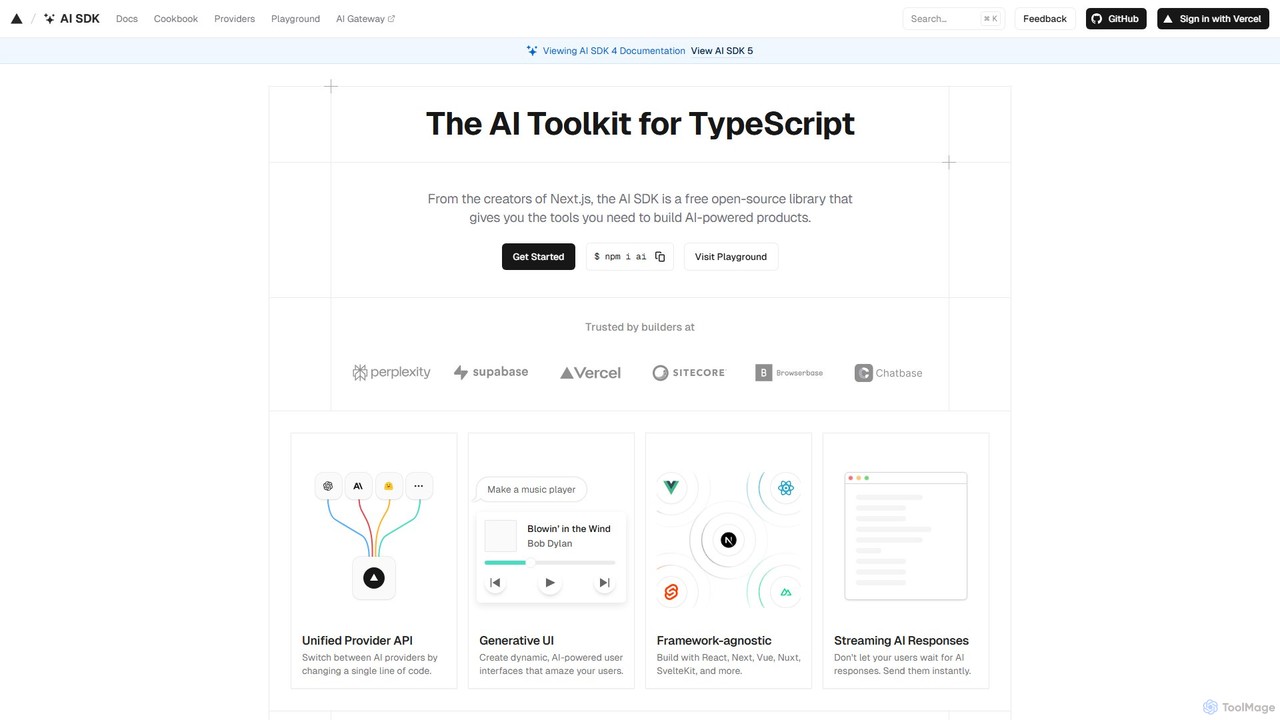
AI SDK by Vercel is a free, open-source TypeScript toolkit for building AI-powered applications. It provides a unified API to seamlessly integrate various large language models (LLMs) like OpenAI, Google, and Anthropic. It simplifies development with features like streaming responses, generative UI components, and tool calling, enabling developers to build and ship AI features faster across frameworks like Next.js, React, and Svelte.
About Library
AI Libraries are essential collections of pre-written code, functions, and resources specifically designed to streamline AI development within the broader Development category. These powerful tools encapsulate complex algorithms, machine learning models, and data processing functionalities, providing ready-to-use modules for various AI tasks. They empower developers to build sophisticated AI applications more efficiently by abstracting underlying complexities, accelerating the development lifecycle, and fostering innovation. By leveraging these AI development libraries, engineers can focus on unique problem-solving rather than reinventing foundational components.
Core Features
- Pre-built Algorithms: Offer optimized implementations of common AI algorithms like neural networks and decision trees.
- Model Architectures: Provide templates and components for building various machine learning model structures.
- Data Handling Utilities: Include functions for efficient data loading, preprocessing, transformation, and augmentation.
- API Integrations: Facilitate seamless connection with other services, datasets, or hardware accelerators.
- Performance Optimization: Often include highly optimized routines for speed and resource efficiency in AI computations.
Applicable Scenarios
AI libraries are indispensable for data scientists, machine learning engineers, and software developers. They are used for rapid prototyping of machine learning models, integrating AI capabilities into existing software, and developing custom AI solutions for specific industry problems such as predictive analytics or natural language understanding.
How to Choose
When selecting an AI library, consider its framework compatibility with your existing tech stack (e.g., Python, Java). Evaluate its functionality scope to ensure it covers your required AI tasks (e.g., NLP, computer vision). Look for strong community support and comprehensive documentation for troubleshooting. Finally, assess its performance and scalability to handle your project's data volume and computational demands.
LibraryUse Cases
Building a Custom Recommendation Engine
A data scientist utilizes a machine learning library like TensorFlow or PyTorch to implement collaborative filtering or content-based recommendation algorithms. This allows an e-commerce platform to suggest personalized products to users, significantly boosting engagement and sales by tailoring recommendations based on user behavior and preferences.
Developing an Automated Image Classification System
A computer vision engineer leverages an image processing library (e.g., OpenCV, scikit-image) and a deep learning framework to train a model for identifying objects in images. This system can automate quality control in manufacturing by detecting defects or categorize vast image archives for easier search and retrieval, saving significant manual effort.
Integrating Natural Language Processing (NLP) into a Chatbot
A software developer uses an NLP library (e.g., spaCy, NLTK, Hugging Face Transformers) to add sentiment analysis and entity recognition capabilities to a customer service chatbot. This enables the chatbot to understand user intent more accurately, respond contextually, and escalate complex queries appropriately, leading to improved customer satisfaction and reduced support costs.
Accelerating Data Preprocessing for Machine Learning
A machine learning engineer utilizes a data manipulation library (e.g., Pandas, NumPy) to efficiently clean, transform, and prepare large datasets for model training. By automating tasks like missing value imputation, feature scaling, and data aggregation, these libraries significantly reduce the time spent on data preparation, allowing for faster iteration and deployment of ML models.
Creating a Real-time Anomaly Detection System
A cybersecurity analyst employs a time-series analysis library (e.g., Prophet, statsmodels) to build a system that identifies unusual patterns in network traffic or sensor data. This allows for real-time detection of potential security breaches, equipment failures, or fraudulent activities, providing immediate alerts and enabling proactive intervention to mitigate risks.
Implementing Reinforcement Learning for Game AI
A game developer uses a reinforcement learning library (e.g., Stable Baselines3, Ray RLlib) to train AI agents to learn optimal strategies in complex game environments. This enhances player experience by creating intelligent NPCs, enables automated game testing, and can even be used for procedural content generation, pushing the boundaries of interactive entertainment.