XenonStack
XenonStack is an enterprise-grade AI platform designed to build, deploy, and manage Agentic AI systems. It provides a …
XenonStack is an enterprise-grade AI platform designed to build, deploy, and manage Agentic AI systems. It provides a comprehensive 'Data Foundry' and a suite of tools to automate complex workflows, enhance decision-making, and ensure responsible AI governance. It empowers businesses to transform their operations through autonomous, intelligent agents.
ClearML GenAI App Engine
An enterprise-grade platform for rapidly deploying, managing, and scaling Generative AI applications. It provides a unified infrastructure control …
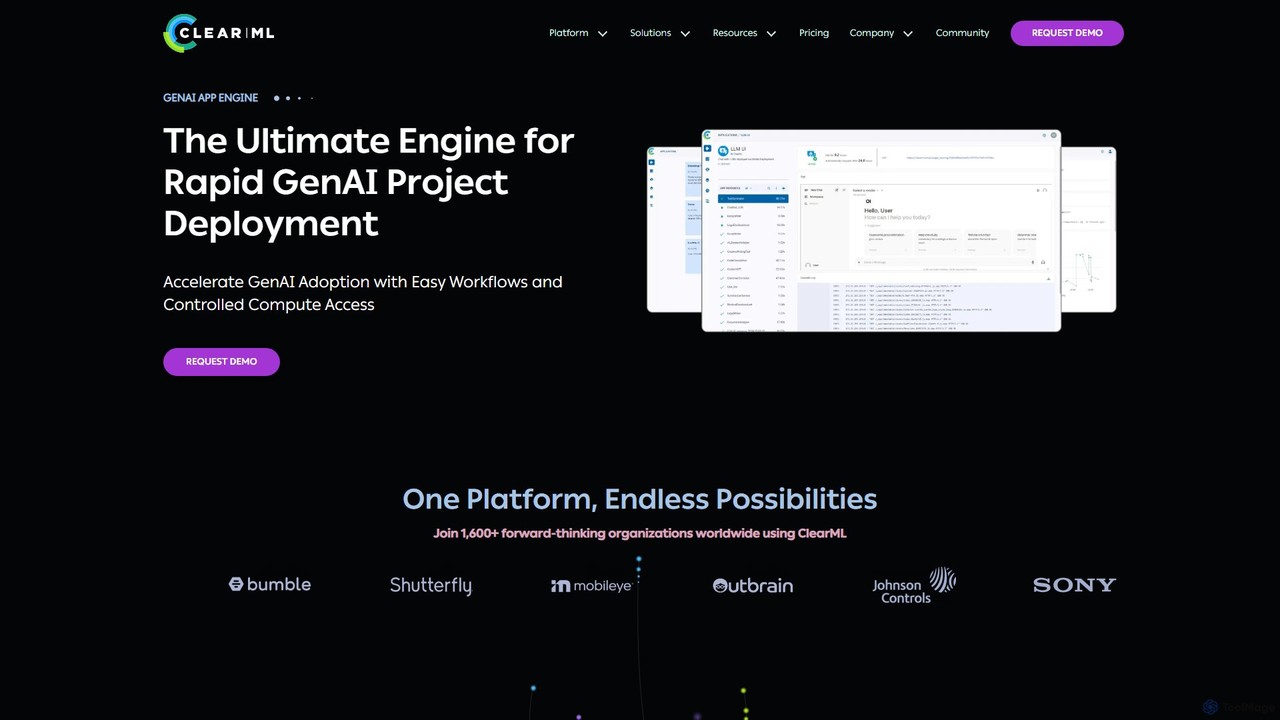
An enterprise-grade platform for rapidly deploying, managing, and scaling Generative AI applications. It provides a unified infrastructure control plane to streamline LLM deployment, monitor performance, and optimize compute costs, accelerating GenAI adoption securely and efficiently.

Weights & Biases
Weights & Biases is the leading MLOps platform for developers to build better models faster. It helps machine …
Weights & Biases is the leading MLOps platform for developers to build better models faster. It helps machine learning teams track experiments, version datasets, manage model lifecycles, and collaborate seamlessly. Ideal for everything from academic research to enterprise-level AI development.
About Mlops
MLOps tools are platforms designed to automate and streamline the entire machine learning (ML) lifecycle, from data preparation to model deployment and monitoring. They apply DevOps principles to machine learning, unifying model development with operational deployment. This approach enables organizations to reliably and efficiently deploy, manage, monitor, and govern ML models in production at scale. By providing a structured framework, these tools foster collaboration between data scientists, ML engineers, and IT operations teams.
Core Features
- CI/CD for ML: Automates the building, testing, and deployment of machine learning pipelines.
- Model Registry & Versioning: Tracks and manages different versions of models, data, and code for reproducibility.
- Model Monitoring: Continuously observes production models for performance degradation, data drift, and prediction accuracy.
- Feature Store: A centralized repository for managing, sharing, and serving features for both model training and inference.
- Workflow Orchestration: Automates and schedules complex, multi-step ML workflows and pipelines.
Use Cases
MLOps tools are essential for organizations moving machine learning models from research to production. They are widely used in industries like finance for fraud detection model management, e-commerce for retraining recommendation engines, and healthcare for governing diagnostic AI. Key roles that benefit include ML Engineers responsible for production systems and data science teams aiming to accelerate deployment cycles.
How to Choose
When selecting an MLOps tool, consider its scope—whether it's an end-to-end platform or a point solution for a specific task like monitoring. Evaluate its integration capabilities with your existing cloud infrastructure (AWS, GCP, Azure) and ML frameworks (TensorFlow, PyTorch). Also, assess its scalability to handle your data volume and model complexity, and consider the technical expertise required by your team to operate the platform effectively.
MlopsUse Cases
Automating Model Retraining Pipelines
An e-commerce company's data science team needs to keep their product recommendation model up-to-date with the latest user behavior. Using an MLOps platform, they build an automated pipeline that triggers whenever new interaction data is collected. The pipeline automatically retrains the model, evaluates its performance against the current production model, and if it's better, deploys the new version without any manual intervention. This ensures recommendations are always relevant, improving user engagement and sales.
Monitoring for Model Drift in Finance
A financial institution uses an ML model for credit scoring. Economic shifts can cause 'concept drift,' where the model's predictions become less accurate over time. An MLOps tool continuously monitors the live prediction data and input features. It automatically detects statistical drift between the training data and production data, sending an alert to the ML engineering team. This proactive monitoring allows them to investigate and trigger a retraining process before the model's performance significantly impacts lending decisions.
Reproducible Experiment Tracking for R&D
A pharmaceutical research team is developing an ML model to predict drug efficacy. They run hundreds of experiments with different algorithms, hyperparameters, and data subsets. An MLOps tool with experiment tracking capabilities automatically logs every detail of each run: the code version, parameters, dataset used, and resulting metrics. This creates a fully reproducible history, allowing scientists to easily compare results, identify the best performing model, and provide a complete audit trail for regulatory compliance.
Centralized Feature Management with a Feature Store
A ride-sharing company uses multiple models for ETA prediction, surge pricing, and driver matching. These models often share features like 'average trip duration' or 'user rating'. Instead of recalculating these features for each model, they use a centralized Feature Store within their MLOps platform. This ensures consistency between the features used for training and real-time inference, preventing training-serving skew. It also allows data scientists to discover and reuse existing features, accelerating new model development.
CI/CD for Computer Vision Models at the Edge
A manufacturing company uses computer vision models on edge devices to detect product defects on an assembly line. When an ML engineer improves the model, they commit the new code to a repository. This triggers a CI/CD pipeline in their MLOps tool. The pipeline automatically runs tests, builds a new containerized version of the model optimized for the edge device, and deploys it to a staging environment for validation. Once approved, the new model is rolled out to all devices on the factory floor with zero downtime.
Model Governance and Auditing in Healthcare
A healthcare provider uses an AI model to assist in diagnosing diseases from medical images. Due to strict regulations like HIPAA, they must maintain a complete audit trail. Their MLOps platform serves as a central system of record. It logs who trained the model, what data was used (with privacy preserved), its performance metrics across different versions, and when it was deployed. When an audit is required, they can instantly generate a report demonstrating compliance, model fairness, and a full history of the model's lifecycle.