allquiet
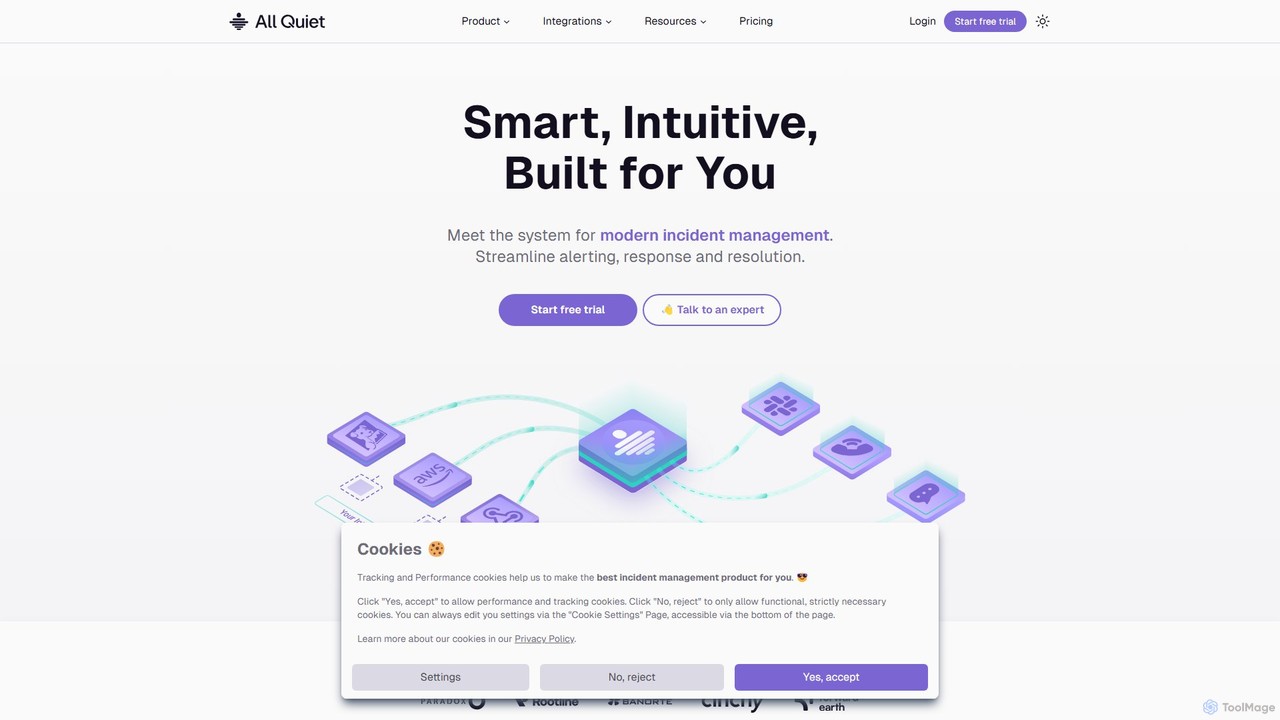
allquiet is a modern IT incident management and on-call scheduling platform for tech teams. It streamlines alerting, response, …
allquiet is a modern IT incident management and on-call scheduling platform for tech teams. It streamlines alerting, response, and resolution with over 35 integrations, multi-channel notifications, and developer-friendly tools like Terraform. It focuses on maximizing team productivity and system uptime with transparent, value-driven pricing.
About Monitoring
AI Monitoring tools are a class of software within the DevOps lifecycle that automatically track, analyze, and report on the health and performance of applications and infrastructure. Leveraging machine learning, these tools learn normal system behavior to detect anomalies, predict potential failures, and reduce alert fatigue. They provide real-time visibility into complex environments, enabling teams to move from reactive problem-solving to proactive issue prevention. This is crucial for maintaining service reliability and optimizing user experience in dynamic, large-scale systems.
Core Features
- Anomaly Detection: Automatically identifies unusual patterns and deviations from normal performance baselines using machine learning.
- Predictive Analytics: Forecasts future trends, potential capacity bottlenecks, and system failures based on historical data.
- Automated Root Cause Analysis (RCA): Correlates disparate events and metrics to pinpoint the likely source of a problem, reducing investigation time.
- Dynamic Alerting: Generates intelligent alerts that adapt to changing system conditions, minimizing false positives.
Use Cases
Primarily used by Site Reliability Engineers (SREs), DevOps teams, and IT Operations (ITOps) professionals. Common applications include monitoring microservices architectures, cloud-native applications on platforms like Kubernetes, and ensuring the stability of CI/CD pipelines by tracking performance post-deployment.
How to Choose
When selecting an AI Monitoring tool, consider its integration capabilities with your existing tech stack (e.g., cloud providers, CI/CD tools), the sophistication of its machine learning models, its scalability to handle your data volume, and the clarity of its dashboards for quick diagnostics. Also, evaluate the balance between automation and user control.

MonitoringUse Cases
Real-time Application Performance Monitoring (APM)
A DevOps team for a SaaS application uses an AI monitoring tool to track user experience in real-time. The tool automatically analyzes transaction traces, database queries, and API response times. When it detects a gradual increase in latency for a specific API endpoint affecting only users in a certain region, it raises a predictive alert. This allows the team to investigate and resolve a network routing issue before it escalates into a major outage, preserving the service level agreement (SLA) and customer satisfaction.
Proactive Infrastructure Health Monitoring
An IT operations team manages a large-scale hybrid cloud environment. An AI monitoring tool continuously analyzes metrics from servers, virtual machines, and network devices. It learns the normal patterns of resource utilization, such as daily CPU spikes during batch processing. The tool identifies a subtle memory leak in a cluster of servers that would be missed by static threshold alerts. It predicts that the servers will run out of memory in 48 hours and alerts the team, providing enough time for a scheduled, non-disruptive fix.
Automated Root Cause Analysis in Microservices
A Site Reliability Engineer (SRE) receives an alert for slow performance in a checkout service. Instead of manually checking logs and metrics from dozens of interdependent microservices, the AI monitoring tool automatically presents a root cause analysis. It correlates the checkout slowdown with a recent deployment in a downstream payment processing service and high latency from a third-party shipping API. This allows the SRE to immediately focus on the correct services, reducing the Mean Time to Resolution (MTTR) from hours to minutes.
Business KPI and Performance Correlation
For an online media company, a monitoring tool is configured to track not only technical metrics like server load but also business Key Performance Indicators (KPIs) such as user sign-ups and ad clicks. The AI model detects a sharp drop in user sign-ups that coincides with a minor increase in page load time after a new feature release. It flags this correlation, which might otherwise go unnoticed. The product team is alerted, allowing them to quickly optimize the new feature's performance and restore the conversion rate.
Capacity Planning and Forecasting
A cloud infrastructure team needs to plan for future resource needs to avoid performance degradation and control costs. The AI monitoring tool analyzes historical usage data for compute, storage, and network resources. It uses predictive analytics to forecast demand for the upcoming holiday season, projecting a 40% increase in traffic. Based on this forecast, the team can proactively scale up resources in advance, ensuring smooth performance during the peak period while avoiding the cost of over-provisioning year-round.
Reducing Alert Fatigue for On-call Engineers
An on-call engineer is frequently woken up by non-critical alerts, leading to burnout. The organization implements an AI monitoring tool that uses adaptive thresholding and anomaly detection. Instead of alerting for every minor CPU spike, the tool learns the system's normal rhythm and only flags significant deviations. It also groups related alerts into a single, context-rich incident. This reduces the total number of alerts by over 80%, ensuring that the engineer is only notified for genuine, actionable issues, improving both response time and well-being.