ToolMage
Sign in

Best 1 Ai Tools for Discovery

Popular Ai Tools in Discovery include AI Art Weekly, helping you work more efficiently.

AI Art Weekly
Freemium

AI Art Weekly

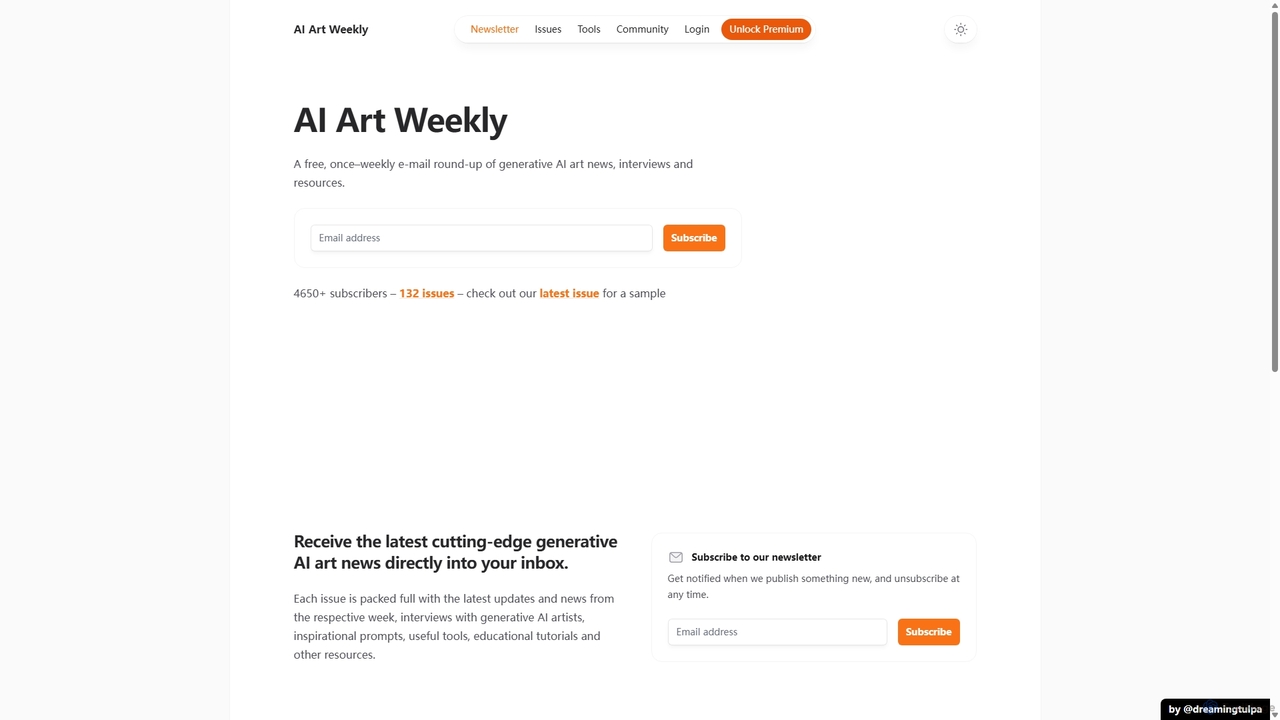
A free weekly newsletter and resource hub for the generative AI art community. It delivers curated news, artist interviews, inspirational prompts, and a comprehensive toolbox of AI papers and tools for creating digital art.

Generative Art
Visits 10KFavorites 118Likes 115

About Ai Tools

AI Tools are software applications and platforms that leverage artificial intelligence technologies to perform specific tasks, automate processes, and generate insights. These tools are built upon advanced machine learning, deep learning, natural language processing, and computer vision algorithms, enabling them to learn from data, adapt, and execute complex cognitive functions. They are designed to enhance productivity, foster creativity, and support data-driven decision-making across a multitude of industries and professional domains.

Core Features

  • Intelligent Automation: Automate repetitive tasks, data entry, and workflow processes, reducing manual effort and errors.
  • Content Generation: Create diverse forms of content, including text, images, audio, and video, based on user prompts or data inputs.
  • Advanced Data Analysis: Process vast datasets to identify patterns, extract insights, and generate predictive models for business intelligence.
  • Personalization & Recommendation: Tailor user experiences, product recommendations, and content delivery based on individual preferences and behaviors.
  • Natural Language Understanding & Generation: Comprehend human language for tasks like sentiment analysis, translation, and generating human-like text responses.

Use Cases

AI Tools are widely adopted across various sectors. Marketing teams utilize them for generating campaign copy and analyzing customer sentiment. Customer service departments deploy AI chatbots for instant support and query resolution. Developers leverage AI for code completion and bug detection, while researchers use them for accelerating data processing and pattern recognition in complex datasets.

How to Choose

Selecting the right AI Tool involves assessing several factors. Consider the specific problem you aim to solve and ensure the tool's core functionality aligns with your needs. Evaluate its integration capabilities with your existing software ecosystem, its ease of use for your team, and its scalability to grow with your demands. Finally, compare pricing models and support options to find a solution that offers the best value.

Featured tool rankings

Ai Tools use cases

1

Automating Customer Support Inquiries

Customer service teams can deploy AI chatbots to handle routine inquiries, provide instant answers to FAQs, and guide users through troubleshooting steps 24/7. This frees human agents to focus on complex issues, significantly reducing response times and improving customer satisfaction.

2

Generating Marketing Copy and Ad Creatives

Marketing professionals use AI tools to quickly generate multiple variations of ad headlines, product descriptions, social media posts, and email content. By inputting keywords and target audience details, they can produce high-quality, engaging copy at scale, accelerating campaign launches and A/B testing.

3

Extracting Insights from Large Datasets

Business analysts and data scientists leverage AI tools to process and analyze vast amounts of structured and unstructured data, such as sales figures, customer feedback, or market trends. These tools can identify hidden patterns, predict future outcomes, and provide actionable insights for strategic decision-making.

4

Assisting Software Development and Code Generation

Developers utilize AI-powered coding assistants for tasks like code completion, suggesting optimal algorithms, identifying potential bugs, and even generating entire code snippets based on natural language descriptions. This accelerates development cycles, improves code quality, and reduces debugging time.

5

Personalizing Educational Content and Learning Paths

Educators and e-learning platforms employ AI to create adaptive learning experiences. AI tools can analyze a student's performance and learning style to recommend personalized content, exercises, and learning paths, optimizing engagement and knowledge retention for individual learners.

6

Summarizing Documents and Research Papers

Researchers, students, and professionals can use AI summarization tools to quickly distill the key information from lengthy documents, articles, or research papers. This saves significant time in information gathering and helps in rapidly grasping the core arguments or findings without reading the entire text.

Ai Tools FAQ

What are AI Tools?

AI Tools are software applications that utilize artificial intelligence technologies, such as machine learning and natural language processing, to perform tasks that typically require human intelligence. They are designed to automate, analyze, create, and optimize various processes across industries, from content generation to data analysis and customer service.

How do AI Tools work?

AI Tools primarily work by processing vast amounts of data to identify patterns and learn from them. Machine learning algorithms enable them to make predictions or decisions without explicit programming. For example, a natural language processing tool learns language rules from text data, while a computer vision tool learns to recognize objects from image data. This learning allows them to perform specific tasks intelligently.

Who can benefit from using AI Tools?

A wide range of individuals and organizations can benefit from AI Tools. This includes content creators for generating ideas and drafts, marketers for optimizing campaigns, customer service teams for automating support, developers for accelerating coding, business analysts for data insights, and educators for personalized learning. Essentially, anyone looking to automate tasks, enhance creativity, or make data-driven decisions can find value.

What are the main types of AI Tools available?

AI Tools encompass a broad spectrum, including AI content generators (text, image, video), AI chatbots and virtual assistants, AI data analysis and prediction platforms, AI automation tools for workflows, AI coding assistants, and AI-powered design tools. Each type specializes in leveraging AI for a particular domain or function, offering diverse solutions for various needs.

How to choose the best AI Tool for my needs?

To choose the best AI Tool, first clearly define your specific problem or goal. Evaluate the tool's core functionalities to ensure they directly address your requirements. Consider its ease of integration with your existing systems, user-friendliness, and the level of support provided. Also, assess its scalability for future growth and compare pricing models to ensure it fits your budget and offers a good return on investment.