
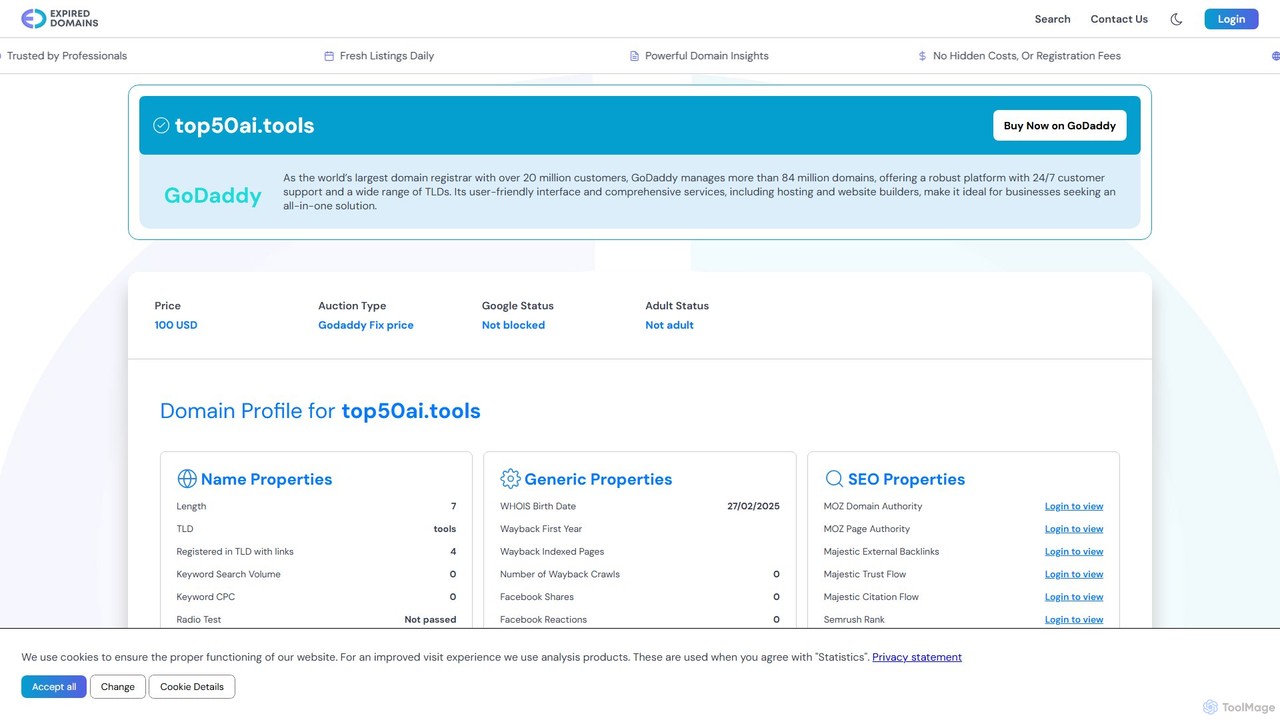
Top50AI.tools
A curated discovery platform that ranks and reviews the top 50 AI tools across various categories. It helps …
A curated discovery platform that ranks and reviews the top 50 AI tools across various categories. It helps professionals, creators, and enthusiasts find the most effective and innovative AI solutions, saving time and effort in the search for the perfect tool.
About Ai Directory
An AI Directory is a specialized online platform designed to curate, categorize, and showcase a vast collection of artificial intelligence tools and services. These platforms function as comprehensive databases, utilizing structured taxonomies and advanced filtering systems to help users efficiently navigate the rapidly growing AI landscape. Their primary value lies in simplifying the discovery process, enabling professionals, developers, and enthusiasts to find the most relevant AI solutions for their specific needs. By aggregating information, reviews, and comparisons, AI Directories save significant research time and facilitate informed decision-making.
Core Features
- Advanced Search & Filtering: Quickly locate tools by category, pricing model, features, platform compatibility, and integration options.
- Curated Collections: Discover hand-picked lists of top tools for specific tasks, industries, or user roles, such as "AI for Marketing" or "Top AI Video Editors".
- User Reviews and Ratings: Leverage community feedback and real-world user experiences to assess a tool's effectiveness and reliability.
- Detailed Tool Profiles: Access comprehensive pages for each tool, featuring in-depth descriptions, key features, pricing plans, and user interface screenshots.
- Side-by-Side Comparison: Evaluate multiple AI tools simultaneously based on standardized criteria to easily identify key differences and advantages.
Use Cases
AI Directories are invaluable for a wide range of users. Marketing managers use them to find content generation and analytics tools. Software developers explore them to discover new APIs and platforms for integration. Entrepreneurs and product managers rely on them for competitive analysis and to identify market gaps. For individual creators and students, they serve as a gateway to exploring cutting-edge AI technology.
How to Choose
When selecting an AI Directory, consider its comprehensiveness and how frequently it's updated with new tools. Evaluate the quality of its search and filtering capabilities—the more granular, the better. Look for a platform with an active community providing genuine reviews. Finally, a clean, intuitive user interface that makes comparing tools straightforward is a key factor for an efficient discovery experience.
Ai DirectoryUse Cases
Researching Competitors and Market Trends
A startup founder or product manager needs to understand the current AI tool landscape before launching a new product. They use an AI Directory to filter for tools in their target niche, such as 'AI-powered customer support'. They can analyze the feature sets, pricing models, and user reviews of existing solutions. This process helps them identify market leaders, underserved features, and potential differentiation strategies, saving weeks of manual research on search engines and app stores.
Finding the Right MarTech Stack
A marketing manager is tasked with building a more efficient marketing technology (MarTech) stack. They use an AI Directory's 'Marketing' category and apply filters for 'SEO', 'Social Media Management', and 'Email Marketing'. They compare the top-rated tools, read user reviews focusing on integration capabilities with their existing CRM, and ultimately select a suite of AI tools that automates content creation and personalizes campaigns, improving team productivity and campaign ROI.
Discovering APIs for a New Application
A software developer is building an application that requires natural language processing (NLP) capabilities. Instead of building a model from scratch, they consult an AI Directory, specifically searching for 'NLP APIs'. They filter by programming language (e.g., Python) and pricing (e.g., 'Pay-as-you-go'). The directory provides direct links to documentation and developer portals, allowing them to quickly evaluate and prototype with several APIs to find the most accurate and cost-effective option for their project.
Sourcing Tools for Content Creation
A freelance content creator produces videos and blog posts for multiple clients. To scale their output, they turn to an AI Directory to find tools for specific tasks. They search for 'AI Video Editing' to find tools that can automatically generate subtitles, and 'AI Writing Assistant' to overcome writer's block and optimize articles for SEO. By using the directory, they build a personal toolkit that automates repetitive tasks, allowing them to focus on creative strategy and take on more client work.
Vetting Tools for Enterprise Adoption
An IT decision-maker in a large corporation is responsible for evaluating AI solutions for enterprise-wide deployment. They use a trusted AI Directory to create a shortlist of tools that meet specific security and compliance standards (e.g., GDPR, SOC 2). They focus on user reviews that mention scalability, customer support quality, and ease of integration with enterprise systems like Salesforce or Microsoft 365. The directory acts as a preliminary vetting mechanism, ensuring only viable candidates proceed to a formal procurement process.
Enhancing Academic Research
An academic researcher is working on a paper about the impact of AI on data analysis. They use an AI Directory to survey the landscape of 'AI Data Science' and 'Machine Learning' platforms. The directory helps them categorize existing tools based on their underlying algorithms and primary applications. This systematic overview provides a strong foundation for their literature review and helps them identify specific tools to test and cite in their research, ensuring their work reflects the current state of the technology.