Rp1
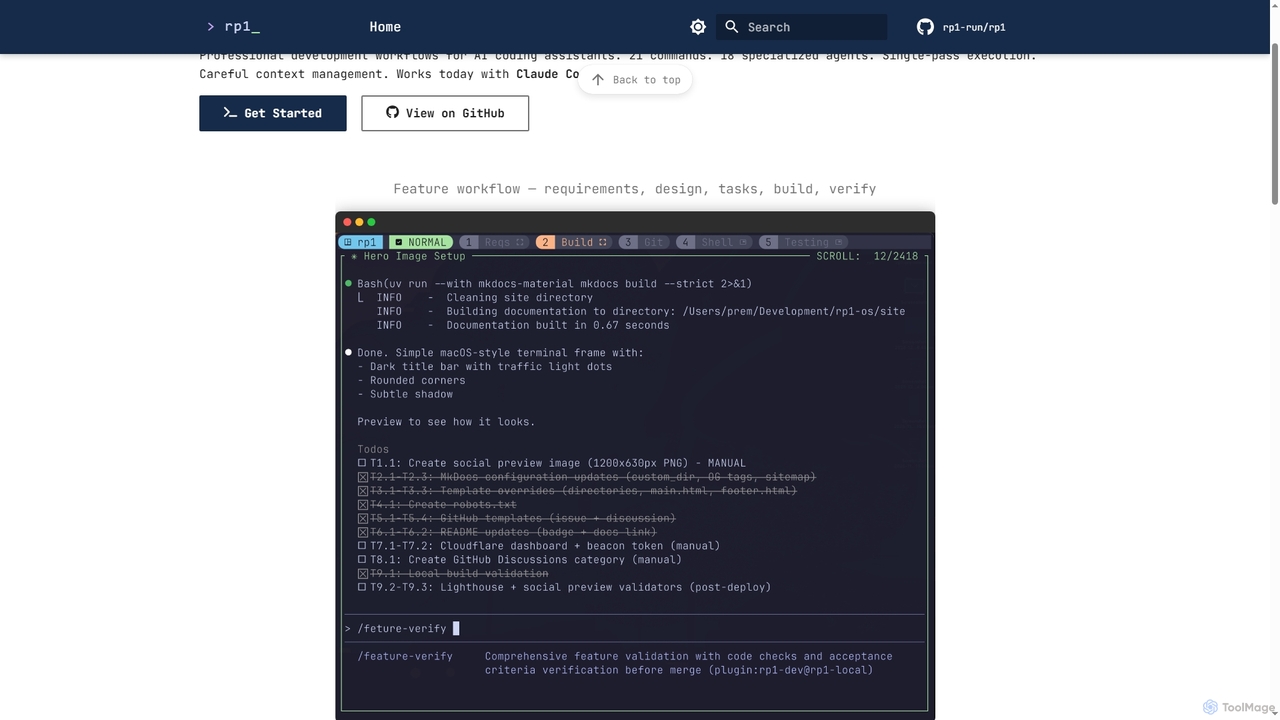
Rp1 is a professional development workflow tool for AI coding assistants, designed to streamline software creation from requirements …
Rp1 is a professional development workflow tool for AI coding assistants, designed to streamline software creation from requirements to deployment. It offers 21 commands and 18 specialized agents for efficient, single-pass execution of complex coding tasks, ensuring structured outputs and deep codebase awareness.
About Documentation
Documentation tools are AI-powered solutions designed to automate, streamline, and significantly enhance the creation, management, and maintenance of various forms of documentation. Leveraging advanced natural language processing (NLP), machine learning, and generative AI, these tools can intelligently generate content, organize vast amounts of information, and provide highly efficient, intelligent search capabilities. They are instrumental in reducing manual effort in technical writing, customer support, and knowledge management, ensuring accuracy, consistency, and up-to-dateness across all documents while adapting to evolving information needs.
Core Features
- Automated Content Generation: Automatically drafts technical specifications, user manuals, FAQs, or API documentation from structured data, existing content, or natural language prompts, accelerating the initial creation phase.
- Intelligent Search & Retrieval: Enhances knowledge base search with semantic understanding and contextual awareness, allowing users to find relevant information quickly and accurately, even with complex or ambiguous queries.
- Content Analysis & Optimization: Analyzes existing documentation for clarity, consistency, tone, and completeness, suggesting improvements, identifying outdated information, and ensuring adherence to style guides.
- Version Control & Collaboration: Manages document versions seamlessly, tracks all changes made by contributors, and facilitates real-time, collaborative editing among multiple team members across different roles.
- Multi-format Export & Integration: Supports exporting documentation into various formats like PDF, HTML, Markdown, or integrating directly with web platforms, content management systems, and development environments for broader accessibility.
Use Cases
These tools are invaluable for software development teams creating and maintaining complex API documentation, product managers drafting comprehensive user guides and release notes, and customer support departments building and managing extensive, self-service knowledge bases. They also significantly assist technical writers in handling large volumes of complex information, ensuring accuracy and consistency, and enable HR teams to efficiently develop and update internal training materials and policy documents.
How to Choose
When selecting AI documentation tools, it's crucial to consider the specific AI capabilities, such as the quality of content generation, the accuracy of natural language processing, and the depth of semantic search. Evaluate its integration with your existing tech stack (e.g., Git repositories, CRM systems, project management tools), the level of customization available for content style, branding, and workflows, and its scalability to handle your current and future documentation volume. Additionally, assess the ease of use for both content creators and end-users, along with robust security features to protect sensitive information.
DocumentationUse Cases
Automating API Documentation Generation
For software developers and technical writers, AI documentation tools can automatically generate comprehensive API documentation directly from source code comments, OpenAPI specifications, or code repositories. This eliminates manual transcription errors, ensures documentation is always up-to-date with code changes, and significantly accelerates the release cycle for new features and updates, saving hundreds of hours of manual effort.
Creating Intelligent Customer Knowledge Bases
Customer support teams can leverage AI tools to build and maintain dynamic knowledge bases that offer intelligent search capabilities. The AI can analyze support tickets to identify common questions, automatically draft FAQ answers, and suggest relevant articles to customers based on their queries. This empowers self-service, reduces support ticket volume, and improves customer satisfaction by providing instant, accurate information.
Streamlining User Manual & Guide Creation
Product managers and technical authors can use AI to streamline the creation of user manuals, product guides, and onboarding tutorials. By inputting product specifications or feature descriptions, the AI can generate initial drafts, suggest improvements for clarity and consistency, and adapt content for different user levels or languages. This accelerates time-to-market for new products and ensures high-quality, user-friendly documentation.
Maintaining Compliance & Policy Documents
Legal, HR, and compliance departments often deal with vast amounts of regulatory and internal policy documentation that requires frequent updates. AI documentation tools can monitor regulatory changes, automatically flag sections needing revision, and help draft updated policies. This ensures continuous compliance, reduces legal risks, and maintains an accurate, auditable record of all policy versions.
Generating Internal Training & Onboarding Materials
HR and training departments can utilize AI documentation tools to rapidly create and update internal training modules, onboarding guides, and employee handbooks. The AI can synthesize information from various sources, structure learning paths, and generate quizzes or summaries. This ensures new hires are quickly brought up to speed and existing employees have access to consistent, up-to-date training resources.
Localizing Documentation for Global Markets
For companies operating globally, AI documentation tools can automate the translation and localization of technical documents, marketing materials, and user interfaces into multiple languages. Beyond simple translation, AI can adapt cultural nuances and ensure technical terminology is consistent across all localized versions. This significantly reduces localization costs and time, enabling faster market expansion.