
CyberIQ
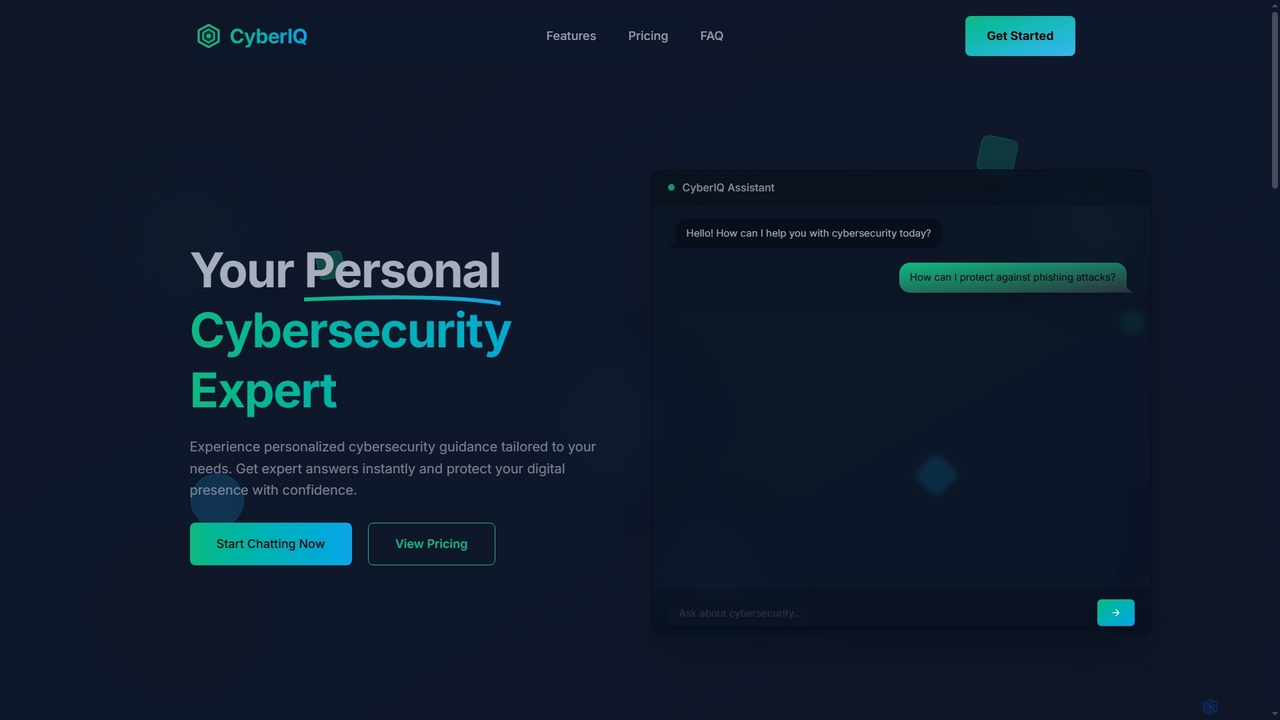
CyberIQ is your personal AI-powered cybersecurity assistant, offering tailored guidance and instant expert answers to protect your digital …
CyberIQ is your personal AI-powered cybersecurity assistant, offering tailored guidance and instant expert answers to protect your digital presence. It covers everything from personal security and home network protection to enterprise solutions and security learning.
About Cybersecurity Learning
Cybersecurity Learning tools are AI-powered platforms designed to educate individuals and organizations on digital security principles, threat detection, and defense strategies. These tools leverage artificial intelligence to offer personalized learning paths, interactive simulations, and real-time threat intelligence updates, enabling users to develop critical skills for protecting digital assets and infrastructure. They provide a dynamic and adaptive environment for mastering the complexities of cyber defense, from foundational concepts to advanced ethical hacking techniques.
Core Features
- Personalized Learning Paths: AI algorithms adapt course content and difficulty based on individual progress and skill gaps.
- Interactive Labs & Simulations: Hands-on virtual environments for practicing ethical hacking, incident response, and forensic analysis in a safe setting.
- Real-time Threat Intelligence: Integrates current cyber threat data into learning modules, keeping content relevant and up-to-date.
- Gamified Learning: Incorporates game-like elements, challenges, and leaderboards to enhance engagement and retention.
- Automated Assessment & Feedback: AI-driven systems evaluate performance in exercises and provide immediate, constructive feedback.
Use Cases
These tools are crucial for various professionals and organizations. IT security teams use them for continuous professional development and certification preparation. New entrants to the cybersecurity field leverage them for foundational knowledge and practical skill acquisition. Businesses deploy them for company-wide security awareness training, ensuring employees understand best practices to prevent phishing and data breaches.
How to Choose
When selecting a Cybersecurity Learning tool, consider the breadth and depth of its curriculum, ensuring it covers relevant domains like network security, cryptography, and compliance. Evaluate the quality and realism of its interactive labs and simulations, as hands-on experience is vital. Assess the platform's adaptability to different learning styles and its integration of up-to-date threat intelligence. Finally, compare pricing models and certification pathways offered.
Cybersecurity LearningUse Cases
Practicing Penetration Testing in a Safe Environment
A cybersecurity student or aspiring ethical hacker uses an AI-powered learning platform to access simulated network environments. They can perform various penetration testing techniques, identify vulnerabilities, and exploit them without risking real-world systems. The AI provides immediate feedback on their actions, suggests alternative approaches, and tracks their progress in mastering offensive security skills, preparing them for certifications like OSCP.
Training New Cybersecurity Analysts
Aspiring cybersecurity professionals utilize these platforms to acquire foundational knowledge and practical skills. Through guided modules and virtual labs, they learn about network security, incident response, and vulnerability assessment, preparing them for entry-level roles and industry certifications like CompTIA Security+ or CEH.
Upskilling IT Teams on Latest Threat Vectors
An enterprise security team utilizes an AI-driven cybersecurity learning platform to keep their IT staff updated on the latest cyber threats, attack methodologies, and defensive countermeasures. The platform offers modules on emerging topics like supply chain attacks, ransomware variants, and cloud security misconfigurations. Through interactive lessons and simulated incident response scenarios, team members enhance their ability to detect, analyze, and mitigate sophisticated attacks, reducing the organization's overall risk posture.
Continuous Professional Development for Security Teams
Existing IT security teams and professionals engage with these tools for ongoing skill enhancement and staying current with evolving threats. They access advanced courses on cloud security, penetration testing, or threat hunting, ensuring their expertise remains sharp and relevant in a dynamic threat landscape.
Preparing for Industry Cybersecurity Certifications
Individuals aiming for certifications like CompTIA Security+, Certified Ethical Hacker (CEH), or CISSP leverage AI-powered cybersecurity learning tools for comprehensive exam preparation. These platforms offer structured curricula aligned with certification objectives, practice questions, and mock exams that simulate the actual testing environment. Adaptive learning features identify areas where the user needs more focus, providing targeted resources and exercises to ensure they are fully prepared to pass their certification exams and advance their careers.
Company-wide Security Awareness Training
Organizations implement cybersecurity learning tools to educate all employees, not just IT staff, on common cyber threats. Interactive modules cover topics like phishing detection, strong password practices, and data privacy, significantly reducing human error as a vulnerability point and fostering a security-conscious culture.
Conducting Security Awareness Training for Employees
Organizations implement AI-powered cybersecurity learning tools to deliver engaging and effective security awareness training to all employees, regardless of their technical background. These tools offer interactive modules on topics like phishing detection, strong password practices, and data privacy compliance. The AI personalizes the training experience, highlighting common vulnerabilities based on user behavior and industry-specific threats, significantly reducing the human element of cyber risk across the company.
Preparing for Ethical Hacking Certifications
Individuals aiming for certifications such as Certified Ethical Hacker (CEH) or Offensive Security Certified Professional (OSCP) use these platforms for specialized training. They practice advanced penetration testing techniques, exploit vulnerabilities in simulated environments, and master tools used by ethical hackers to identify system weaknesses.
Learning Digital Forensics and Incident Response
A digital forensics analyst uses an AI-powered platform to simulate complex cyber incident scenarios, such as data breaches or malware infections. The tool guides them through the entire incident response lifecycle, from initial detection and containment to eradication and recovery. They practice using forensic tools, analyzing logs, and preserving evidence in a controlled environment. The AI provides real-time feedback on their investigative steps, helping them develop critical thinking and practical skills for effective incident handling.
Developing Incident Response Capabilities
Security operations center (SOC) teams leverage these tools to simulate cyberattacks and practice incident response procedures. They learn to identify, contain, eradicate, and recover from various security incidents, improving their team's readiness and reducing the potential impact of real-world breaches through realistic drills.
Understanding Compliance and Regulatory Frameworks
Compliance officers and legal professionals utilize AI-driven cybersecurity learning platforms to understand complex regulatory frameworks like GDPR, HIPAA, or CCPA. These tools break down legal jargon into understandable modules, explain the implications of non-compliance, and offer scenarios where users must apply their knowledge to ensure data protection and privacy. The AI can highlight specific clauses relevant to their industry and provide updates on evolving regulations, ensuring organizations remain compliant and avoid costly penalties.
Academic Integration for Computer Science Students
Universities and colleges integrate cybersecurity learning platforms into their computer science or information security curricula. Students gain access to structured courses and practical labs that complement theoretical knowledge, providing hands-on experience with real-world security challenges and tools before entering the workforce.