
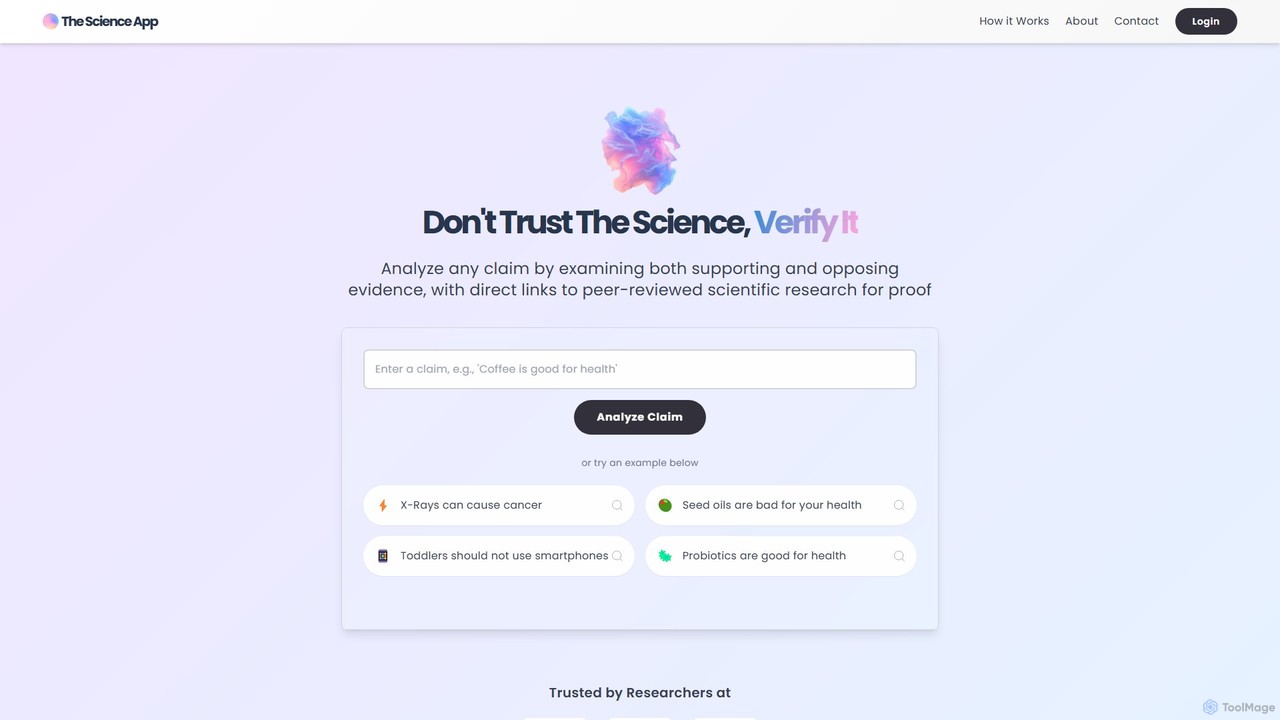
The Science App
The Science App is an AI-powered tool that analyzes any scientific claim by examining both supporting and opposing …
The Science App is an AI-powered tool that analyzes any scientific claim by examining both supporting and opposing evidence. It searches peer-reviewed research to provide a balanced perspective, with direct links to the original scientific papers for verification. Ideal for researchers, students, and curious minds, it makes complex scientific information accessible and promotes evidence-based decision-making.
About Fact Checking
Fact Checking tools are a class of AI-powered applications designed to automatically verify the accuracy of statements and claims. These tools leverage Natural Language Processing (NLP) and machine learning to analyze text, compare it against vast databases of reliable sources, and assess its credibility. They are essential for combating misinformation in various fields, from journalism to academic research, by providing rapid, data-driven assessments of information. This capability helps users make more informed decisions and fosters a more trustworthy information ecosystem.
Core Features
- Claim Detection & Extraction: Automatically identifies specific, verifiable assertions within a larger piece of content.
- Source Analysis: Evaluates the reputation and historical accuracy of the sources cited or referenced in the text.
- Evidence Retrieval: Scans news archives, scientific papers, and fact-checking databases to find supporting or contradictory evidence.
- Bias Identification: Analyzes language patterns to detect potential political, commercial, or ideological bias in the content.
- Credibility Scoring: Generates a confidence score or rating that summarizes the likely veracity of the information.
Use Cases
These tools are widely used by journalists and news organizations to quickly verify information before publication. In academia, researchers and students use them to ensure the integrity of their sources. Content moderation teams on social media platforms also rely on them to flag and manage the spread of misinformation at scale.
How to Choose
When selecting a Fact Checking tool, consider the breadth and quality of its source database. Evaluate its language support and its ability to analyze different content types, such as articles, social media posts, or even videos. Look for transparency in its verification methodology and consider whether it offers integrations like browser extensions or APIs for seamless workflow integration.
Fact CheckingUse Cases
Verifying Claims in Breaking News for Journalists
A journalist covering a fast-developing event receives a tip with a critical claim. Before publishing, they use an AI Fact Checking tool to instantly analyze the claim. The tool cross-references the information against reputable news archives, official statements, and academic databases in real-time. It flags potential inconsistencies and provides a credibility score along with links to supporting or refuting evidence. This allows the journalist to quickly validate or debunk the information, ensuring their reporting is accurate and maintaining the news outlet's credibility under tight deadlines.
Assessing Source Reliability for Academic Research
A university student is writing a research paper and needs to build a bibliography of credible sources. They use a fact-checking tool to evaluate potential articles and studies. By inputting the URL or text of a source, the tool analyzes the author's credentials, the publication's reputation, and whether its claims are supported by other established research. The system flags sources with a history of bias or retraction, helping the student avoid unreliable information. This process strengthens the academic integrity of their paper and teaches critical evaluation skills.
Moderating User-Generated Content on Social Platforms
A content moderation team for a large social media platform uses an AI fact-checker to screen posts for misinformation at scale. The tool's API is integrated into their moderation queue, automatically flagging content that contains claims related to sensitive topics like health or politics. The tool provides a report for each flagged item, highlighting the specific claim and linking to reputable fact-checking organizations. This allows human moderators to prioritize their work, make faster, more consistent decisions, and reduce the spread of harmful falsehoods on the platform.
Monitoring Brand Reputation and Countering Disinformation
A public relations team for a major corporation uses a fact-checking tool to monitor online mentions of their brand. The system continuously scans news sites, blogs, and social media for claims made about the company or its products. When it detects a false or misleading narrative gaining traction, it alerts the PR team. The tool provides a dossier of evidence refuting the claim, which the team can use to craft a swift and accurate public response. This proactive approach helps protect the brand's reputation and mitigates the financial and social impact of disinformation campaigns.
Validating Market Intelligence for Financial Analysts
A financial analyst researching a potential investment opportunity encounters a news article with bold claims about a company's upcoming technology. To perform due diligence, the analyst uses an AI fact-checker to verify the article's assertions. The tool checks the claims against patent filings, official company press releases, and reports from established financial news outlets. It might flag that the 'breakthrough' technology is still in a very early, speculative stage, providing a more nuanced view than the original article. This helps the analyst make a more informed, risk-assessed investment recommendation.
Promoting Media Literacy for Everyday Internet Users
An individual sees a provocative post shared widely on their social media feed. Instead of immediately sharing it, they use a browser extension powered by a fact-checking AI. The extension automatically analyzes the content of the post, identifies the core claims, and displays a small pop-up with a credibility rating. It might show that the claim originates from a known satirical source or has been debunked by multiple independent fact-checkers. This immediate feedback helps the user become a more critical consumer of information and prevents them from unintentionally contributing to the spread of fake news.