Your Political Place
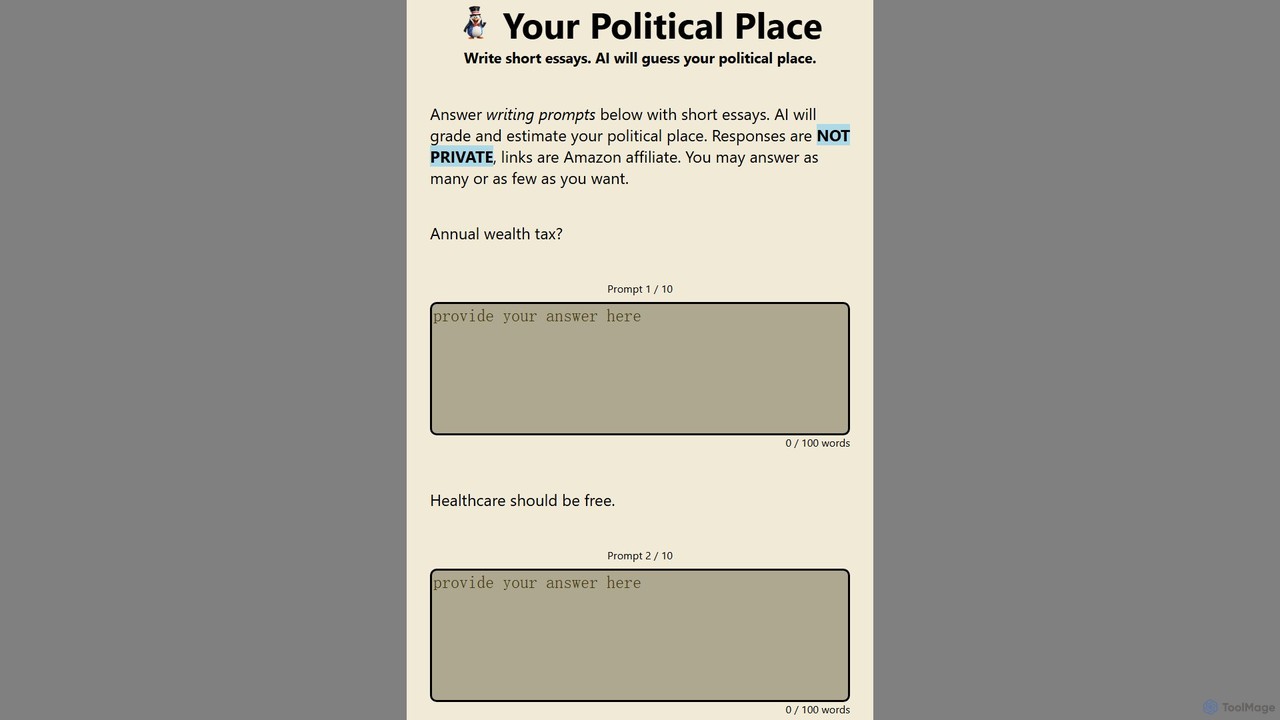
An AI-powered tool that analyzes your political leanings. Users write short essays on various political topics, and the …
An AI-powered tool that analyzes your political leanings. Users write short essays on various political topics, and the AI evaluates the text to estimate their position on the political spectrum. It's an engaging way to explore and understand political perspectives through written expression.
About Political Science
AI Political Science tools are specialized applications that use artificial intelligence to analyze political data, texts, and trends. They leverage natural language processing (NLP) and machine learning models to extract insights from sources like legislation, social media, and news reports. These tools empower researchers, students, and analysts to understand public opinion, track policy changes, and model political scenarios with greater speed and accuracy. Their primary advantage lies in processing vast amounts of unstructured data that would be challenging to analyze manually.
Core Features
- Sentiment Analysis: Automatically gauges public opinion and identifies key themes in political communication.
- Policy Impact Simulation: Models the potential economic and social outcomes of proposed legislation.
- Legislative Tracking: Monitors and summarizes new bills, regulations, and voting records in real-time.
- Discourse Analysis: Identifies frames, arguments, and topics within large volumes of political text.
- Predictive Modeling: Utilizes historical data and current trends to forecast events like election outcomes.
Use Cases
These tools are primarily used in academia for research, by government agencies and think tanks for policy analysis, and in journalism for investigative reporting. For example, a policy analyst can use a tool to forecast the public response to a new tax law, while a student can visualize the evolution of political discourse over decades.
How to Choose
When selecting a tool, consider the types of data sources it supports (e.g., social media APIs, legal texts), the complexity of its analytical models, and its user interface. Also, evaluate whether you need real-time analysis capabilities and if the tool's specialization aligns with your focus, such as election analysis or international relations.
Political ScienceUse Cases
Analyze Public Sentiment on a Policy
A policy analyst at a non-profit organization needs to understand public reaction to a proposed environmental regulation. Using an AI Political Science tool, they input keywords related to the policy to scan millions of social media posts and news articles. The tool generates a sentiment dashboard, showing positive, negative, and neutral opinions, and identifies the main arguments being made by different groups. This allows the analyst to produce a comprehensive report for stakeholders in hours, not weeks.
Track Legislative Changes for Compliance
A corporate compliance team must stay updated on new data privacy laws across multiple jurisdictions. They use an AI legislative tracking tool that automatically monitors government websites for new bills. The tool summarizes the key provisions of each bill, highlights changes from existing laws, and sends alerts for relevant updates. This automates a highly manual process, reducing the risk of non-compliance and saving significant research time for the legal team.
Conduct Academic Research on Political Discourse
A university researcher is studying how political rhetoric has changed over 50 years. They upload a massive corpus of digitized parliamentary speeches and presidential addresses into an AI analysis platform. The tool performs topic modeling to identify recurring themes and tracks the frequency of specific frames and keywords over time. The results provide quantitative evidence for their thesis on evolving political communication, enabling a depth of analysis previously unattainable.
Forecast Election Outcomes for Campaign Strategy
A political campaign manager wants to allocate resources effectively in a tight race. They use an AI forecasting tool that combines polling data, historical voting patterns, and real-time social media sentiment. The model runs thousands of simulations to predict the likely outcome in different districts, identifying key swing areas where campaigning efforts will have the most impact. This data-driven approach helps optimize campaign strategy and budget allocation for maximum effect.
Simulate Economic Impact of a Trade Agreement
A government economist is tasked with evaluating a new international trade agreement. They use an AI policy simulation tool, inputting the terms of the agreement and existing economic data. The model simulates the potential effects on GDP, employment rates, and specific industries. The output includes visualizations and reports that help policymakers understand the potential benefits and drawbacks before ratification, leading to more informed decision-making.
Enhance Political Science Education
A professor wants to make complex political theories more accessible to undergraduate students. They use an interactive AI simulation tool in the classroom where students can act as policymakers. Students can propose policies, see the AI-simulated public and economic reactions, and learn about the consequences of their decisions in a controlled, engaging environment. This transforms abstract concepts like game theory or public choice theory into practical, memorable lessons.