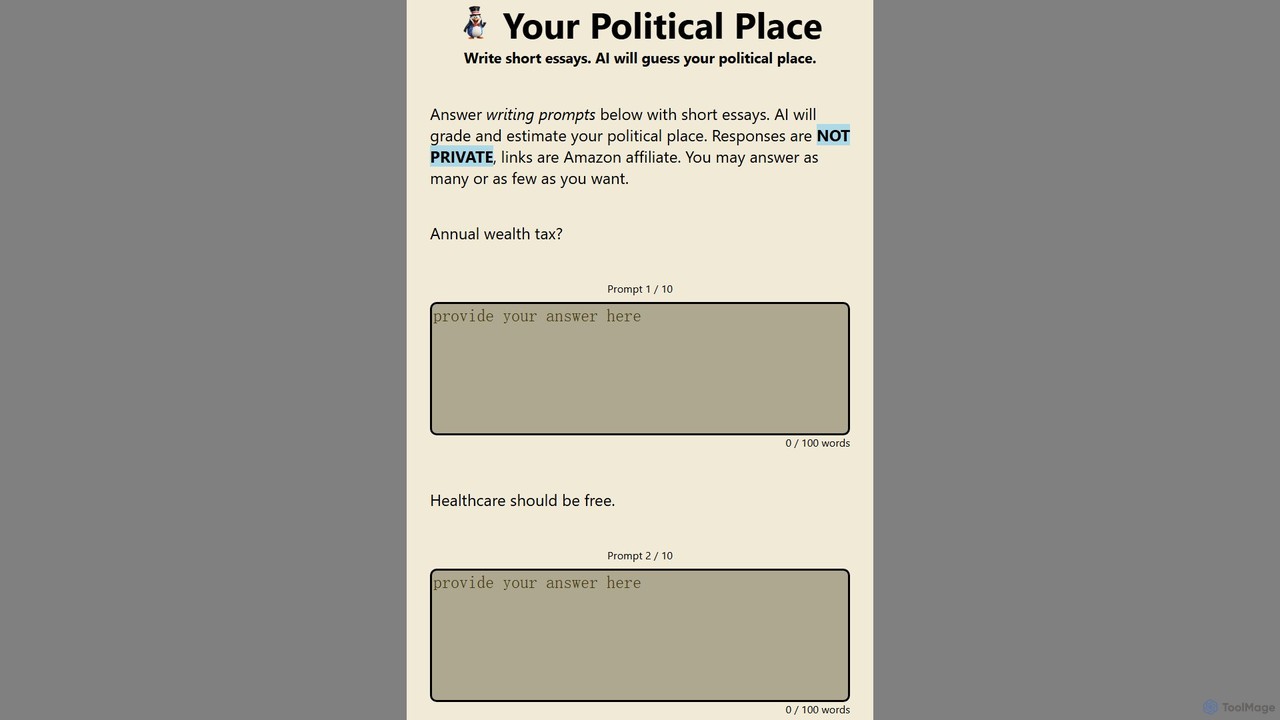
AI Political Science tools are specialized applications that use artificial intelligence to analyze political data, texts, and trends. They leverage natural language processing (NLP) and machine learning models to extract insights from sources like legislation, social media, and news reports. These tools empower researchers, students, and analysts to understand public opinion, track policy changes, and model political scenarios with greater speed and accuracy. Their primary advantage lies in processing vast amounts of unstructured data that would be challenging to analyze manually.
Core Features
- Sentiment Analysis: Automatically gauges public opinion and identifies key themes in political communication.
- Policy Impact Simulation: Models the potential economic and social outcomes of proposed legislation.
- Legislative Tracking: Monitors and summarizes new bills, regulations, and voting records in real-time.
- Discourse Analysis: Identifies frames, arguments, and topics within large volumes of political text.
- Predictive Modeling: Utilizes historical data and current trends to forecast events like election outcomes.
Use Cases
These tools are primarily used in academia for research, by government agencies and think tanks for policy analysis, and in journalism for investigative reporting. For example, a policy analyst can use a tool to forecast the public response to a new tax law, while a student can visualize the evolution of political discourse over decades.
How to Choose
When selecting a tool, consider the types of data sources it supports (e.g., social media APIs, legal texts), the complexity of its analytical models, and its user interface. Also, evaluate whether you need real-time analysis capabilities and if the tool's specialization aligns with your focus, such as election analysis or international relations.