ToolMage
Sign in

Best 2 Academic Assistant for Education

Popular Academic Assistant in Education include StudentAI and goodgrade, helping you work more efficiently.

StudentAI
Freemium

StudentAI

StudentAI is an all-in-one AI platform for students, graduates, and professionals. It offers over 200 specialized tools and 24/7 AI tutors to assist with homework, research, writing, and job searches. From summarizing PDFs and YouTube videos to generating cover letters and practicing for interviews, StudentAI enhances academic performance and career development.

Job Application
Visits 37KFavorites 117Likes 117
goodgrade
Freemium

goodgrade

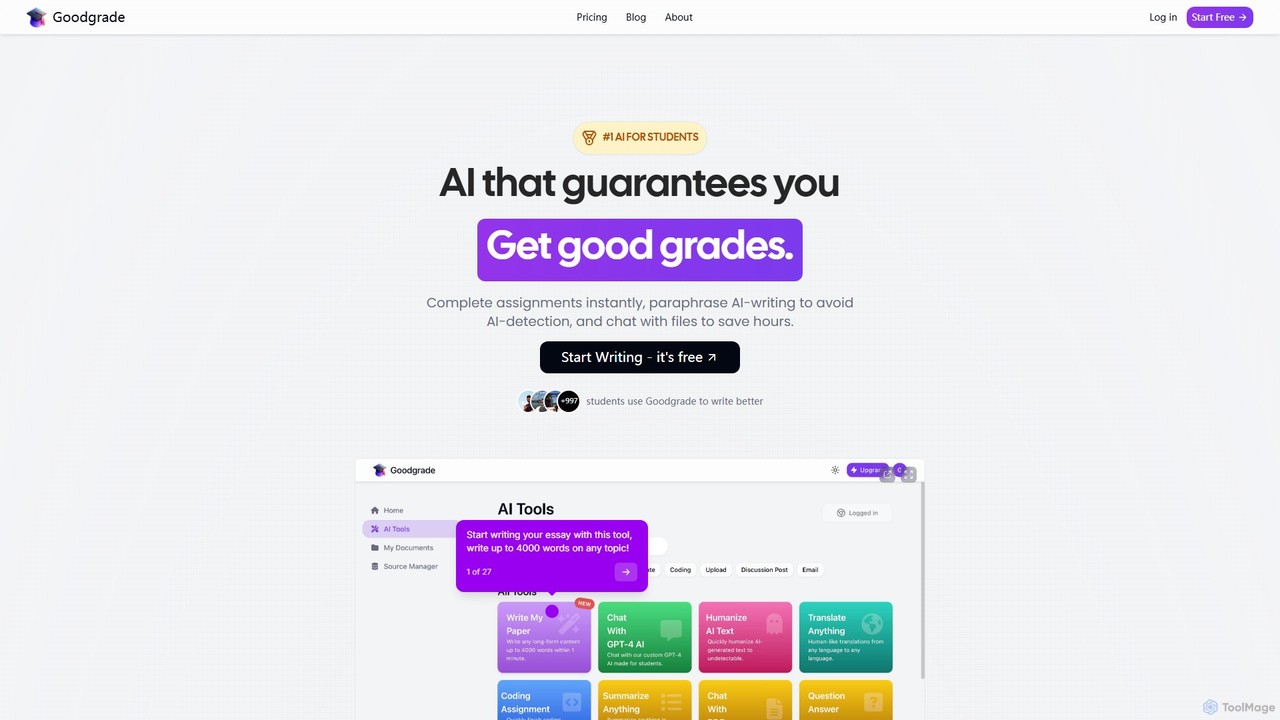
goodgrade is an AI-powered academic assistant designed for students. It helps write essays and assignments instantly, humanizes AI-generated text to bypass detection tools like Turnitin, and allows users to chat with uploaded files for research and summarization. It also features automated citation generation and contextual writing suggestions.

Text Generation
Visits 11.5KFavorites 136Likes 148

About Academic Assistant

Academic Assistant tools are AI-powered platforms designed to streamline and enhance various aspects of academic work. Leveraging advanced natural language processing and machine learning, these tools assist students, researchers, and educators in tasks ranging from literature review and essay writing to data analysis and study organization. They aim to boost productivity, improve research quality, and facilitate a deeper understanding of complex subjects, making academic pursuits more efficient and effective.

Core Features

  • Literature Review & Summarization: Automatically identify key papers, extract relevant information, and summarize complex articles or research findings.
  • Academic Writing Support: Offer grammar and style checks, citation generation, plagiarism detection, and content suggestions for essays, theses, and papers.
  • Data Analysis & Visualization: Assist in processing research data, identifying patterns, and generating visual representations for reports and presentations.
  • Study & Learning Aids: Create personalized study guides, flashcards, and practice questions, or explain difficult concepts in simpler terms.
  • Research Organization: Help manage references, track research progress, and efficiently organize notes and documents.

Applicable Scenarios

Students can use them for essay drafting and citation management, while researchers benefit from automated literature reviews and data interpretation. Educators might leverage these tools to generate personalized learning materials or assess student understanding more effectively.

How to Choose

When selecting an Academic Assistant, consider its specific functionalities (e.g., writing, research, data analysis), the accuracy and reliability of its AI models, and its integration capabilities with existing academic software like reference managers or learning management systems. Evaluate the tool's ease of use, data privacy policies, and whether it offers features tailored to your specific discipline or academic level.

Academic Assistant use cases

1

Automating Literature Reviews for Research Papers

A PhD student needs to conduct an extensive literature review for their dissertation. Using an AI Academic Assistant, they can upload dozens of research papers, and the tool will automatically identify key themes, summarize findings, extract methodologies, and highlight gaps in existing research, saving hundreds of hours compared to manual review and ensuring comprehensive coverage.

2

Enhancing Essay Writing and Citation Management

An undergraduate student is drafting a complex essay and struggles with academic phrasing and correct citation. The Academic Assistant provides real-time grammar and style suggestions, checks for academic tone, and automatically generates citations in various formats (APA, MLA, Chicago) based on uploaded sources, significantly improving writing quality and reducing plagiarism risks.

3

Simplifying Complex Scientific Concept Explanations

A high school teacher wants to explain advanced physics concepts to students with varying comprehension levels. An AI Academic Assistant can break down intricate topics into simpler language, create analogies, generate interactive quizzes, or even produce visual aids, making difficult subjects more accessible and engaging for the entire class.

4

Streamlining Research Data Analysis and Interpretation

A social science researcher has collected a large dataset from surveys and interviews. Instead of manual coding and statistical analysis, the Academic Assistant can process qualitative and quantitative data, identify correlations, generate preliminary insights, and even suggest appropriate statistical tests, accelerating the data interpretation phase of their project.

5

Personalized Study Plan and Material Generation

A university student preparing for final exams needs a tailored study approach. An Academic Assistant can analyze their learning style, identify weak areas from past assignments, and then generate personalized study schedules, create custom flashcards, and provide practice questions focused on specific topics, optimizing their revision process.

6

Detecting Plagiarism and Ensuring Academic Integrity

An academic institution's faculty member needs to verify the originality of student submissions. An AI Academic Assistant can quickly scan essays and papers against a vast database of academic and web content, highlighting potential instances of plagiarism, improper paraphrasing, or uncredited sources, thereby upholding academic integrity standards.

Academic Assistant FAQ

What are Academic Assistant tools?

Academic Assistant tools are AI-powered software designed to support students, researchers, and educators in various academic tasks. They leverage artificial intelligence to automate processes like literature review, academic writing, data analysis, and study organization, aiming to enhance efficiency, accuracy, and the overall quality of academic work.

How do Academic Assistant tools differ from general education software?

While general education software often focuses on broad learning management, course delivery, or administrative tasks, Academic Assistant tools are specifically tailored for the process of academic work. They provide direct support for research, writing, data interpretation, and study aids, rather than just facilitating learning environments or administrative functions. Their AI capabilities are deeply integrated into academic workflows.

What are the key benefits of using an AI Academic Assistant?

The primary benefits include significant time savings in research and writing, improved quality of academic output through advanced grammar and style checks, enhanced understanding of complex subjects via simplified explanations, and better organization of academic resources. These tools help reduce manual effort, minimize errors, and allow users to focus more on critical thinking and analysis.

Are Academic Assistant tools reliable for citation and plagiarism detection?

Many Academic Assistant tools offer robust citation generation and plagiarism detection features. They can accurately format citations in various styles and compare submitted texts against extensive databases to identify potential plagiarism. However, users should always cross-verify generated citations and use plagiarism detection as a supplementary tool, as human review remains crucial for nuanced academic integrity assessments.

Who can benefit most from using Academic Assistant tools?

Academic Assistant tools are highly beneficial for a wide range of users. Students, from high school to postgraduate levels, can use them for essay writing, research, and study preparation. Researchers and academics can streamline literature reviews, data analysis, and manuscript drafting. Educators can leverage them for creating teaching materials, assessing assignments, and providing personalized feedback, making them valuable across the entire academic spectrum.