Storiara
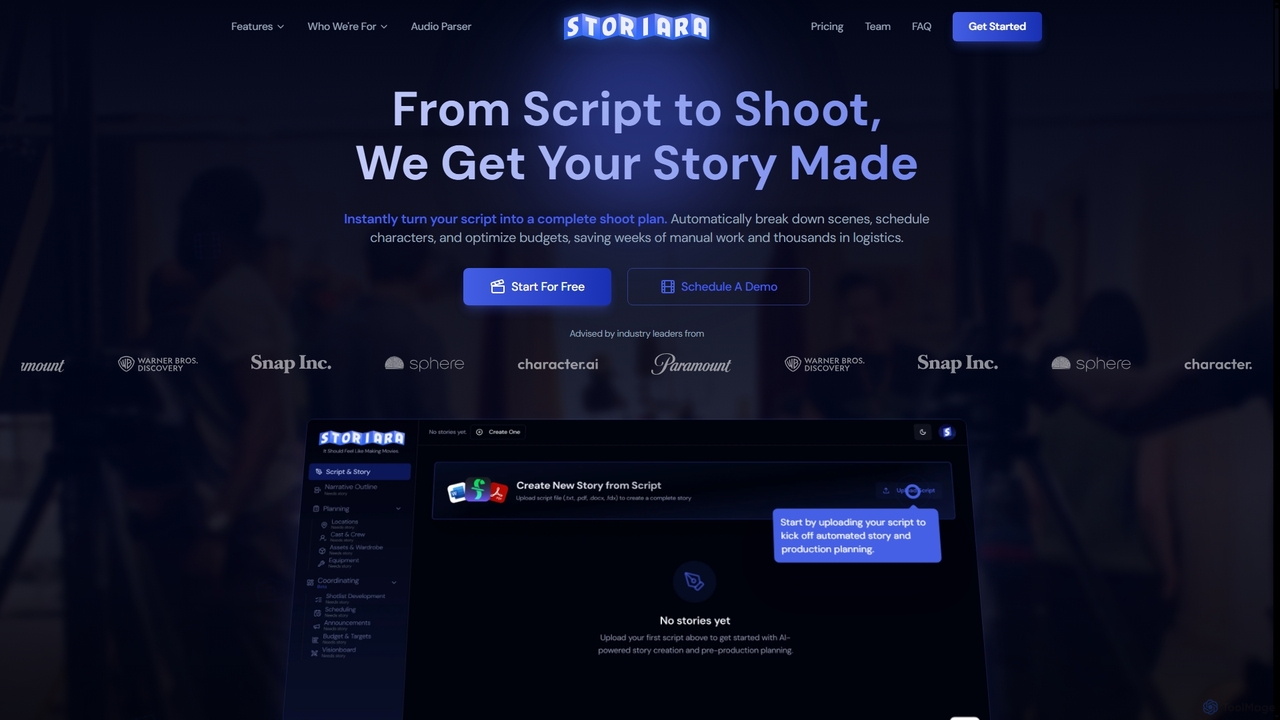
Storiara is an AI-powered production platform that transforms scripts into complete shoot plans, automating pre-production tasks like scheduling, …
Storiara is an AI-powered production platform that transforms scripts into complete shoot plans, automating pre-production tasks like scheduling, budgeting, storyboarding, and call sheet generation. It helps filmmakers save weeks of manual work and thousands in logistics, getting stories made faster and more efficiently.
About Film Production
Film Production AI tools are a category of advanced software leveraging artificial intelligence to enhance various stages of filmmaking, from pre-production to post-production. These tools utilize machine learning, computer vision, and natural language processing to automate repetitive tasks, generate creative assets, and provide data-driven insights. Their application significantly streamlines workflows, reduces costs, and unlocks new creative possibilities for filmmakers, studios, and content creators.
Core Features
- Script Analysis: AI analyzes scripts for character arcs, emotional beats, pacing, and commercial viability, offering insights for refinement.
- Virtual Production & Previsualization: Generate realistic virtual sets, character models, and scene blocking for pre-production planning and real-time shooting environments.
- Automated Editing & Assembly: AI assists in initial video assembly, identifying key moments, syncing audio, and suggesting cuts based on content and rhythm.
- Visual Effects (VFX) Enhancement: Automate rotoscoping, background removal, object tracking, and generate realistic digital assets or environmental effects.
- Sound Design & Audio Restoration: AI tools can clean up dialogue, remove noise, generate ambient sounds, and even compose background music based on scene mood.
Use Cases
Filmmakers and production studios utilize these tools to accelerate complex processes. For instance, an independent director might use AI for script breakdown and scheduling, while a large studio could deploy AI for large-scale VFX rendering or intelligent asset management across multiple projects.
How to Choose
When selecting Film Production AI tools, consider the specific stage of filmmaking you need to enhance (pre-production, production, post-production), the level of automation desired, integration capabilities with existing software (e.g., NLEs, DCCs), and the scalability for your project size. Evaluate the accuracy of AI outputs, user interface complexity, and the pricing model relative to your budget and technical expertise.
Film ProductionUse Cases
Automating Script Breakdown and Scheduling
Independent filmmakers and production coordinators use AI tools to rapidly analyze screenplays, identifying characters, locations, props, and scene requirements. This automation generates detailed breakdown sheets and optimized shooting schedules, significantly reducing the manual effort and time traditionally spent in pre-production planning, allowing for more efficient resource allocation.
Generating Realistic Virtual Sets and Environments
VFX artists and virtual production teams leverage AI to create highly detailed and immersive virtual sets or extend practical environments. By inputting conceptual descriptions or reference images, AI can generate diverse architectural styles, landscapes, and atmospheric effects, enabling filmmakers to visualize and shoot complex scenes without physical limitations or extensive set construction.
Enhancing Visual Effects with AI-Powered Rotoscoping
Post-production houses and VFX artists employ AI to automate the laborious process of rotoscoping, which involves isolating subjects from backgrounds frame by frame. AI tools can accurately detect and mask objects, characters, or elements in footage, drastically speeding up the creation of complex visual effects, compositing, and green screen work, saving hundreds of hours of manual labor.
Intelligent Audio Restoration and Sound Design
Sound engineers and editors utilize AI to clean up production audio by removing unwanted noise, hums, or echoes, and to enhance dialogue clarity. Additionally, AI can generate ambient soundscapes, foley effects, or even suggest musical cues that perfectly match the mood and pacing of a scene, streamlining the sound design process and improving overall audio quality.
Accelerating Rough Cut Assembly and Scene Selection
Video editors and assistant editors use AI-powered editing tools to quickly generate initial rough cuts. By analyzing footage for emotional beats, dialogue, and camera movements, AI can identify the most impactful takes and sequence them logically, providing a strong starting point for human editors and significantly reducing the time spent on initial assembly.
Creating AI-Driven Storyboards and Pre-visualization
Directors and storyboard artists employ AI to rapidly generate visual storyboards and pre-visualization sequences from script descriptions. This allows for quick iteration on camera angles, character blocking, and scene composition, helping to visualize complex shots and sequences before actual production begins, ensuring creative alignment and efficient shooting.