Acting Assistant
Acting Assistant is an AI-powered thinking partner designed for CXOs and business leaders. It transforms business systems into …
Acting Assistant is an AI-powered thinking partner designed for CXOs and business leaders. It transforms business systems into a conversational interface, providing real-time insights, automating complex tasks, and executing decisions instantly. Specializing in finance, it helps uncover hidden losses, streamline operations, and enhance strategic decision-making with robust data security and sovereignty.
nuvio
Nuvio is an AI-powered financial analytics platform designed to go beyond traditional accounting. It makes complex financial data …
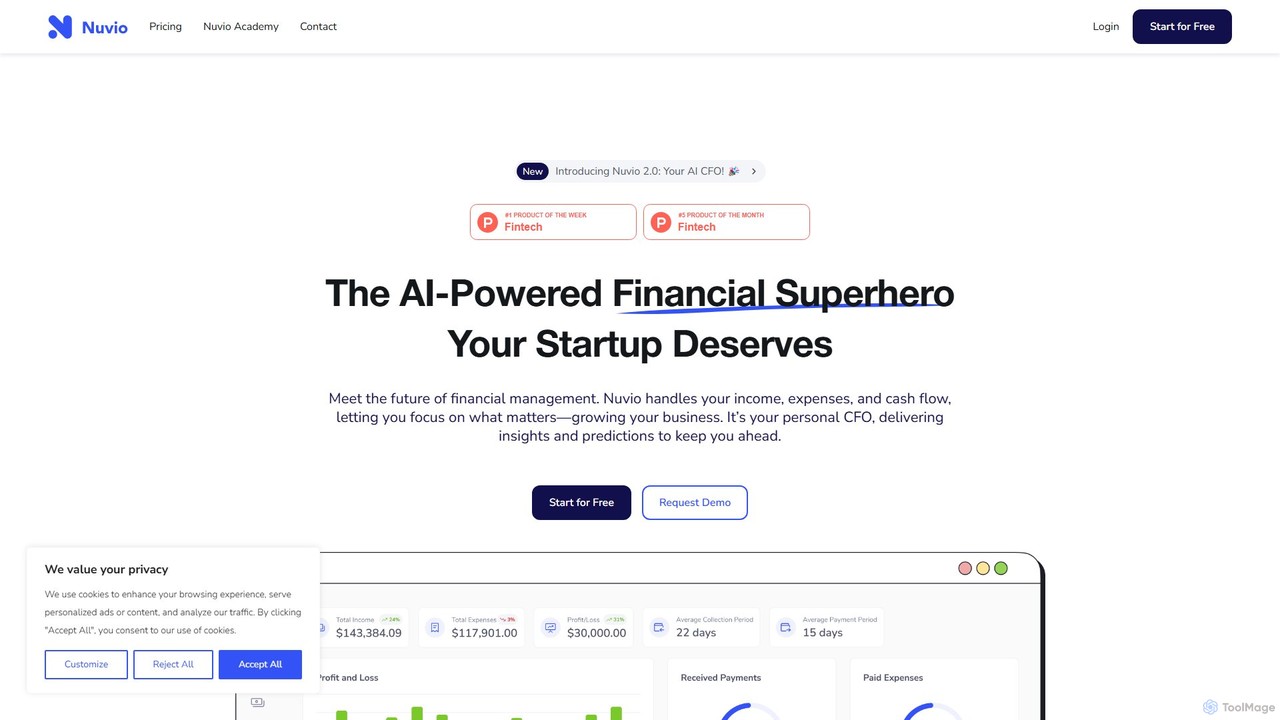
Nuvio is an AI-powered financial analytics platform designed to go beyond traditional accounting. It makes complex financial data accessible to businesses of all sizes, offering automated reporting, intelligent forecasting, and real-time KPI tracking. Nuvio transforms raw financial data into actionable insights, empowering founders, executives, and finance teams to make smarter, data-driven decisions for strategic growth.
About Financial Analytics
AI Financial Analytics tools are a specialized class of software that leverages machine learning and data science to interpret complex financial data. These tools automate the analysis of market trends, investment performance, and economic indicators to generate predictive insights and actionable intelligence. They empower investors, analysts, and businesses to make data-driven decisions, optimize portfolios, and manage risk with greater precision. Their core strength lies in processing vast, unstructured datasets to uncover hidden correlations and forecast future outcomes beyond human capabilities.
Core Features
- Predictive Forecasting: Utilizes historical data and algorithms to forecast stock prices, market trends, and economic indicators.
- Risk Assessment Modeling: Simulates various market scenarios to quantify potential investment risks and portfolio volatility.
- Algorithmic Trading Signals: Generates buy or sell signals based on real-time analysis of multiple data sources and predefined strategies.
- Sentiment Analysis: Analyzes news articles, social media, and earnings reports to gauge market sentiment towards specific assets.
- Portfolio Optimization: Recommends the ideal asset allocation to maximize returns for a given level of risk tolerance.
Use Cases
These tools are primarily used by investment firms, hedge funds, corporate finance departments, and individual traders. For instance, a quantitative analyst might use them to backtest trading strategies, while a corporate CFO could model the financial impact of different business decisions. They are essential for anyone needing to derive deep insights from financial data.
How to Choose
When selecting a Financial Analytics tool, consider the breadth of data sources it integrates with (e.g., stock exchanges, news APIs). Evaluate the customizability of its analytical models and the robustness of its backtesting features. Also, assess its compliance and security protocols, especially for enterprise use, and consider the user interface's complexity relative to your team's technical expertise.

Financial AnalyticsUse Cases
Predicting Stock Market Trends for Hedge Funds
A quantitative analyst at a hedge fund uses an AI financial analytics tool to process vast amounts of real-time data, including market prices, news sentiment, and macroeconomic indicators. The tool's machine learning models identify complex patterns and correlations that are invisible to human analysts. Based on this analysis, it generates predictive forecasts on the short-term movements of specific stocks or entire sectors, providing the analyst with a data-backed edge to inform their trading strategies and potentially increase portfolio returns.
Automating Corporate Financial Risk Assessment
A corporate finance team needs to assess the potential impact of interest rate fluctuations on their company's debt portfolio. Instead of manual spreadsheet modeling, they use an AI analytics platform. They input their financial data, and the tool runs thousands of simulations based on different economic scenarios. The platform provides a clear report showing the probable range of financial outcomes, identifies key risk drivers, and suggests hedging strategies. This automates a complex, time-consuming process and provides a more robust, probabilistic view of financial risk.
Optimizing Investment Portfolios for Wealth Managers
A wealth manager is responsible for dozens of client portfolios, each with a unique risk tolerance and investment goals. Using an AI financial analytics tool, the manager can automate the monitoring and rebalancing process. The AI continuously analyzes each portfolio against market movements and the client's profile. When an asset allocation drifts from its optimal state, the tool alerts the manager and suggests specific trades to rebalance the portfolio, ensuring it remains aligned with the client's long-term strategy while maximizing potential returns.
Analyzing Earnings Call Transcripts for Sentiment
An individual investor wants to gain a deeper understanding of a company's quarterly performance beyond the raw numbers. They upload the transcript of the latest earnings call to an AI analytics tool. The tool performs sentiment analysis on the language used by executives, identifying tones of confidence, uncertainty, or concern. It also extracts key themes and compares the frequency of certain keywords (e.g., 'growth', 'headwinds') to previous calls. This provides the investor with nuanced insights that help them make a more informed investment decision.
Real-Time Fraud Detection in Financial Transactions
A fintech company processes thousands of transactions per second. To combat fraud, they integrate an AI financial analytics engine into their payment gateway. The AI model analyzes each transaction in real-time, comparing it against the user's historical behavior, location, and other contextual data. It instantly flags transactions that deviate from normal patterns, such as an unusually large purchase from a new location. This allows the company to block fraudulent payments automatically, protecting both their customers and their business from financial loss.
Generating Algorithmic Trading Strategies
A sophisticated retail trader wants to move beyond manual trading. They use an AI platform that analyzes historical market data to identify profitable trading patterns. The trader sets parameters like risk level and target assets. The AI then generates several potential algorithmic trading strategies, complete with backtested performance results and key metrics like Sharpe ratio. The trader can review these AI-generated strategies, select the most promising one, and deploy it for automated execution, allowing them to capitalize on market opportunities 24/7 without constant monitoring.