Tydus
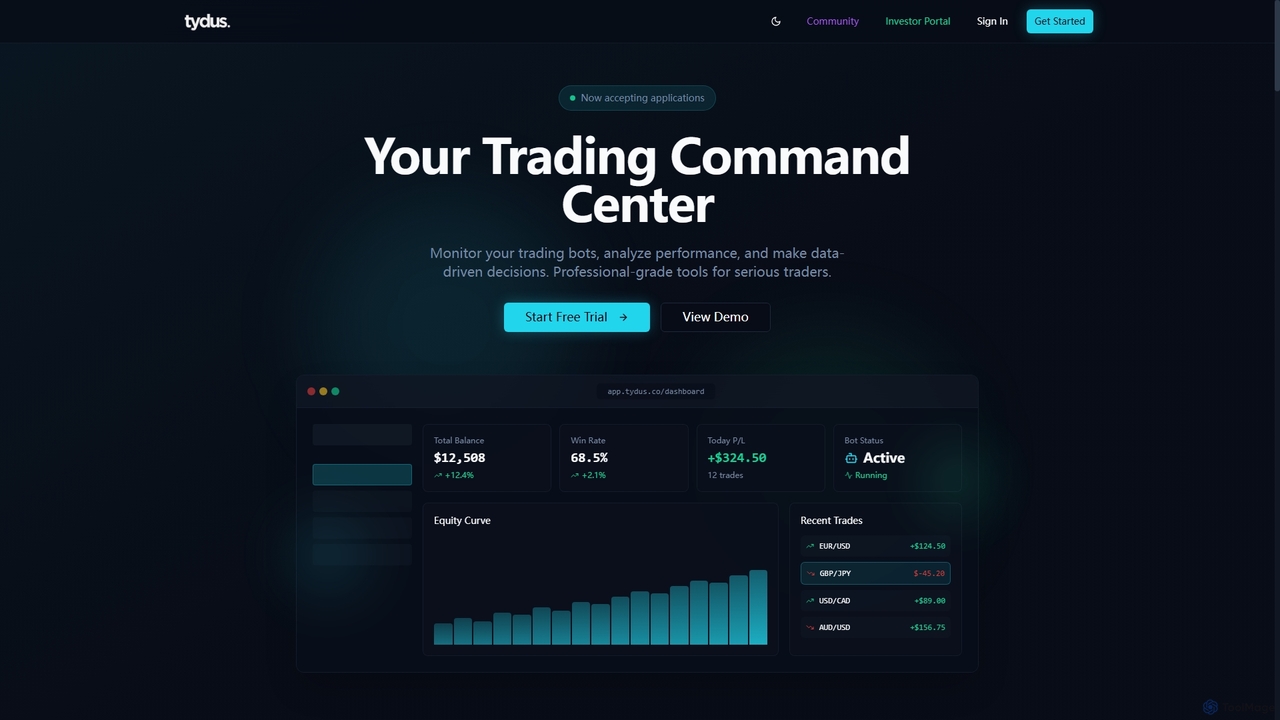
Tydus is a professional-grade platform for serious traders and accredited investors. It offers comprehensive tools for monitoring trading …
Tydus is a professional-grade platform for serious traders and accredited investors. It offers comprehensive tools for monitoring trading bots, advanced performance analytics, AI-powered trading signals, strategy backtesting, and a collaborative strategy hub. Additionally, it provides an exclusive portal for accredited investors to access curated institutional-grade investment opportunities across various asset classes.

Cash Flow Portal
Cash Flow Portal is an all-in-one investment management software designed for real estate syndicators and fund managers. It …
Cash Flow Portal is an all-in-one investment management software designed for real estate syndicators and fund managers. It streamlines capital raising, automates investor relations, and provides a secure portal for LPs to track their investments. The platform simplifies complex processes like distribution calculations, document management, and performance reporting, enabling GPs to scale their business efficiently while enhancing investor transparency and trust.
Legalist
Legalist is a technology-powered investment firm that uses AI to source, underwrite, and manage investments in alternative assets. …
Legalist is a technology-powered investment firm that uses AI to source, underwrite, and manage investments in alternative assets. It specializes in litigation finance, bankruptcy financing, and government receivables, offering uncorrelated returns for institutional investors.
SageFusion
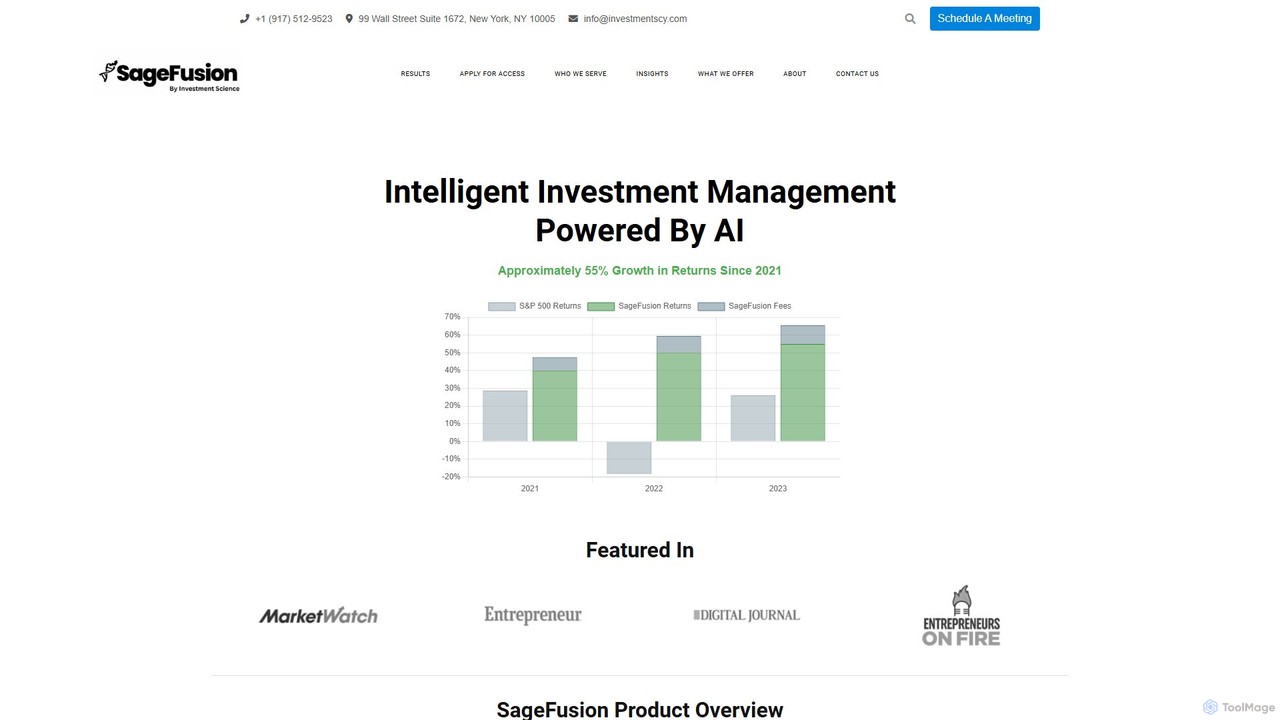
SageFusion is an AI-powered investment management platform that combines advanced technology with financial expertise to optimize portfolios. It …
SageFusion is an AI-powered investment management platform that combines advanced technology with financial expertise to optimize portfolios. It serves high-net-worth individuals, institutional investors, and governments, aiming to deliver superior returns by leveraging proprietary AI models, advanced risk management, and unique data analysis for intelligent trend forecasting.
Fassport
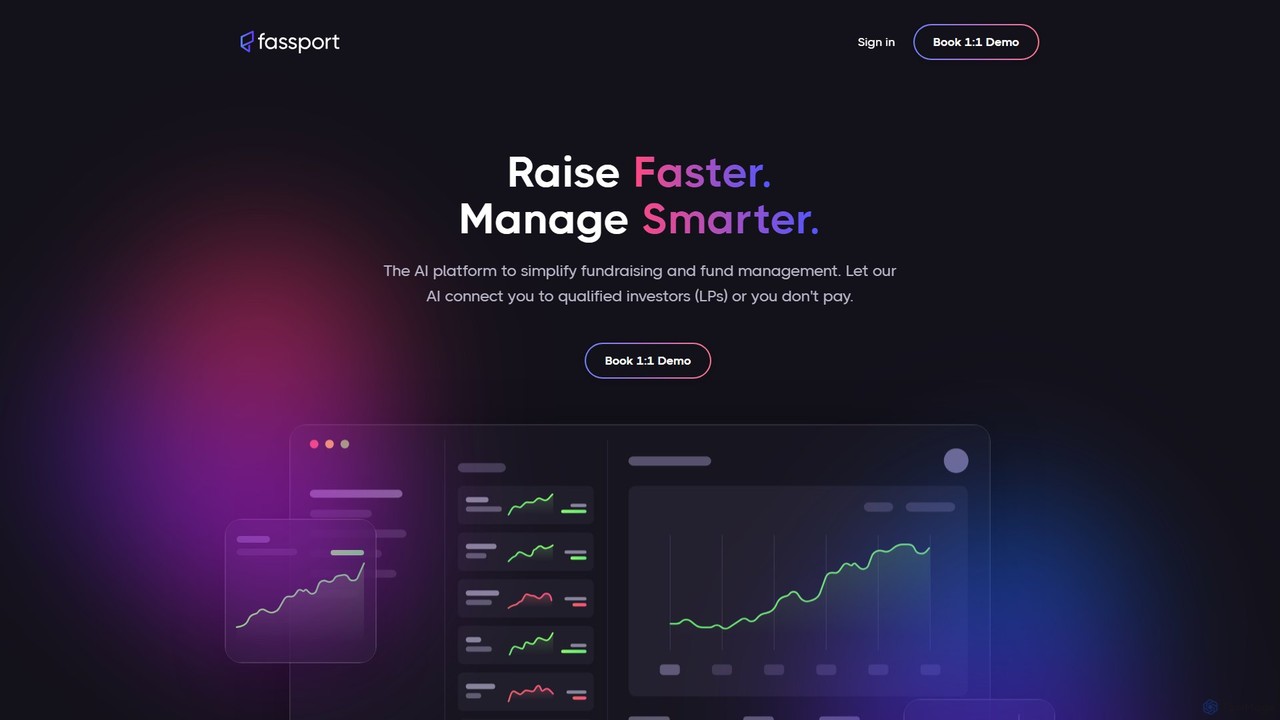
Fassport is an AI-powered platform designed to streamline fundraising and fund management for the alternative investment market. It …
Fassport is an AI-powered platform designed to streamline fundraising and fund management for the alternative investment market. It connects fund managers with qualified limited partners (LPs), automates investor onboarding and accreditation verification, and provides robust CRM tools for managing investor relations. Fassport simplifies the entire capital-raising lifecycle, from marketing new offerings to ensuring regulatory compliance, enabling users to raise faster and manage smarter.
About Investment Management
AI Investment Management tools are specialized platforms that leverage machine learning and quantitative analysis to optimize investment strategies. These tools process vast amounts of market data, economic indicators, and news sentiment to identify patterns and forecast potential outcomes. They empower investors and financial advisors to make data-driven decisions, manage portfolio risk, and uncover opportunities that are not apparent through traditional analysis. The core value lies in automating complex analysis and providing sophisticated modeling capabilities to a wider range of users.
Core Features
- Portfolio Optimization: Uses algorithms to construct and rebalance portfolios based on risk tolerance, return goals, and market constraints.
- Risk Analysis & Simulation: Employs models like Monte Carlo simulations to forecast portfolio performance under various market scenarios.
- Predictive Market Forecasting: Applies machine learning to historical data to predict trends in stocks, indices, or other assets.
- Algorithmic Signal Generation: Identifies potential buy or sell signals based on technical indicators, fundamental data, and sentiment analysis.
- Automated Financial Data Analysis: Scans and interprets financial reports, earnings calls, and news articles to extract actionable insights.
Use Cases
These tools are widely used by individual investors seeking to enhance their strategies, financial advisors managing multiple client portfolios, and quantitative analysts at hedge funds and asset management firms. They are integral to developing automated trading systems, performing due diligence on assets, and providing personalized robo-advisory services.
How to Choose
When selecting an AI Investment Management tool, consider the breadth and quality of its data sources (market data, fundamentals, alternative data). Evaluate the transparency of its models and the ability to backtest strategies against historical data. Also, assess its integration capabilities with your existing brokerage accounts and the overall cost structure, including subscription fees and data charges.
Investment ManagementUse Cases
Automated Portfolio Construction for Individual Investors
An individual investor wants to build a diversified portfolio aligned with their moderate risk tolerance and long-term growth goals. Using an AI investment tool, they input their financial profile and objectives. The platform's algorithm analyzes thousands of ETFs and stocks, considering factors like historical volatility, correlation, and expense ratios. It then proposes a globally diversified portfolio optimized for the user's risk-return preference. This process automates what would typically require extensive research or a human advisor, providing a data-backed starting point in minutes.
Risk Simulation for Financial Advisors
A financial advisor manages portfolios for 50 clients. To better communicate potential risks, the advisor uses an AI tool to run Monte Carlo simulations on each client's portfolio. The tool models 10,000 possible market futures based on historical volatility and correlations. It then generates a report showing the probability of achieving financial goals and the potential range of portfolio values during a market downturn. This allows the advisor to have more concrete, data-driven conversations about risk with clients and adjust strategies proactively, enhancing trust and client retention.
Algorithmic Strategy Backtesting for Quants
A quantitative analyst at a hedge fund develops a new trading strategy based on momentum and volatility factors. Before deploying real capital, they use an AI investment platform to backtest the strategy against 20 years of historical market data. The platform simulates trades according to the strategy's rules, accounting for transaction costs and slippage. The AI provides detailed performance metrics, including Sharpe ratio, maximum drawdown, and alpha. This rigorous testing allows the analyst to validate the strategy's viability, refine its parameters, and avoid costly real-world failures.
Market Sentiment Analysis for Opportunity Sourcing
A growth investor is looking for emerging trends before they become mainstream. They use an AI tool that scans millions of news articles, social media posts, and regulatory filings in real-time. The AI identifies companies or sectors with rapidly increasing positive sentiment and discussion volume. For example, it might flag a small biotech company that is suddenly being mentioned frequently in scientific journals and forums. This provides the investor with early, data-driven leads for further due diligence, helping them discover opportunities ahead of the broader market.
Identifying Undervalued Stocks with AI Screeners
A value investor aims to find stocks trading below their intrinsic worth. Instead of manually sifting through thousands of financial statements, they use an AI-powered stock screener. The investor sets criteria based on fundamental metrics like P/E ratio, debt-to-equity, and free cash flow yield. The AI not only filters stocks meeting these criteria but also applies a layer of qualitative analysis, such as assessing the strength of a company's economic moat or management quality from earnings call transcripts. The result is a concise, high-quality list of potentially undervalued companies for deeper analysis.
Dynamic Rebalancing Based on Market Conditions
A wealth management firm uses an AI platform to monitor client portfolios. The platform is configured with target asset allocations for each client. The AI continuously analyzes market movements and asset correlations. When a portfolio drifts significantly from its target due to market performance (e.g., equities outperform bonds), the system automatically generates a rebalancing alert. It suggests specific trades needed to sell the overperforming assets and buy underperforming ones to restore the desired allocation, helping to manage risk and lock in gains systematically.