ConvexValue
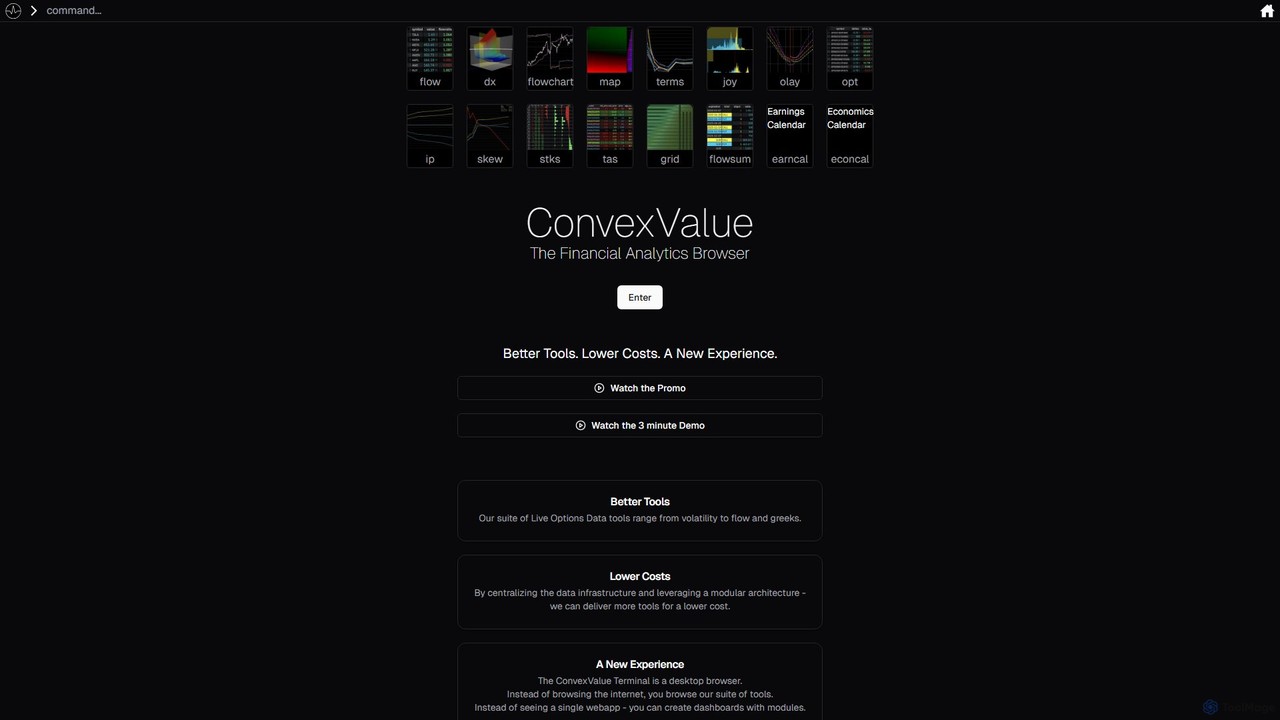
ConvexValue is a powerful financial analytics browser designed for serious traders and analysts. It operates as a desktop …
ConvexValue is a powerful financial analytics browser designed for serious traders and analysts. It operates as a desktop terminal, offering a suite of live options data tools for analyzing volatility, order flow, and Greeks. Its unique modular architecture allows users to build, save, and share custom dashboards, providing a highly flexible and cost-effective alternative to traditional financial data platforms.

drahim
drahim is a Sharia-compliant robo-advisor and personal finance app based in Saudi Arabia. It offers automated, diversified investment …
drahim is a Sharia-compliant robo-advisor and personal finance app based in Saudi Arabia. It offers automated, diversified investment portfolios with low fees, expense tracking via Open Banking, and an AI financial assistant, Drahim GPT, to provide personalized financial guidance.
About Investment
AI Investment tools are a specialized category of financial technology that use machine learning and data analysis to inform and automate investment decisions. These platforms process vast amounts of market data, financial reports, and news sentiment in real-time to identify patterns and predict market trends. This enables investors, from individuals to institutions, to optimize portfolios, manage risk more effectively, and uncover opportunities that may be missed by human analysis alone. They provide data-driven insights to support a more strategic and disciplined approach to investing.
Core Features
- Predictive Market Analysis: Utilizes historical data and machine learning models to forecast potential price movements of stocks, cryptocurrencies, and other assets.
- Algorithmic Trading: Automates the execution of trades based on predefined criteria and real-time market signals, operating at high speeds.
- Portfolio Optimization: Recommends asset allocation strategies to maximize returns for a given level of risk, based on user goals and market conditions.
- Risk Assessment: Simulates various market scenarios to quantify potential risks within a portfolio and suggests hedging strategies.
- Sentiment Analysis: Scans news articles, social media, and reports to gauge market sentiment towards specific assets, providing qualitative insights.
Use Cases
These tools are widely used by retail investors seeking to automate their strategies, financial advisors managing client portfolios, and hedge funds or asset management firms executing complex quantitative trading strategies. For example, a day trader might use an AI tool for high-frequency trading, while a long-term investor could use it to periodically rebalance their retirement portfolio based on risk analysis.
How to Choose
When selecting an AI Investment tool, consider the supported asset classes (stocks, crypto, forex), the transparency of its algorithms, and its backtesting capabilities to validate strategies with historical data. Also, evaluate its integration with your existing brokerage accounts, the level of customization allowed for trading strategies, and the pricing model, which can range from subscriptions to performance-based fees.
InvestmentUse Cases
Automated Stock Trading for Retail Investors
A retail investor with a full-time job wants to actively trade but lacks the time to monitor markets constantly. Using an AI investment tool, they can define their risk tolerance, preferred sectors, and key technical indicators (like RSI and MACD). The AI then scans the market 24/7, identifies trading opportunities that match the criteria, and automatically executes buy or sell orders through an integrated brokerage account. This allows the investor to participate in market movements without being glued to a screen, turning a complex strategy into a manageable, automated process.
Portfolio Risk Analysis for Financial Advisors
A financial advisor manages dozens of client portfolios, each with unique goals and risk profiles. To provide proactive advice, the advisor uses an AI tool to perform stress tests and scenario analysis. By inputting a client's portfolio, the AI simulates its performance under various market conditions, such as a sudden interest rate hike or a sector-specific downturn. The tool generates a detailed risk report, highlighting concentrated positions and potential losses. This enables the advisor to have data-driven conversations with clients and recommend specific adjustments, like diversification or hedging, to better align the portfolio with their long-term objectives.
Identifying Undervalued Stocks for Hedge Funds
A quantitative analyst at a hedge fund is tasked with finding undervalued assets. They use a sophisticated AI investment platform that goes beyond standard financial metrics. The AI scans thousands of quarterly earnings reports, patent filings, and news articles, using natural language processing (NLP) to analyze sentiment and identify subtle cues. It might flag a company with negative public sentiment but strong, overlooked fundamentals in its financial statements. The platform then correlates this with market data to generate a list of potential investment targets, allowing the analyst to focus their deep-dive research on the most promising, data-vetted opportunities.
Real Estate Investment Opportunity Scouting
A real estate investment firm wants to identify the next high-growth urban areas before they become mainstream. They employ an AI tool that analyzes diverse datasets, including demographic shifts, building permit applications, new business registrations, and social media check-in trends. The AI model identifies correlations that suggest gentrification or economic growth, such as a rise in coffee shop openings followed by an increase in property searches. It generates a heat map of promising neighborhoods, allowing the firm to direct its on-the-ground scouting resources more efficiently and make informed acquisition decisions ahead of the competition.
Cryptocurrency Arbitrage Trading
A crypto trader specializes in arbitrage, which involves exploiting price differences for the same asset across different exchanges. Manually tracking these fleeting opportunities is nearly impossible. The trader uses an AI-powered bot that simultaneously monitors price feeds from dozens of cryptocurrency exchanges. When the AI detects a profitable price discrepancy—factoring in trading fees and transfer times—it instantly executes a buy order on the lower-priced exchange and a sell order on the higher-priced one. This entire process is completed in milliseconds, capitalizing on market inefficiencies that a human trader could never act on quickly enough.
ESG Investment Screening for Ethical Portfolios
An asset management firm offers portfolios focused on Environmental, Social, and Governance (ESG) criteria. Manually vetting thousands of companies against complex ESG standards is a massive undertaking. The firm uses an AI platform that ingests data from sustainability reports, NGO watchlists, news media, and regulatory filings. The AI scores companies on hundreds of factors, such as carbon emissions, labor practices, and board diversity. This allows portfolio managers to quickly filter the investment universe to include only companies that meet their specific ethical standards, ensuring compliance and building trust with clients who prioritize responsible investing.