Finance Best in category 1 results Market Data AI Tool

Popular AI tools in the Market Data field of Finance include Alpha Vantage MCP, etc., helping you quickly improve efficiency.

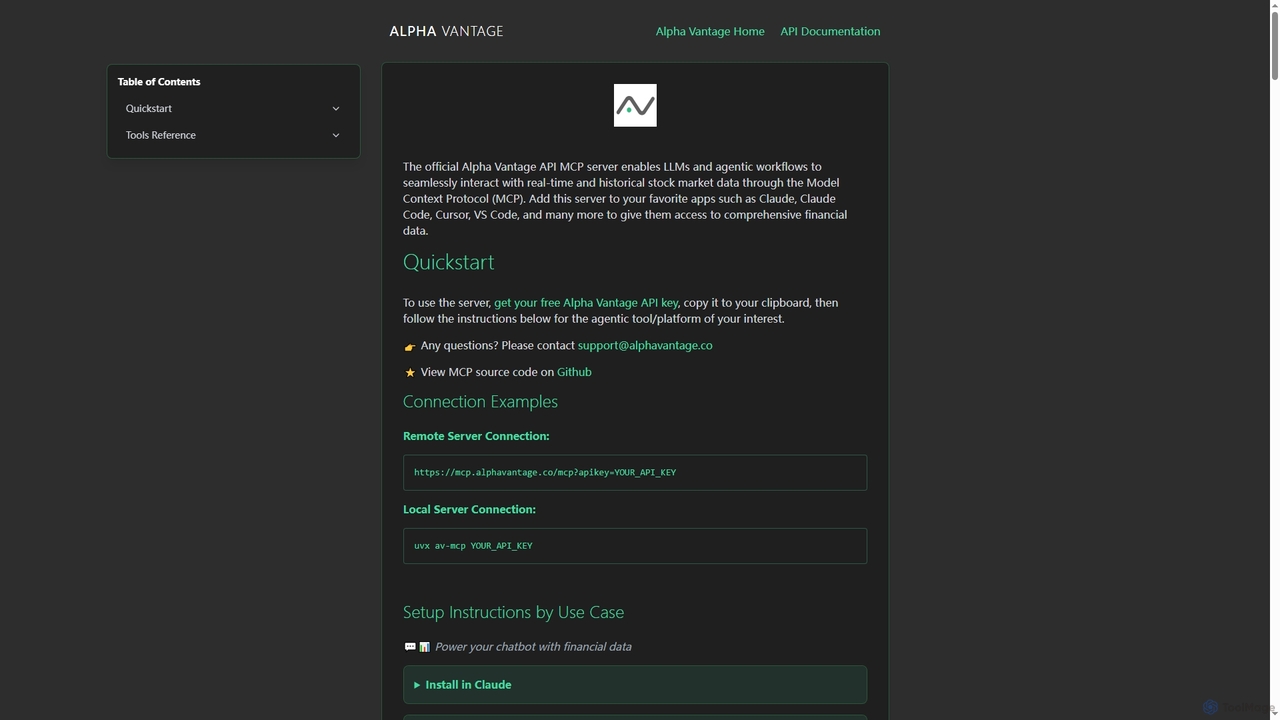
Alpha Vantage MCP

Alpha Vantage MCP

Alpha Vantage MCP is a Model Context Protocol server that enables Large Language Models (LLMs) and agentic workflows …

36.9K

About Market Data

Market Data AI tools are specialized platforms that leverage artificial intelligence to collect, process, analyze, and interpret vast amounts of financial market information. These tools utilize machine learning algorithms, natural language processing, and predictive modeling to extract actionable insights from real-time and historical data. They empower financial professionals, traders, and investors to make data-driven decisions, identify trends, and manage risks more effectively within the broader finance sector.

Core Features

  • Automated Data Aggregation: Continuously collects and integrates market data from diverse sources like exchanges, news feeds, and economic reports.
  • Real-time Analytics: Processes live market feeds to provide instant insights, identify anomalies, and track price movements.
  • Predictive Modeling: Employs AI to forecast future market trends, price changes, and volatility based on historical patterns and current events.
  • Sentiment Analysis: Analyzes news articles, social media, and reports to gauge market sentiment and its potential impact on asset prices.
  • Quantitative Strategy Backtesting: Allows users to test trading and investment strategies against historical market data to evaluate performance.

Applicable Scenarios

Financial analysts use these tools for deep market research and trend identification. Algorithmic traders leverage real-time data and predictive models to execute high-frequency strategies. Investment managers apply them for portfolio optimization and risk assessment, while researchers explore complex market dynamics and behavioral finance patterns.

How to Choose

When selecting Market Data AI tools, consider the breadth and depth of data coverage (asset classes, regions), the accuracy and latency of real-time feeds, and the sophistication of predictive analytics capabilities. Evaluate integration options with existing trading or analysis platforms, the explainability of AI models, and the overall cost-effectiveness for your specific financial analysis or trading needs.

Market DataUse Cases

1

Real-time Market Trend Identification for Traders

Algorithmic traders and day traders utilize Market Data AI tools to instantly identify emerging market trends and anomalies. By continuously processing live price feeds, trading volumes, and news sentiment, these tools alert traders to significant shifts, potential breakouts, or reversals. This enables them to execute timely trades, optimize entry/exit points, and react to market dynamics faster than manual analysis, potentially improving trading strategy performance by identifying profitable opportunities within seconds.

2

Automated Portfolio Risk Assessment for Investment Managers

Investment managers leverage Market Data AI tools to conduct automated, continuous risk assessments of their portfolios. These tools analyze vast historical market data, volatility metrics, and correlation patterns across various assets to identify potential vulnerabilities. They can simulate stress scenarios, predict the impact of market shocks, and suggest rebalancing strategies to mitigate risk, helping managers maintain optimal portfolio allocation and protect against adverse market movements with greater precision and efficiency.

3

Economic Indicator Forecasting for Policy Makers

Government agencies and economic policy makers utilize Market Data AI tools to forecast key economic indicators with greater accuracy. By integrating diverse datasets including financial market movements, consumer sentiment, and supply chain data, these tools can predict GDP growth, inflation rates, and employment trends. This advanced forecasting capability provides critical insights for formulating effective monetary and fiscal policies, enabling proactive responses to economic shifts and supporting national economic stability.

4

Identifying Arbitrage Opportunities Across Markets

Quantitative analysts and arbitrageurs employ Market Data AI tools to scan multiple exchanges and asset classes simultaneously for fleeting arbitrage opportunities. These tools can detect minute price discrepancies between correlated assets or across different markets (e.g., spot vs. futures, different exchanges) that human analysts might miss. By rapidly identifying and signaling these inefficiencies, the AI enables automated or semi-automated execution of trades to capitalize on price differences before they disappear, leading to consistent, low-risk profits.

5

Backtesting and Optimizing Trading Strategies

Quantitative researchers and strategy developers utilize Market Data AI tools to rigorously backtest and optimize their trading strategies. By feeding historical market data into these tools, users can simulate how a strategy would have performed over various market conditions, identifying strengths and weaknesses. The AI can then suggest parameter adjustments or alternative logic to enhance profitability and reduce drawdowns, significantly accelerating the development cycle for robust and effective trading algorithms before live deployment.

6

Enhanced Due Diligence for M&A and Investments

Corporate finance teams and private equity firms leverage Market Data AI tools for enhanced due diligence during mergers, acquisitions, and investment decisions. These tools can rapidly analyze historical market performance of target companies, industry trends, competitor analysis, and even sentiment from news and social media. This comprehensive, AI-driven data analysis provides a deeper understanding of market positioning, growth potential, and potential risks, enabling more informed and strategic investment choices with reduced manual effort.

7

Predicting Commodity Price Movements

Commodity traders and supply chain managers use Market Data AI tools to predict future price movements of raw materials like oil, gold, or agricultural products. By analyzing a combination of historical price data, geopolitical events, weather patterns, and supply-demand indicators, these AI models can forecast short-term and long-term price trends. This foresight enables businesses to optimize procurement strategies, hedge against price volatility, and make informed decisions on inventory management, significantly impacting profitability and operational stability.

Market DataFrequently Asked Questions