Finance Best in category 1 results Prediction Markets AI Tool

Popular AI tools in the Prediction Markets field of Finance include soccersm, etc., helping you quickly improve efficiency.

soccersm

soccersm

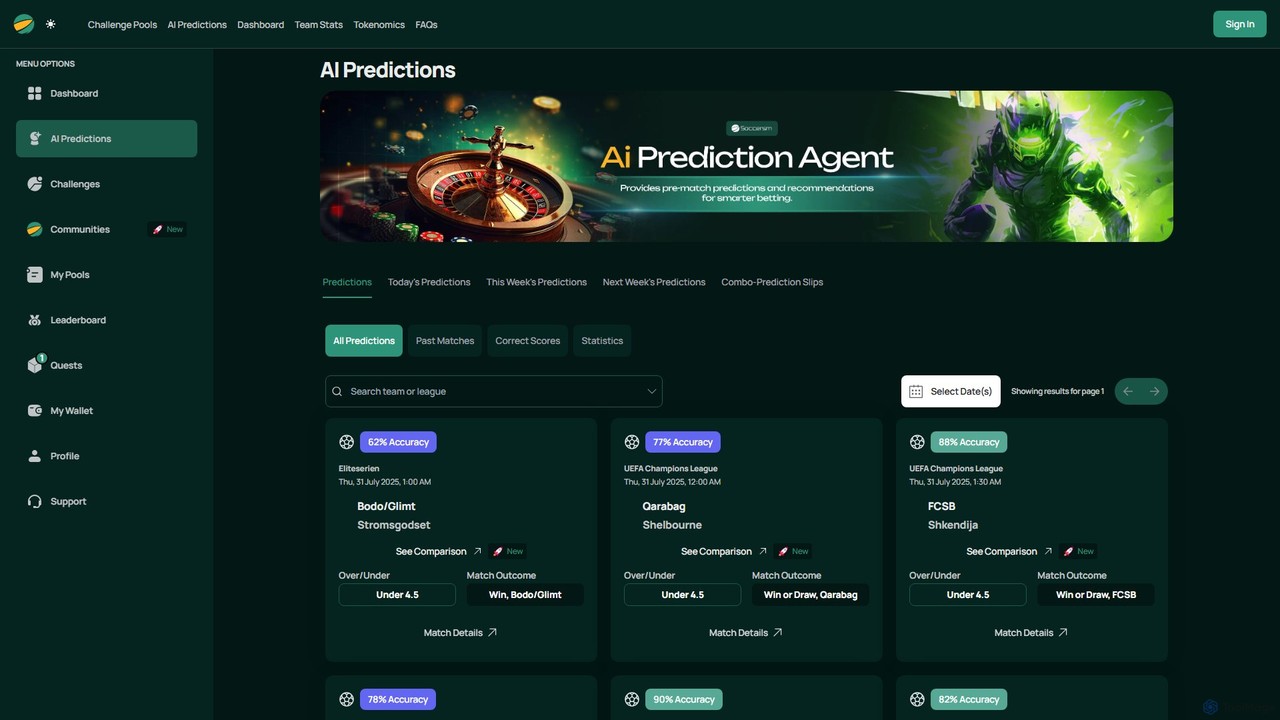
Soccersm is an AI-powered platform offering detailed soccer match predictions, including outcomes, over/under, and correct scores. Beyond sports, …

12.1K

About Prediction Markets

Prediction Markets are platforms where users trade contracts based on the outcomes of future events, effectively harnessing collective intelligence for forecasting. These tools operate on the principle that market prices, determined by supply and demand, can aggregate diverse information into highly accurate probabilistic forecasts. AI enhances these markets by analyzing vast datasets to inform traders, automating trading strategies, and improving the accuracy of market mechanisms. They provide a dynamic, real-time alternative to traditional forecasting methods like surveys or expert panels.

Core Features

  • Event Contracts Trading: Allows users to buy and sell shares representing the outcome of a specific, verifiable future event.
  • Probabilistic Odds: The market price of a contract directly reflects the collective belief in the probability of an event occurring, updated in real-time.
  • Information Aggregation: Pools knowledge and opinions from a wide range of participants into a single, quantifiable forecast.
  • AI-Powered Insights: Some platforms integrate AI to analyze related data sources, identify arbitrage opportunities, or provide trading signals.
  • Decentralized Options: Many modern prediction markets are built on blockchain technology, offering transparency, security, and permissionless access.

Applicable Scenarios

Prediction markets are utilized across various sectors. In finance, they help forecast asset prices, economic indicators, and the impact of regulatory changes. Corporations use them for internal forecasting, such as predicting project completion dates or sales figures. They are also prominent in politics for predicting election results and in technology for anticipating product launch dates or adoption rates.

Selection Criteria

When choosing a prediction market tool, consider the platform's liquidity, as higher volume generally leads to more accurate prices. Evaluate the variety of available markets to ensure they align with your interests. Assess the underlying technology—whether it's a centralized platform or a decentralized one on a blockchain—as this impacts fees, security, and accessibility. Finally, check for any integrated AI analytics or API access for automated trading.

Prediction MarketsUse Cases

1

Corporate Strategic Forecasting

A product manager at a tech company needs to gauge the likelihood of a new feature achieving a 15% adoption rate within the first quarter after launch. Instead of relying solely on internal surveys, they create a private prediction market for the product and sales teams. Team members can buy 'yes' or 'no' shares on this outcome. The resulting market price, for example, hovering at $0.65 for a 'yes' share, provides a real-time, aggregated forecast of a 65% probability of success. This data helps the manager adjust marketing resources and set more realistic expectations with stakeholders.

2

Financial Market Analysis and Hedging

A quantitative analyst at a hedge fund uses a prediction market to supplement their models on macroeconomic events. They participate in markets predicting the outcome of the next central bank interest rate decision. If the market shows a high probability of a rate hike that their models didn't fully capture, they can use this insight to adjust their portfolio's exposure to interest-rate-sensitive assets. This acts as a form of hedging and incorporates a diverse set of external opinions, reducing the risk of relying on a single predictive model.

3

Political Campaign Strategy Adjustment

A data analyst for a political campaign monitors public prediction markets on their candidate's election odds in a key swing state. They observe that the odds drop from 55% to 48% over a week. This real-time signal, often faster and more nuanced than traditional polls, prompts the campaign manager to investigate potential causes. They might discover negative local news coverage or a successful ad campaign by the opponent. In response, they can reallocate advertising budget and schedule candidate appearances in that state to counter the negative trend, using the prediction market as an early warning system.

4

Decentralized Crypto Asset Speculation

A DeFi trader uses a blockchain-based prediction market to speculate on the future price of Ethereum (ETH). They find a market asking 'Will ETH price be above $4,000 on December 31st?'. Believing in a strong market uptrend, they purchase 'yes' shares. Because the platform is decentralized, their funds are held in a smart contract, ensuring transparency and reducing counterparty risk. They can monitor the share price fluctuations throughout the year as a real-time sentiment indicator and can sell their position at any time before the expiry date to lock in profits or cut losses.

5

Forecasting Scientific Research Outcomes

A pharmaceutical research institute wants to aggregate expert opinions on the likelihood of a new drug passing Phase II clinical trials. They set up a prediction market for their researchers and consulting physicians. Participants can trade on whether the trial will meet its primary endpoint. This method incentivizes participants to reveal their true beliefs and incorporate all available private information. The resulting market probability serves as a valuable, continuously updated metric for the institute's R&D portfolio management, helping them decide whether to allocate more funding or pivot resources elsewhere.

6

Managing Supply Chain Disruption Risks

A global logistics company uses an internal prediction market to forecast potential disruptions. A supply chain manager creates a market asking, 'Will there be a major labor strike at the Port of Shanghai in Q4?'. Employees from different departments—operations, local agents, and market analysts—can participate. The market price aggregates their diverse, on-the-ground knowledge. If the probability starts to rise, it serves as an early warning, allowing the manager to proactively reroute shipments, secure alternative transport, and inform clients, thereby mitigating the financial and operational impact of a potential strike.

Prediction MarketsFrequently Asked Questions