ToolMage
Sign in

Best 4 Sports Betting AI tools for Finance

Popular Sports Betting AI tools in Finance include Leans.AI, Xaslarbet, cocoleco, and Locks, helping you work more efficiently.

Xaslarbet
Freemium

Xaslarbet

Xaslarbet is an AI-powered platform providing sports betting picks and predictions. It uses self-learning models to deliver data-driven insights for major sports leagues including the NFL, NBA, MLB, NHL, Soccer, and UFC. The tool offers free cheat sheets, detailed analytics, and a premium daily parlay builder to help bettors make more informed decisions.

Sports Betting
Visits 9.4KFavorites 124Likes 127
Leans.AI
Freemium

Leans.AI

Leans.AI is an AI-powered sports analytics platform providing data-driven betting picks and predictions. Its AI, "Remi," analyzes thousands of data points across NFL, NBA, MLB, NHL, and college sports to identify high-value betting opportunities. The platform offers transparent performance tracking, educational resources, and free daily picks to help bettors make more informed decisions.

Sports Betting
Visits 39.6KFavorites 127Likes 133
Locks
Paid

Locks

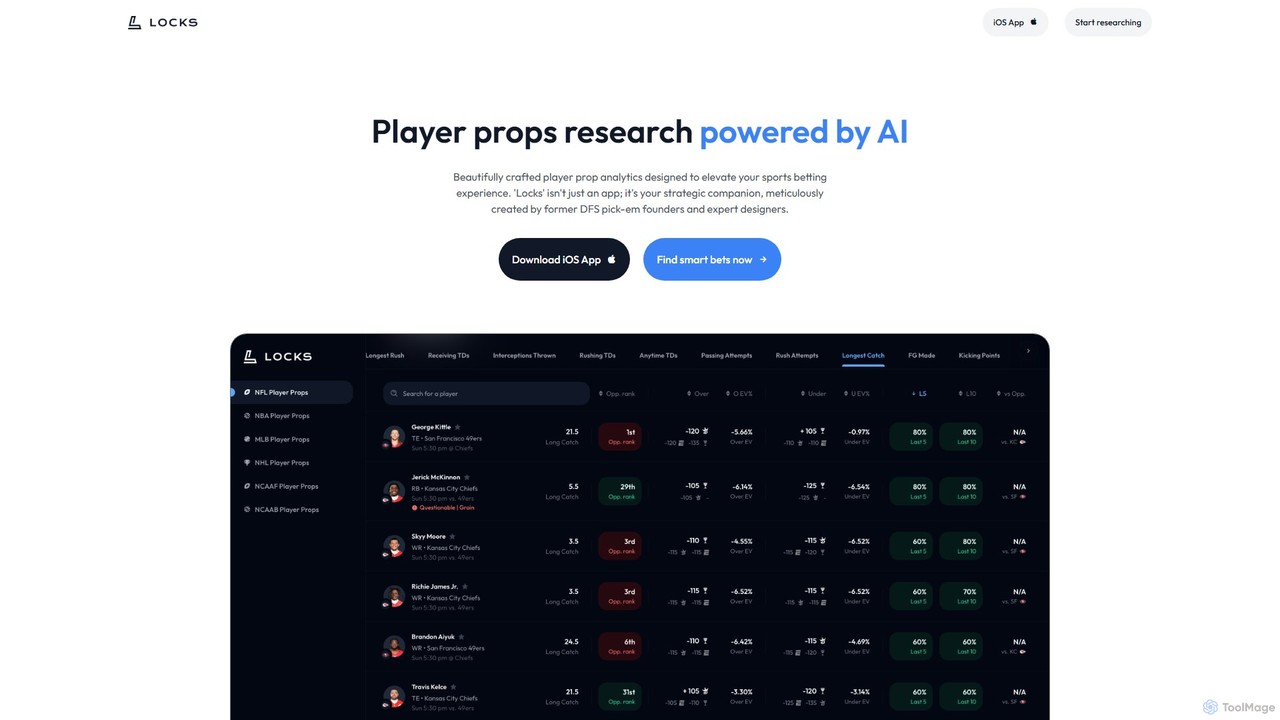
An AI-powered iOS app for sports betting research, specializing in player props. It uses proprietary algorithms to identify +EV (Positive Expected Value) bets, helping users make data-driven, profitable decisions by analyzing trends, matchups, and market data.

Predictive Analytics
Visits 5.9KFavorites 127Likes 126
cocoleco
Free

cocoleco

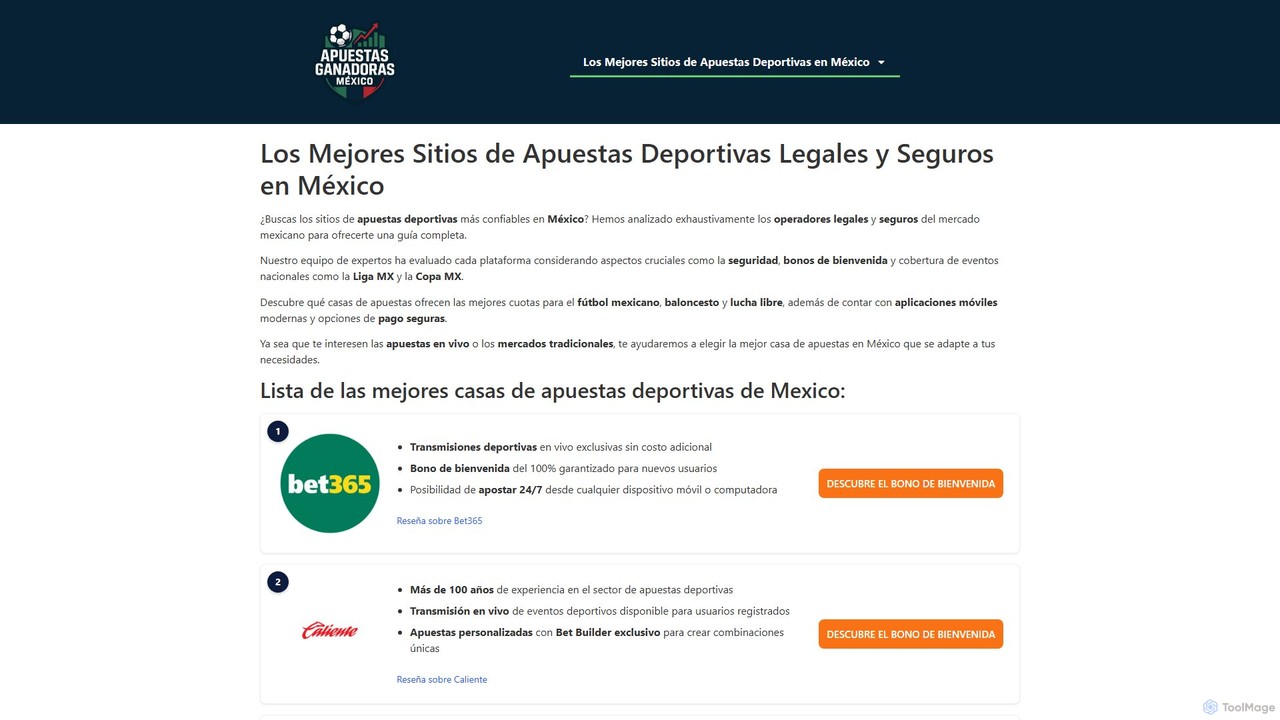
An AI-powered comparison platform that analyzes and ranks the best sports betting sites in Mexico. It provides in-depth reviews, bonus tracking, and data-driven recommendations to help users find secure and high-value betting operators, with a special focus on local leagues like Liga MX.

Sports Betting
Visits 6KFavorites 140Likes 133

About Sports Betting

AI Sports Betting tools are analytical platforms that use machine learning algorithms to predict the outcomes of sporting events. These tools process vast amounts of historical data, player statistics, and real-time market odds to identify patterns and probabilities that are not apparent to human analysts. Their primary value lies in providing data-driven insights, helping users move beyond intuition to make more informed and strategic betting decisions. They essentially apply financial modeling and predictive analytics principles to the sports domain.

Core Features

  • Predictive Modeling: Generates probabilities for match outcomes (win/loss/draw), scores, and other specific in-game events.
  • Value Bet Identification: Scans odds across multiple bookmakers to find bets where the estimated probability of an outcome is higher than the implied odds.
  • Bankroll Management: Recommends optimal stake sizes based on strategies like the Kelly Criterion to manage risk and maximize long-term growth.
  • Arbitrage Detection: Identifies risk-free betting opportunities by finding and calculating bets on all outcomes of an event across different bookmakers.
  • Real-time Data Analysis: Processes live game data, injury news, and market sentiment to update predictions and suggestions dynamically during an event.

Use Cases

These tools are primarily used by serious sports bettors, professional analysts, and syndicates who seek a statistical edge. They are applied in pre-match analysis to formulate strategies, during live games for in-play betting decisions, and for long-term portfolio management to ensure sustainable betting practices.

How to Choose

When selecting an AI Sports Betting tool, consider the breadth of sports and leagues covered, the transparency and historical accuracy of its predictive models, the frequency of data updates, and whether it offers features like bankroll management or direct integration with betting exchanges. Also, evaluate the user interface to ensure it matches your level of technical expertise.

Sports Betting use cases

1

Pre-Match Analysis for Football Betting

A football analyst preparing for a weekend of Premier League matches uses an AI tool to gain a competitive edge. They input the upcoming fixtures, and the tool generates detailed probabilistic forecasts for each game. This includes win-draw-loss percentages, expected goals (xG) for both teams, and predictions for specific markets like 'Both Teams to Score'. The AI model, trained on years of match data, player performance metrics, and team formations, highlights a potential upset where a home underdog has a 40% chance of winning, significantly higher than the 25% implied by bookmaker odds. This allows the analyst to identify a high-value betting opportunity.

2

Identifying Value Bets in NBA Player Props

A data-savvy basketball fan uses an AI tool that specializes in player proposition bets (props). Before a major NBA game, the tool analyzes hundreds of data points for a star player, including recent performance, usage rate, matchup history against the opposing defender, and even referee tendencies. The AI model projects the player will score 28.5 points. The tool then scans the market and finds a bookmaker offering odds for 'Over 25.5 points' that imply only a 50% probability. Since the AI's projection is significantly higher, it flags this as a high-value 'value bet', suggesting a statistical edge exists for the bettor.

3

Automated Arbitrage Betting Detection

A professional bettor uses an AI-powered arbitrage tool to find risk-free profit opportunities. The tool continuously monitors the odds for a single tennis match across dozens of international bookmakers in real-time. It suddenly detects an arbitrage opportunity: Bookmaker A offers odds of 2.10 for Player 1 to win, while Bookmaker B offers 2.05 for Player 2 to win. The AI instantly calculates that by placing precisely proportioned bets on both outcomes, a guaranteed profit of 1.2% is possible, regardless of who wins. The tool alerts the user, who then quickly places the two bets before the odds shift, locking in the profit.

4

In-Play Betting Strategy for Cricket

During a live T20 cricket match, a bettor uses an AI tool that analyzes real-time, ball-by-ball data. After a key batsman is unexpectedly dismissed, the AI model immediately recalculates the projected final score. It processes variables like the current run rate, the remaining batsmen's historical performance under pressure, and the bowling team's strengths. The model's new projection for the final score is 15-20 runs lower than the live odds market suggests. The tool sends an alert recommending a bet on the 'Under' for the total runs market, allowing the user to capitalize on the market's slow reaction to the game-changing event.

5

Optimizing Bankroll with Kelly Criterion Staking

A systematic bettor aims to maximize long-term growth while managing risk. They use an AI platform that integrates the Kelly Criterion for stake sizing. For each value bet the AI identifies, it also provides a probability percentage (e.g., 55% chance of winning) and the decimal odds (e.g., 2.00). The user inputs their total bankroll into the tool. The AI then automatically calculates the optimal stake for that specific bet according to the Kelly formula, which might be 2.5% of the total bankroll. This data-driven approach prevents emotional decisions like over-staking after a win or chasing losses, promoting disciplined and sustainable bankroll growth.

6

Building Custom Models for Horse Racing

An advanced user with a background in data science wants to create a predictive model for UK horse racing. They use a sophisticated AI platform that allows for custom model building. The user uploads their proprietary dataset, which includes not just standard race results but also detailed variables like jockey-trainer combinations, ground conditions, and horse bloodlines. Using the platform's interface, they select machine learning algorithms (like Gradient Boosting), define features, and train the model on historical data. The platform then backtests the model's performance, showing a simulated profit/loss. This allows the user to refine and deploy a unique predictive model tailored to their specific strategy and data insights.

Sports Betting FAQ

What are AI Sports Betting tools?

AI Sports Betting tools are software applications that use machine learning and statistical analysis to forecast outcomes of sporting events. They analyze vast datasets—including historical performance, player stats, and market odds—to identify profitable betting opportunities that might not be obvious. These tools provide users with data-driven probabilities and predictions, serving as a powerful analytical aid to supplement, rather than replace, a user's own research and judgment.

How do I choose the right AI Sports Betting tool?

Choosing the right tool depends on your needs. Consider these factors:

  • Sports Coverage: Ensure it covers the sports, leagues, and markets you are interested in.
  • Model Transparency & Performance: Look for tools that provide historical performance data (backtesting) and are transparent about their modeling approach.
  • Features: Do you need simple predictions, value bet detection, arbitrage alerts, or advanced bankroll management features?
  • User Experience: Select a tool with an interface that matches your technical skill level, whether you're a beginner or a data scientist.
  • Cost: Evaluate subscription plans against the features offered and your budget.
Are AI Sports Betting tools a guarantee of winning?

No, absolutely not. AI tools are not a guarantee of profit and do not eliminate risk. They are decision-support systems designed to identify statistical advantages. Sports are inherently unpredictable, and even the most sophisticated models can be wrong. These tools should be used as one component of a broader, well-researched betting strategy. Always practice responsible gambling and never bet more than you can afford to lose.

What's the difference between AI betting tools and tipster services?

The key difference lies in their foundation. AI betting tools are data-driven systems that use objective, quantitative analysis of historical data to generate probabilities. Their recommendations are based on mathematical models. Tipster services, on the other hand, are typically based on an individual's or group's qualitative analysis, expertise, and intuition. While some tipsters may use data, their final decision is often subjective. AI tools offer systematic, repeatable analysis, whereas tipster performance can be more variable and less transparent.

What kind of data do AI Sports Betting tools use?

These tools ingest a wide variety of data to build their predictive models. Common data sources include:

  • Historical Match Data: Final scores, team statistics (e.g., possession, shots on goal), and individual player performance metrics.
  • Betting Market Data: Opening and closing odds from various bookmakers, and market liquidity. This helps the model understand market expectations.
  • Advanced Metrics: Sport-specific advanced stats like Expected Goals (xG) in football or Player Efficiency Rating (PER) in basketball.
  • Situational Data: Information about injuries, team news, weather conditions, and even travel schedules.

The quality and breadth of the data used are critical factors in a model's accuracy.