TrendIQ
TrendIQ is an AI-powered technical analysis tool for traders across crypto, stocks, futures, and forex markets. It instantly …
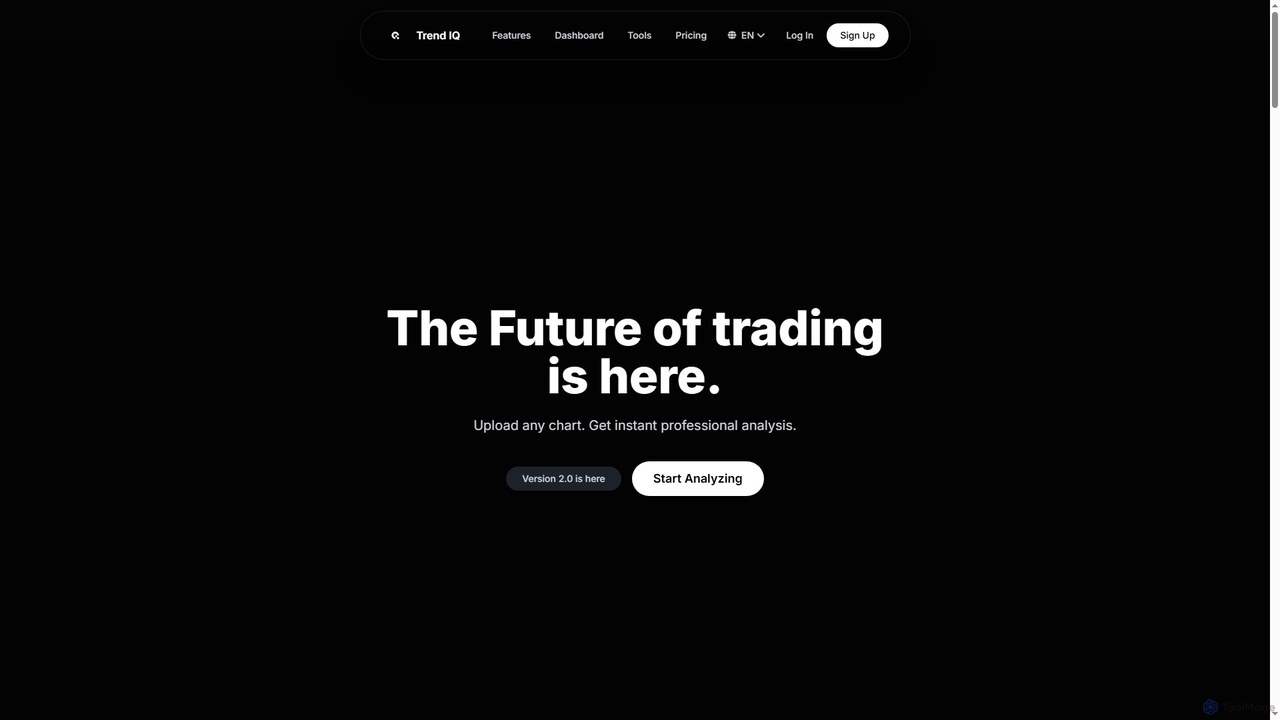
TrendIQ is an AI-powered technical analysis tool for traders across crypto, stocks, futures, and forex markets. It instantly analyzes uploaded chart screenshots, providing professional insights, pattern recognition, and risk management to enhance trading decisions.
About Trading Analysis
AI Trading Analysis tools are a specialized category of financial software that leverages machine learning and data science to interpret market data and generate actionable trading insights. These platforms process vast datasets, including price action, trading volume, news sentiment, and economic indicators, to identify patterns and predict future market movements. Their primary value lies in empowering traders and investors to make more objective, data-driven decisions, moving beyond traditional analysis methods. By automating complex analytical tasks, they help users discover opportunities and manage risk more effectively in volatile markets.
Core Features
- Predictive Forecasting: Utilizes machine learning models to predict potential price trends for assets like stocks, crypto, and forex.
- Sentiment Analysis: Scans news articles, social media, and financial reports in real-time to gauge market sentiment.
- Automated Pattern Recognition: Automatically identifies technical chart patterns and indicator signals that human traders might miss.
- Strategy Backtesting: Allows users to simulate trading strategies against historical data to evaluate their potential performance and risk.
- Risk Assessment: Calculates key risk metrics and can suggest optimal position sizing or stop-loss levels based on user-defined parameters.
Use Cases
These tools are widely used by retail day traders, swing traders, quantitative analysts (quants), and portfolio managers at hedge funds and investment firms. They are applied to various financial markets, including equities, cryptocurrencies, forex, and commodities, for tasks ranging from short-term scalping to developing long-term investment theses.
How to Choose
When selecting an AI Trading Analysis tool, consider the range of data sources and markets covered, the transparency of its AI models (explainability), and its integration capabilities with brokerage accounts. Also, evaluate the platform's user interface complexity—whether it's designed for non-technical traders or requires coding skills—and the pricing model's alignment with your trading volume and needs.

Trading AnalysisUse Cases
Real-time Analysis for Day Trading
A day trader focused on volatile tech stocks uses an AI analysis tool to monitor the market. The tool's sentiment analysis feature scans social media and news outlets for breaking stories related to their target stocks, providing real-time alerts on significant sentiment shifts. Simultaneously, its pattern recognition algorithm identifies emerging intraday chart patterns like flags and pennants. This combination allows the trader to enter and exit positions with greater confidence, capitalizing on short-term momentum shifts identified by the AI within minutes, a task that would be manually impossible.
Backtesting a Quantitative Crypto Strategy
A quantitative analyst (quant) develops a new trading algorithm for the cryptocurrency market based on a combination of moving averages and trading volume spikes. Before deploying real capital, they use an AI trading analysis platform to backtest the strategy against five years of historical Bitcoin and Ethereum data. The platform runs thousands of simulations, optimizing parameters like the moving average periods. The results reveal the strategy's historical profitability, maximum drawdown, and Sharpe ratio, allowing the quant to refine the algorithm and set realistic expectations before going live.
Identifying Swing Trading Opportunities
A swing trader aims to capture market trends over several days or weeks. They use an AI tool's predictive forecasting module, which analyzes historical price data, economic reports, and earnings calendars. The AI identifies stocks that are showing early signs of a potential multi-week uptrend and assigns a confidence score to each prediction. This allows the trader to filter through hundreds of stocks efficiently, focusing their in-depth research on a small list of high-probability candidates, thereby improving the quality of their trade entries.
Automated Risk Management for a Portfolio
A portfolio manager oversees a diverse collection of assets and needs to manage risk dynamically. They connect their portfolio to an AI analysis tool that continuously monitors market volatility and correlations between their holdings. The tool automatically calculates the portfolio's Value at Risk (VaR) in real-time. If the overall risk level exceeds a predefined threshold due to a market shock, the system sends an alert and suggests specific hedging actions, such as buying put options on a correlated index, helping the manager to protect capital proactively.
Analyzing Macroeconomic News for Forex Trading
A forex trader specializes in the EUR/USD pair. They use an AI tool that ingests and analyzes economic announcements from the European Central Bank (ECB) and the US Federal Reserve in real-time. The AI's natural language processing (NLP) capabilities detect subtle shifts in the tone of policymakers' statements, classifying them as hawkish, dovish, or neutral. This provides the trader with an immediate, nuanced understanding of potential policy changes, allowing them to anticipate currency movements before they are fully reflected in the price, gaining an edge over traders relying solely on headline numbers.
Discovering Arbitrage Opportunities in Crypto
An arbitrage trader uses a specialized AI tool to scan prices for the same cryptocurrency across dozens of different exchanges simultaneously. The AI algorithm accounts for trading fees, withdrawal fees, and network latency to identify genuine, profitable arbitrage opportunities in real-time. When the price of an asset like Solana (SOL) differs significantly between Exchange A and Exchange B, the tool sends an instant alert with the calculated potential profit, allowing the trader to execute the buy and sell orders quickly before the price gap closes.