Chart
Chart is a developer-focused platform providing instant, real-time access to verified IRS tax records. It empowers fintech companies …
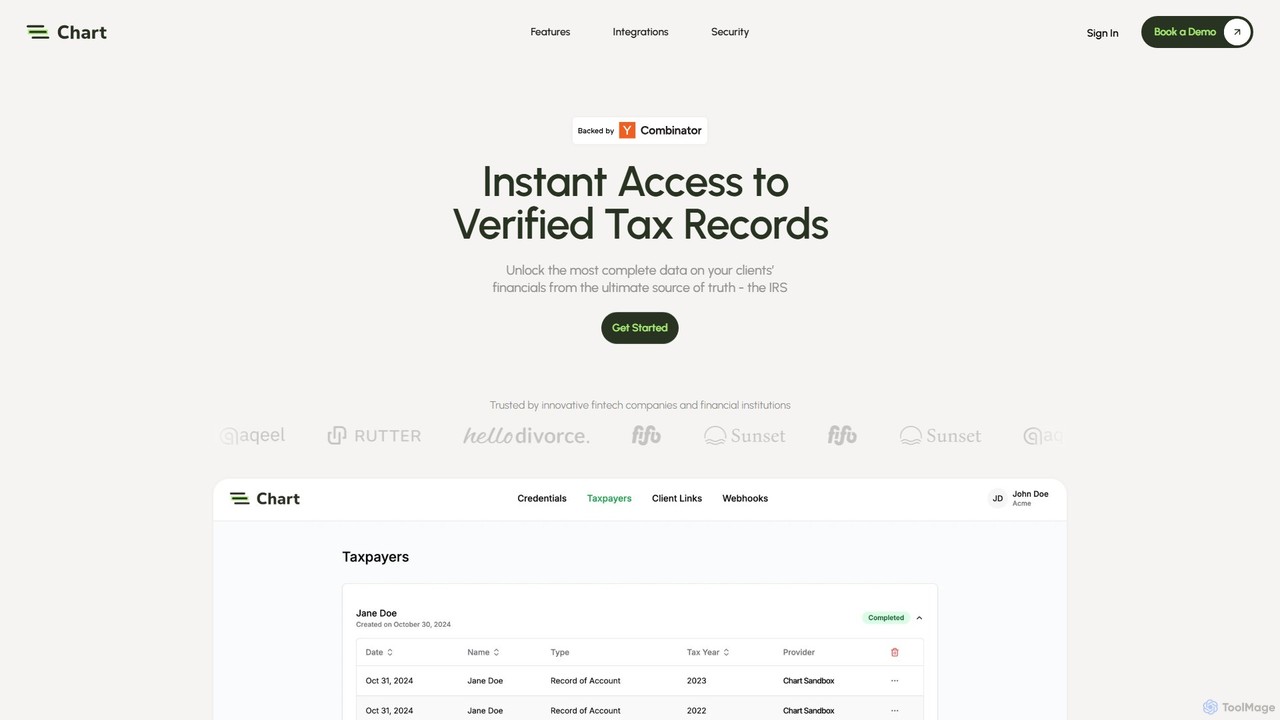
Chart is a developer-focused platform providing instant, real-time access to verified IRS tax records. It empowers fintech companies and financial institutions to automate income verification and streamline client onboarding. By connecting directly to the IRS and tax preparation software, Chart delivers structured JSON data, ensuring accuracy and eliminating fraud with a secure, SOC 2 Type II compliant solution.
About Verification
AI Verification tools are a specialized category within finance technology that automates the confirmation of identities, documents, and data. These tools utilize machine learning, computer vision (OCR), and biometric analysis to validate government-issued IDs, detect liveness, and cross-reference information against global databases. Their primary purpose is to streamline secure customer onboarding, prevent fraud, and ensure regulatory compliance. By replacing manual checks, they significantly increase accuracy and operational efficiency in financial processes.
Core Features
- Identity Verification (IDV): Automatically verifies the authenticity of documents like passports and driver's licenses using OCR and security feature analysis.
- Biometric & Liveness Detection: Confirms a user's physical presence through facial recognition and anti-spoofing checks to prevent identity theft.
- AML/KYC Screening: Screens individuals and businesses against global watchlists, sanctions lists, and Politically Exposed Persons (PEP) databases.
- Document Analysis: Extracts and verifies data from financial documents such as bank statements and utility bills to confirm address or income.
- Fraud Signal Detection: Analyzes user data, device information, and behavioral patterns to identify and flag high-risk activities in real-time.
Use Cases
These tools are crucial for financial institutions, fintech companies, crypto exchanges, and online lending platforms. They are used to automate Know Your Customer (KYC) and Anti-Money Laundering (AML) checks during account opening, secure loan applications by verifying applicant data, and authorize high-value transactions with multi-factor biometric authentication.
How to Choose
When selecting an AI Verification tool, consider its global document coverage and supported languages. Evaluate the accuracy rates for ID verification and liveness detection. Assess its integration capabilities via API, compliance with regulations like GDPR and CCPA, and the flexibility of its pricing model (e.g., per-verification or subscription-based).
VerificationUse Cases
Automating Digital Customer Onboarding (KYC)
A digital bank or fintech app needs to onboard new users quickly and securely while complying with KYC regulations. Instead of a manual process taking days, they integrate an AI Verification tool. A new user simply uploads a photo of their government ID and takes a selfie. The AI instantly verifies the ID's authenticity, extracts the data using OCR, and uses facial recognition with liveness detection to match the selfie to the ID photo, confirming the user is real. This entire process is completed in under two minutes, reducing user drop-off rates and operational costs.
Preventing Transaction Fraud in Real-Time
An e-commerce platform faces challenges with fraudulent transactions and chargebacks. By implementing an AI Verification tool, they can analyze various data points during checkout. This includes device fingerprinting, IP address location, transaction history, and behavioral biometrics (like typing speed). If the system detects a high-risk score—for instance, a login from a new device in a different country attempting a large purchase—it can trigger a step-up verification, requiring the user to complete a quick facial scan to authorize the payment, thus preventing fraud before it occurs.
Streamlining Anti-Money Laundering (AML) Compliance
A financial institution is required to continuously monitor customer accounts for suspicious activities to comply with AML regulations. An AI Verification tool automates this by screening customer names against global sanctions and PEP lists during onboarding and on an ongoing basis. Furthermore, its machine learning models can analyze transaction patterns to detect anomalies indicative of money laundering, such as structuring (making many small deposits to avoid reporting thresholds). The system automatically flags these accounts for review by a compliance officer, improving detection rates and reducing manual workload.
Securing Digital Loan Applications
An online lending platform needs to verify an applicant's income and identity to assess risk and prevent fraud. Using an AI Verification tool, the applicant can securely link their bank account or upload documents like pay stubs and bank statements. The AI uses OCR to extract key information, verifies the document's authenticity, and cross-references the data to detect inconsistencies. This automates the underwriting process, reduces the time to decision from days to minutes, and minimizes the risk of lending to fraudulent applicants.
Biometric Authentication for High-Value Transactions
A wealth management platform wants to add an extra layer of security for actions like authorizing large wire transfers or changing account details. They implement biometric verification. When a client initiates a high-risk action, they receive a push notification on their registered mobile device. To proceed, they must complete a quick liveness check and facial scan. The AI compares this scan to their enrolled biometric profile, providing a highly secure, passwordless authentication method that is much harder to compromise than traditional passwords or SMS codes.
Automating Know Your Business (KYB) Checks
A B2B payment processor needs to verify the legitimacy of new business clients to prevent fraud and comply with regulations. Manually checking company registration documents, identifying Ultimate Beneficial Owners (UBOs), and screening against watchlists is slow and error-prone. An AI KYB tool automates this by allowing businesses to submit their registration number. The AI then connects to official government registries to retrieve and verify company data, uses NLP to analyze corporate structure documents to identify UBOs, and automatically screens all associated entities and individuals against global AML lists, completing the process in minutes.