Frugal
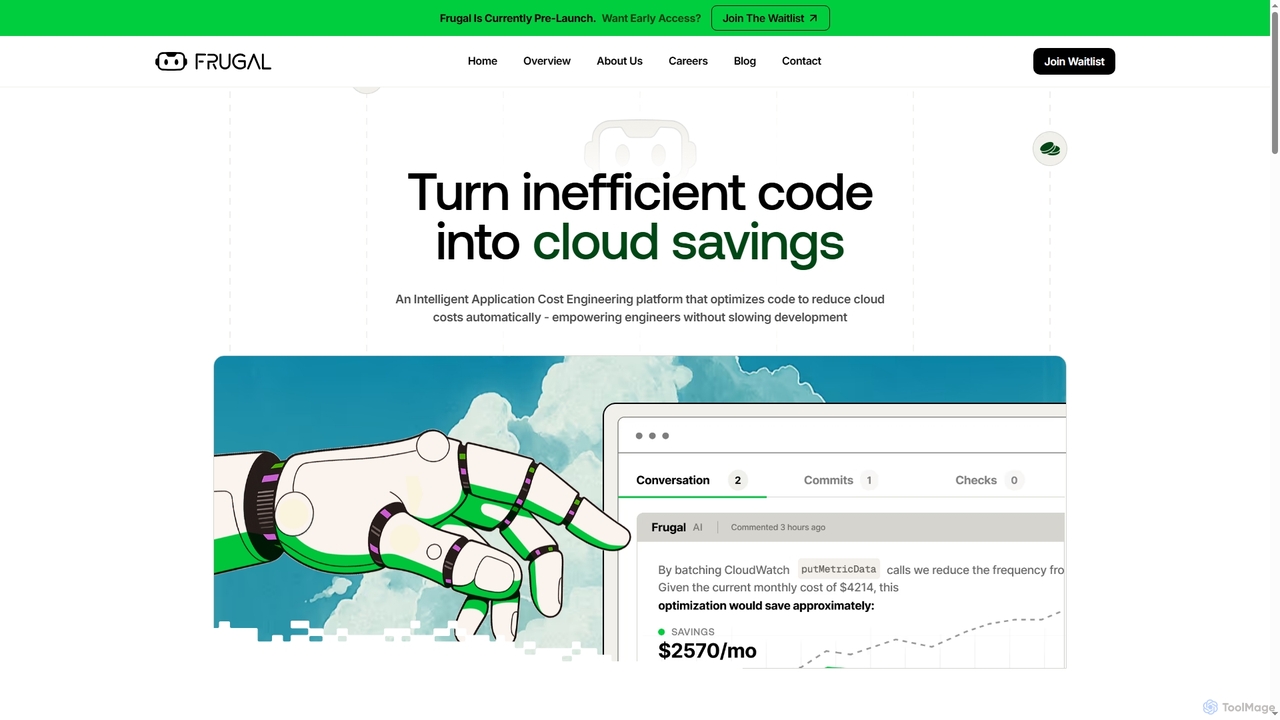
Frugal is an intelligent, AI-powered Application Cost Engineering platform designed for engineers to automatically optimize code and reduce …
Frugal is an intelligent, AI-powered Application Cost Engineering platform designed for engineers to automatically optimize code and reduce cloud costs. It aims to empower developers to eliminate waste at the source without compromising development speed, fostering collaboration between engineering and FinOps teams.
About Cloud Financial Management
Cloud Financial Management tools are a specialized category of software that uses AI and automation to monitor, analyze, and optimize cloud spending. These platforms ingest complex billing data from providers like AWS, Azure, and GCP, translating technical usage metrics into actionable financial insights. They empower organizations to gain clear visibility into their cloud costs, identify waste, and accurately forecast future expenses. As a core technology component of the FinOps framework, these tools are essential for implementing financial accountability in scalable cloud environments.
Core Features
- Cost Monitoring & Allocation: Tracks spending in real-time and attributes costs to specific teams, projects, or products using tags and business rules.
- AI-Powered Anomaly Detection: Automatically identifies unusual spending patterns, budget overruns, or unexpected cost spikes before they escalate.
- Optimization Recommendations: Provides data-driven suggestions for cost savings, such as rightsizing instances, purchasing reserved capacity, or deleting unused resources.
- Budgeting & Forecasting: Creates and manages cloud budgets, using predictive analytics to forecast future spending based on historical trends and growth models.
- Detailed Reporting & Showback: Generates customizable reports for different stakeholders, enabling showback or chargeback models within the organization.
Use Cases
These tools are widely used by technology companies, e-commerce platforms, and large enterprises with significant cloud infrastructure. DevOps engineers use them to optimize resource efficiency, finance teams for budgeting and cost control, and CTOs for strategic oversight of cloud investments. They are particularly valuable in multi-cloud or complex containerized environments where cost tracking is challenging.
How to Choose
When selecting a Cloud Financial Management tool, consider its multi-cloud support for all your providers. Evaluate the granularity of its cost allocation and its ability to handle shared costs. Assess the sophistication of its AI-driven recommendations and its capacity for automated actions. Finally, check for integrations with your existing ecosystem, such as Slack for alerts or Jira for task management.

Cloud Financial ManagementUse Cases
Real-Time Cloud Cost Anomaly Detection
A FinOps analyst at a fast-growing tech startup needs to prevent unexpected budget overruns. A developer accidentally provisions an oversized GPU instance for a simple test, causing a sudden spike in the daily cloud bill. The Cloud Financial Management tool's AI model, trained on historical spending data, immediately detects this anomalous activity. It sends an automated alert via Slack to the FinOps team and the project owner, detailing the resource and the cost implication. The issue is identified and resolved within an hour, preventing thousands of dollars in wasted spend that would have otherwise gone unnoticed until the end-of-month invoice.
Automating Rightsizing Recommendations for Compute Instances
A DevOps team manages hundreds of compute instances for a large e-commerce application. Many instances are over-provisioned to handle peak traffic, leading to significant waste during off-peak hours. The Cloud Financial Management tool continuously analyzes CPU and memory utilization metrics for each instance. It then generates specific, AI-driven recommendations to downsize instances to a more appropriate, cost-effective type without impacting performance. The recommendations are automatically created as tickets in Jira, allowing engineers to review and apply the changes as part of their regular workflow, ultimately reducing compute costs by over 25%.
Accurate Cost Allocation for Departmental Chargebacks
A finance controller at a large enterprise needs to accurately charge back cloud costs to individual business units like Marketing and R&D. However, shared resources like Kubernetes clusters and data transfer costs make this difficult. The Cloud Financial Management tool uses resource tagging and business mapping rules to automatically allocate both direct and shared costs to the correct cost centers. It generates precise, defensible chargeback reports each month, fostering a culture of cost accountability and enabling department heads to manage their own cloud budgets effectively.
Forecasting Cloud Spend for Annual Budgeting
A CTO is preparing the annual budget and needs an accurate forecast for next year's cloud expenditure. Simply extrapolating past spending is unreliable due to seasonality and planned growth. The Cloud Financial Management tool's AI forecasting engine analyzes historical usage trends, seasonality, and growth patterns to predict future cloud spending with a high degree of accuracy. The CTO can also model different scenarios, such as launching a new product or migrating a new workload to the cloud, to understand their financial impact. This enables the company to set a realistic cloud budget, avoiding unexpected overages and facilitating better strategic financial planning.
Optimizing Reserved Instance and Savings Plan Purchases
A Cloud Center of Excellence (CCoE) lead wants to maximize savings by using commitment-based discounts like AWS Reserved Instances (RIs) or Savings Plans. However, they are unsure of the optimal purchase amount to avoid overcommitting and wasting money. The Cloud Financial Management tool analyzes the company's stable, long-term workload usage. It then recommends the ideal mix and quantity of RIs or Savings Plans to purchase, calculating the potential savings, upfront cost, and break-even point. This data-driven approach allows the company to confidently make a commitment purchase, achieving savings of up to 40% on its steady-state workloads.
Identifying and Eliminating Idle Cloud Resources
A cloud engineer is tasked with reducing monthly cloud waste. Over time, numerous unattached storage volumes, old snapshots, and idle load balancers have accumulated in the account, incurring costs without providing value. The Cloud Financial Management tool runs automated daily checks to identify these "zombie" resources across multiple regions and services. It presents a clear, consolidated list of all idle assets, their associated monthly costs, and provides a one-click action to terminate them safely. By using this feature regularly, the engineering team cleans up cloud waste and reduces the monthly bill by 5-10% through simple, automated housekeeping.