Craft
Craft is an AI-powered development framework and Next.js starter kit designed to accelerate SaaS product development. It leverages …
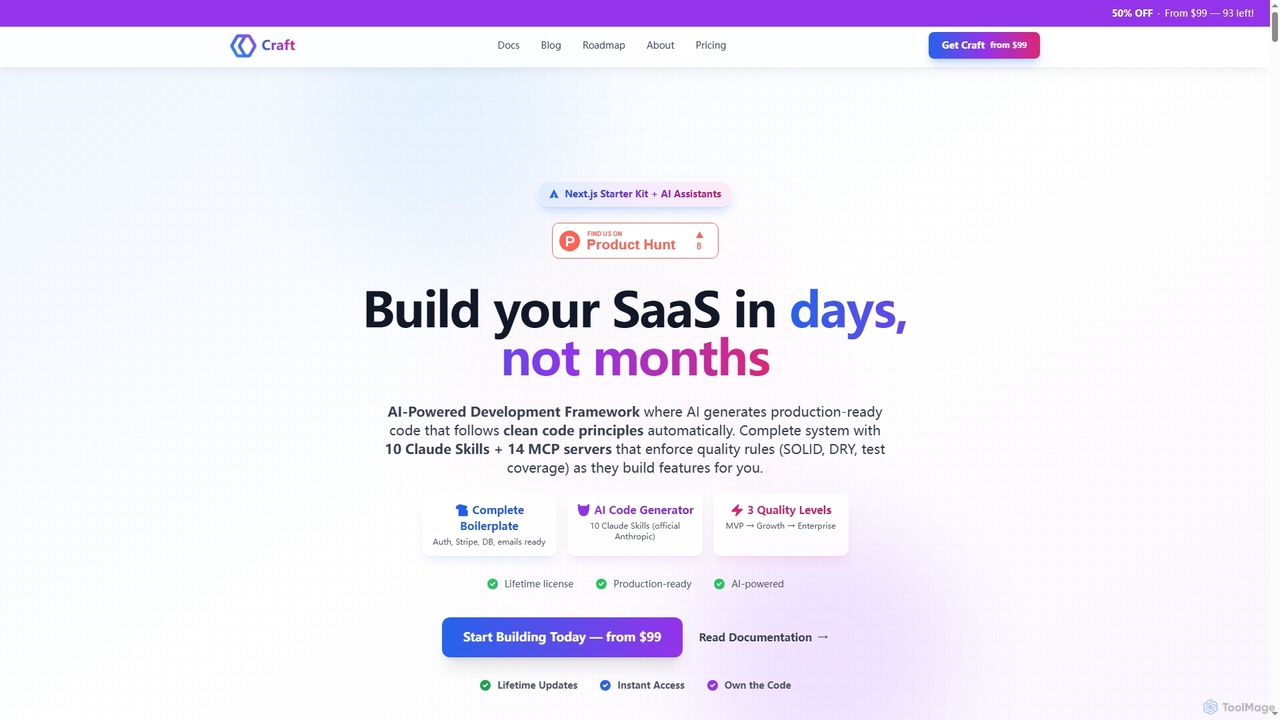
Craft is an AI-powered development framework and Next.js starter kit designed to accelerate SaaS product development. It leverages Anthropic's Claude AI with 10 specialized Skills and 14 pre-configured MCP servers to generate production-ready, clean code. Craft offers adaptive quality levels (Rapid, Balanced, Crafted) to match your product's stage, integrating essential boilerplate features like authentication, payments, and databases, enabling developers to ship features in days, not months.
About Mobile Development
AI Mobile Development frameworks are specialized toolkits for integrating artificial intelligence capabilities directly into iOS and Android applications. They provide developers with pre-built models, APIs, and components for on-device machine learning, computer vision, and natural language processing. This enables the creation of intelligent, responsive, and personalized mobile experiences without constant reliance on cloud servers. These frameworks are optimized to handle the computational and memory constraints of mobile devices, making advanced AI accessible on the go.
Core Features
- On-Device Inference: Execute machine learning models directly on the user's device for low latency, offline functionality, and enhanced data privacy.
- Pre-trained Model Libraries: Offer a collection of ready-to-use models for common tasks like image recognition, text classification, and object detection.
- Cross-Platform Support: Provide a unified API to build and deploy AI features across both iOS and Android from a single codebase.
- Performance Optimization Tools: Include features for model quantization and compression to reduce app size and ensure efficient performance on mobile hardware.
Use Cases
These frameworks are widely used by mobile developers and AI engineers in industries like e-commerce for building personalized recommendation engines, social media for creating real-time AR filters, and healthcare for developing diagnostic aid apps. They are essential for any project requiring intelligent features that must run efficiently and privately on a user's smartphone.
How to Choose
When selecting a framework, consider its platform support (native iOS/Android or cross-platform), the breadth and quality of its pre-trained model library, its performance benchmarks on target devices, and the quality of its documentation and community support. Also, evaluate the ease of integration with your existing mobile development workflow and toolchain.

Mobile DevelopmentUse Cases
Build an Intelligent Camera App with AR Filters
A mobile app developer is tasked with creating a social media camera app that features real-time augmented reality (AR) filters and object recognition. Instead of building the complex machine learning models from scratch, the developer uses an AI mobile development framework. They integrate the framework's pre-trained face detection and landmark models to accurately apply AR masks to a user's face. This approach significantly reduces development time from months to weeks and ensures high performance on a wide range of devices.
Develop an Offline Document Scanner App
A company needs a mobile app for its field agents to digitize invoices and receipts on-site, often in areas with poor internet connectivity. A developer uses an AI mobile framework that includes a powerful, optimized on-device Optical Character Recognition (OCR) model. This allows the app to instantly scan documents, extract text, and populate forms directly on the smartphone without needing to upload images to a server. This ensures the app is fast, reliable offline, and keeps sensitive financial data secure on the device.
Create a Personalized E-commerce Experience
An e-commerce retailer wants to increase user engagement and sales on their mobile app. They use an AI mobile development framework to implement an on-device recommendation engine. The model analyzes a user's browsing history, viewed items, and cart additions in real-time to suggest relevant products directly on the app's home screen and product pages. Because the processing happens on the device, the recommendations are instant and personalized without sending user activity data to the cloud, thus respecting user privacy and improving app performance.
Implement Voice Commands for Hands-Free Control
A developer is creating a navigation app for cyclists and wants to enable hands-free operation. By integrating an AI mobile framework, they can add robust voice command functionality. The framework provides pre-built models for keyword spotting ('Hey, Navi') and speech-to-text conversion that run entirely on-device. This allows the cyclist to ask for directions, report road hazards, or change their destination using only their voice, ensuring a safer user experience without requiring a constant internet connection for voice processing.
Accelerate Development with AI-Powered Code Completion
A mobile development team is working under a tight deadline. To boost productivity, they integrate an AI-powered code completion tool into their IDE, which is built upon a mobile development AI framework. This tool analyzes the context of the code being written and suggests entire blocks of code, from UI components to complex logic. It helps developers write code faster, reduces boilerplate, and catches potential errors before they are compiled. The team estimates this accelerates their coding process by over 25%, allowing them to meet their project milestones.
Enhance App Security with On-Device Biometrics
A fintech startup is building a mobile banking app and needs top-tier security. They leverage an AI mobile framework that provides secure, on-device biometric authentication features. Instead of relying solely on passwords, the app uses the framework's models to perform facial recognition or fingerprint analysis directly on the user's phone. This process is not only faster and more convenient for the user but also more secure, as sensitive biometric data never leaves the device, significantly reducing the risk of server-side data breaches.