Frameworks Best in category 1 results Web Development AI Tool

Popular AI tools in the Web Development field of Frameworks include Craft, etc., helping you quickly improve efficiency.

Craft

Craft

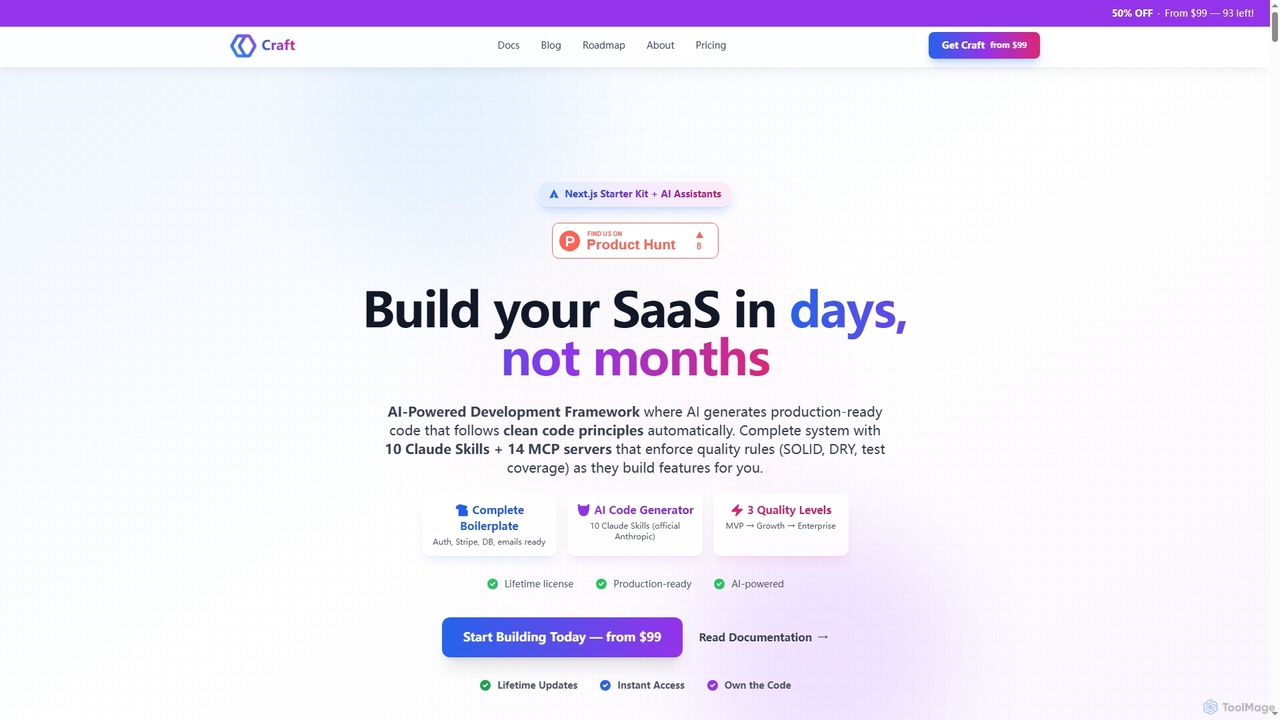
Craft is an AI-powered development framework and Next.js starter kit designed to accelerate SaaS product development. It leverages …

3.2K

About Web Development

AI Web Development tools are a specialized category of frameworks that use artificial intelligence to automate and accelerate the creation of websites and web applications. These tools interpret natural language prompts, design files, or user specifications to generate front-end and back-end code. Their primary value lies in significantly reducing manual coding, enabling rapid prototyping, and lowering the technical barrier for building digital products. They often produce code compatible with popular frameworks like React or Vue, or provide a complete AI-driven development environment.

Core Features

  • Code Generation: Automatically creates HTML, CSS, JavaScript, and back-end logic from text descriptions or visual inputs.
  • UI Component Creation: Generates reusable components like forms, navigation bars, and buttons based on user requirements.
  • Responsive Design: Intelligently adapts layouts and elements to ensure functionality across various screen sizes.
  • Database Schema Generation: Designs and generates database models and schemas from high-level descriptions of data requirements.
  • Automated Deployment: Simplifies the process of deploying applications to the cloud with AI-managed configurations.

Use Cases

These tools are ideal for developers seeking to boost productivity, startups needing to build Minimum Viable Products (MVPs) quickly, and designers wishing to convert their designs into functional code. They are also valuable for entrepreneurs and product managers who want to create functional prototypes without extensive coding knowledge. Common applications include building internal tools, marketing landing pages, and data dashboards.

How to Choose

When selecting an AI Web Development tool, consider the following: the specific programming languages and frameworks it supports, the quality and customizability of the generated code, and its integration capabilities with existing workflows (e.g., Figma, GitHub). Also, evaluate the learning curve, the pricing model (e.g., subscription vs. pay-per-use), and the level of control you retain over the final application.

Web DevelopmentUse Cases

1

Rapid Prototyping for Startups

A startup founder needs to build a functional prototype to validate a business idea and present it to potential investors. Instead of hiring a development team, they use an AI Web Development tool. By providing detailed text prompts describing the user flow, features, and desired UI, the tool generates a complete web application with a database backend in a matter of hours. This allows the founder to gather user feedback and iterate on the product at a fraction of the traditional time and cost.

2

Automating Internal Tool Development

A developer is tasked with creating an internal admin panel for the customer support team to manage user data. This typically involves repetitive boilerplate coding for CRUD (Create, Read, Update, Delete) operations. By using an AI Web Development tool, the developer describes the data model and the required interface elements. The AI generates the entire panel, including data tables, search functionality, and forms for editing records. This frees up the developer to focus on more complex, business-critical tasks, reducing development time for internal tools by over 70%.

3

Converting Figma Designs to Production-Ready Code

A UI/UX designer has finalized a high-fidelity website design in Figma. The next step is to hand it off to developers for implementation. Using an AI tool that integrates with Figma, the designer can directly convert their design into clean, responsive HTML, CSS, and React components. The tool accurately translates layout, styling, and assets, creating a solid foundation for developers. This process dramatically shortens the design-to-development cycle and ensures a higher fidelity translation of the original design vision into the final product.

4

Generating Marketing Landing Pages

A marketing team needs to launch several landing pages for a new campaign, each targeting a different audience segment. Instead of waiting for the development team's availability, a marketer uses an AI web builder. They input the campaign copy, select a visual style, and specify the call-to-action elements. The AI generates multiple page variations in minutes, allowing the team to A/B test different layouts and messaging immediately. This agility enables the marketing team to optimize campaigns much faster and respond to market feedback in real-time.

5

Generating Backend APIs from Descriptions

A front-end developer is building a mobile app and needs a simple backend to handle user authentication and data storage. Lacking deep backend expertise, they use an AI tool. They describe the required data models (e.g., 'User' with email and password fields) and the API endpoints (e.g., '/login', '/register') in natural language. The AI tool generates the complete backend code, including the database schema, server logic, and API documentation. This empowers front-end developers and full-stack teams to build full-featured applications more independently and quickly.

6

AI-Assisted Code Refactoring

A maintenance developer is working on a legacy codebase with inconsistent styling and inefficient functions. They use an AI Web Development tool with refactoring capabilities. By feeding snippets of old code into the tool, they receive suggestions for modernization, performance improvements, and adherence to best practices. The AI can automatically rewrite functions to be more readable, convert class-based components to functional ones in React, or optimize database queries. This accelerates the process of improving code quality and maintainability without requiring a complete rewrite.

Web DevelopmentFrequently Asked Questions