
Outlier
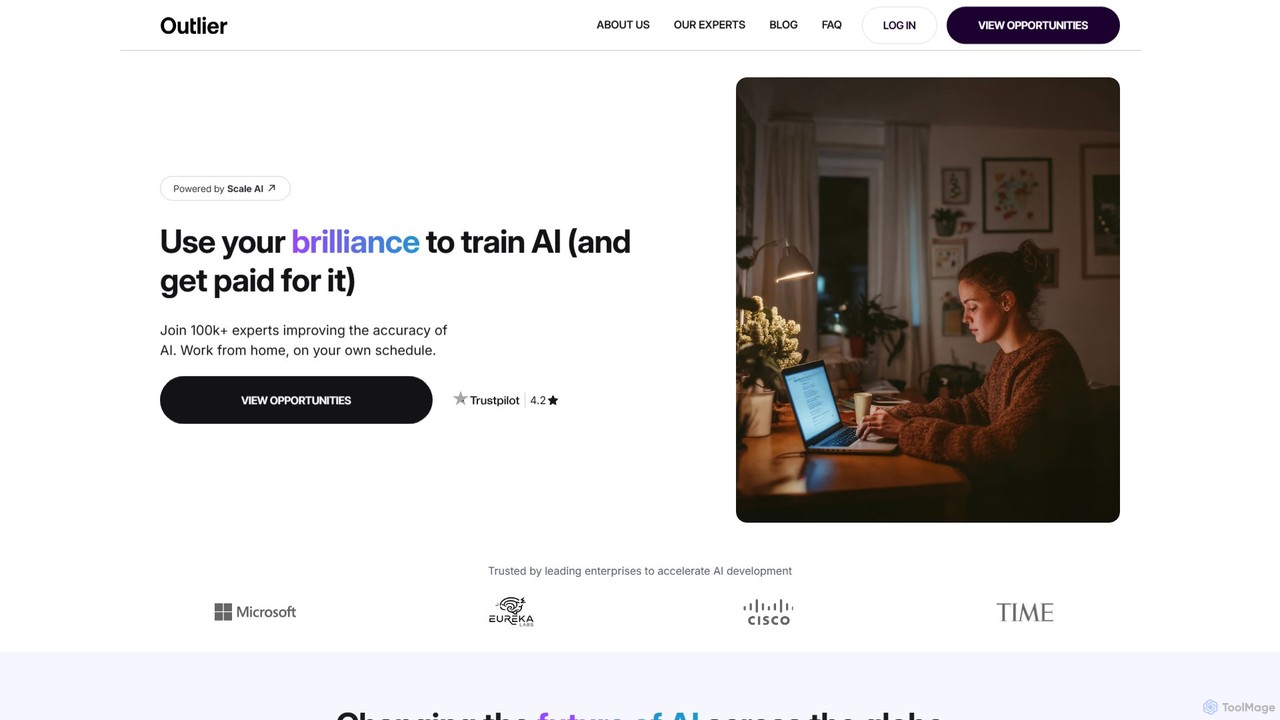
Outlier is a platform powered by Scale AI that connects domain experts with opportunities to train the next …
Outlier is a platform powered by Scale AI that connects domain experts with opportunities to train the next generation of AI models. Freelancers can use their knowledge in fields like coding, math, and languages to complete tasks, improve AI accuracy, and earn money with a flexible, remote work schedule.
About Ai Training
AI Training platforms are specialized services that provide the human workforce and tools necessary to create high-quality datasets for machine learning models. As a specific segment within freelance platforms, they focus exclusively on tasks like data annotation, labeling, and model evaluation. These platforms connect AI developers with a managed, global workforce to perform detailed work such as image segmentation, text classification, or audio transcription. The primary value lies in their ability to scale data preparation processes with built-in quality control, ensuring the accuracy and consistency required to train robust AI systems.
Core Features
- Integrated Annotation Tools: Provides built-in software for various data types, including bounding boxes for images, semantic segmentation, and text entity recognition.
- Workforce Management: Offers access to a scalable, on-demand global workforce, often with options for specialized or vetted annotators.
- Quality Control Workflows: Implements mechanisms like consensus scoring, peer review, and gold standard checks to ensure data accuracy.
- Project Management Dashboard: Allows users to define instructions, distribute tasks, monitor progress, and analyze workforce performance.
Use Cases
These platforms are crucial for industries developing computer vision, natural language processing (NLP), and autonomous systems. For example, automotive companies use them to label vast amounts of road data for self-driving cars. In healthcare, they are used to annotate medical images for diagnostic AI. E-commerce companies also leverage them to categorize products and moderate user-generated content.
How to Choose
When selecting an AI Training platform, consider the quality assurance mechanisms and the level of workforce expertise available. Evaluate the platform's support for your specific data types and the sophistication of its annotation tools. Data security protocols, compliance certifications (like GDPR or HIPAA), and the pricing model (per-task or per-hour) are also critical factors in making an informed decision.
Ai TrainingUse Cases
Training Perception Models for Autonomous Vehicles
An automotive technology company developing a self-driving system needs to train its computer vision models on millions of miles of road data. They use an AI Training platform to access a large, managed workforce. This workforce performs detailed annotation tasks, such as drawing precise bounding boxes around vehicles and pedestrians, applying semantic segmentation to roadways and sidewalks, and labeling traffic signs across diverse weather and lighting conditions. This process creates a massive, high-accuracy dataset essential for teaching the AI to navigate real-world environments safely.
Fine-tuning LLMs with Human Feedback (RLHF)
A research lab is developing a new large language model (LLM) and wants to improve its helpfulness and safety. They use an AI Training platform specializing in Reinforcement Learning from Human Feedback (RLHF). The platform provides an interface where human trainers are shown multiple responses from the AI to a single prompt. The trainers then rank these responses from best to worst or provide detailed written feedback. This structured human preference data is fed back into the model's training loop, aligning its behavior more closely with human values and expectations.
Annotating Medical Images for Diagnostic AI
A healthcare startup is building an AI tool to detect early-stage cancer from medical scans like X-rays and MRIs. To ensure the highest level of accuracy, they require annotations from certified medical professionals. They partner with an AI Training platform that provides a secure, HIPAA-compliant environment and access to a workforce of radiologists and medical experts. These experts use specialized annotation tools on the platform to precisely outline tumors and other anomalies, creating a gold-standard dataset for training a life-saving diagnostic model.
Categorizing Products for E-commerce Search
A large online retailer wants to improve its product search and recommendation engine. They need to accurately categorize millions of products based on images and descriptions, a task too large for their internal team. They upload their product catalog to an AI Training platform and create a project with a detailed taxonomy. A distributed workforce then quickly classifies each item, assigning attributes like 'color', 'style', and 'material'. The resulting structured data is used to train a machine learning model that automates future product categorization, enhancing the customer shopping experience.
Transcribing Audio for Speech Recognition Models
A company developing a voice assistant needs to improve its speech-to-text accuracy across various accents and dialects. They collect thousands of hours of anonymized audio data but need precise human transcriptions. Using an AI Training platform, they create a transcription project where a global workforce of native speakers listens to audio clips and types out the corresponding text. The platform's tools allow for timestamping words and labeling non-speech sounds like background noise. This high-quality, transcribed corpus is then used to train a more accurate and inclusive speech recognition engine.
Validating Geospatial Data for Mapping Services
A mapping and navigation company needs to verify the accuracy of its satellite imagery and street-level data. They use an AI Training platform to deploy tasks to a global workforce. These tasks involve comparing AI-generated map features with actual satellite photos, identifying new construction, verifying business locations, and correcting road network errors. Workers use specialized geospatial tools on the platform to confirm or flag discrepancies. This human-in-the-loop validation process ensures the company's maps are up-to-date and reliable for millions of users.