ToolMage
Sign in

Best 1 Future Prediction AI tools

Popular Future Prediction AI tools include ChronoSim, helping you work more efficiently.

ChronoSim
Paid

ChronoSim

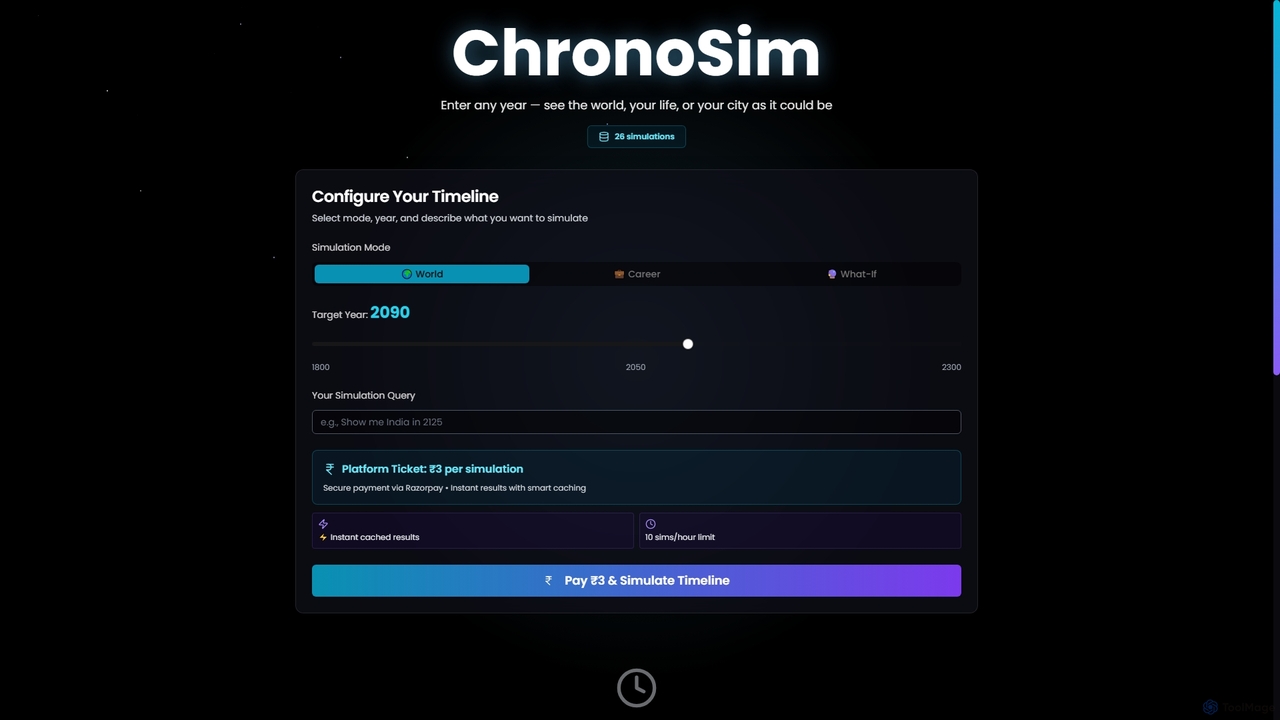
ChronoSim is an AI-powered future simulator that allows users to explore potential scenarios for the world, careers, or hypothetical 'what-if' situations. By simply entering a target year and a descriptive query, users can visualize how things might evolve, offering a unique perspective on future possibilities.

Generative Ai
Visits 3.4KFavorites 118Likes 103

About Future Prediction

Future Prediction tools are AI-powered applications designed to analyze historical and real-time data to forecast future trends, events, and outcomes. They utilize advanced machine learning models, including time-series analysis and neural networks, to identify complex patterns and correlations often invisible to human analysts. These tools provide data-driven insights for strategic planning, risk management, and operational optimization across various industries. By processing vast datasets, they offer more accurate and dynamic forecasts compared to traditional statistical methods.

Core Features

  • Predictive Modeling: Build, train, and deploy custom models to forecast key business metrics.
  • Time-Series Analysis: Analyze sequential data points to identify trends, seasonality, and predict future values.
  • Scenario Simulation: Create 'what-if' scenarios to understand the potential impact of different variables on future outcomes.
  • Risk Assessment: Identify and quantify potential future risks based on historical data and external factors.
  • Data Integration & Processing: Connect to diverse data sources and automatically process large volumes of information for analysis.

Use Cases

These tools are invaluable in sectors like finance for stock market forecasting, retail for demand and inventory planning, and manufacturing for predictive maintenance of machinery. Business analysts, data scientists, and strategic planners use them to anticipate market shifts, optimize resource allocation, and gain a competitive edge.

How to Choose

When selecting a Future Prediction tool, consider its data integration capabilities, the range and customizability of its predictive models, and its methods for validating forecast accuracy. Also, evaluate the user interface's complexity and whether it aligns with your team's technical skills. Finally, assess its scalability to ensure it can grow with your data needs.

Featured tool rankings

Future Prediction use cases

1

Forecasting Financial Market Trends

Financial analysts and investment firms use future prediction tools to analyze historical stock prices, market indices, and macroeconomic indicators. By inputting this data, the AI generates forecasts on potential price movements and market volatility. This allows traders to make more informed decisions, manage portfolio risk, and identify potential investment opportunities that might be missed through manual analysis alone, improving the strategic allocation of assets.

2

Optimizing Retail Inventory with Demand Forecasting

Retail managers and supply chain planners leverage these tools to predict future sales demand for specific products. The AI analyzes past sales data, seasonality, promotional events, and even external factors like weather. The resulting forecast helps businesses optimize stock levels, reduce overstocking or stockouts, improve cash flow, and ensure product availability, ultimately enhancing customer satisfaction and profitability.

3

Predicting Customer Churn for Subscription Services

Marketing and customer success teams in SaaS or subscription-based businesses use prediction tools to identify customers at high risk of churning. The models analyze user engagement metrics, support ticket history, and usage patterns. This early identification enables teams to launch targeted retention campaigns, offer personalized incentives, or proactively address issues before the customer decides to leave, significantly reducing revenue loss.

4

Implementing Predictive Maintenance in Manufacturing

Operations managers in industrial settings apply future prediction tools to forecast equipment failures. Sensors on machinery collect real-time data on temperature, vibration, and performance, which the AI analyzes to predict when a part is likely to fail. This shifts maintenance from a reactive or fixed-schedule approach to a proactive, needs-based one, minimizing downtime, reducing repair costs, and extending equipment lifespan.

5

Anticipating Supply Chain Disruptions

Logistics and supply chain professionals use these tools to forecast potential disruptions. The AI models analyze data from shipping routes, weather patterns, geopolitical events, and supplier performance. This provides early warnings of potential delays or shortages, allowing companies to proactively reroute shipments, find alternative suppliers, or adjust production schedules to mitigate the impact on their operations and customers.

6

Forecasting Energy Consumption for Utility Grids

Energy providers and grid operators utilize future prediction tools to forecast electricity demand. The AI considers historical consumption patterns, weather forecasts, time of day, and special events. Accurate demand forecasting is critical for efficient power generation, grid stability, and energy pricing, helping to prevent blackouts and optimize the use of renewable energy sources.

Future Prediction FAQ

What are AI Future Prediction tools?

AI Future Prediction tools are software applications that use machine learning and data analysis to forecast future events or trends. They process large volumes of historical and current data to identify patterns and make predictions about outcomes in areas like finance, sales, and operations. Unlike simple calculations, they can adapt and learn as new data becomes available, improving their accuracy over time.

How do I choose the right Future Prediction tool?

To choose the right tool, consider these factors:

  • Data Connectivity: Ensure it can easily integrate with your existing data sources (e.g., databases, CRM, APIs).
  • Model Customization: Determine if you need a simple, automated tool or one that allows data scientists to build and fine-tune custom models.
  • Accuracy and Transparency: Look for tools that provide clear metrics on forecast accuracy and explain the factors influencing predictions.
  • Usability: Select a tool with an interface that matches your team's technical expertise.

What is the difference between AI prediction and traditional forecasting?

The main difference lies in complexity and adaptability. Traditional forecasting often relies on simpler statistical models (like moving averages) that work well with stable, linear data. AI prediction tools use advanced machine learning algorithms that can analyze complex, non-linear relationships in massive datasets. AI models can also learn and improve automatically as they are fed new data, making them more dynamic and often more accurate for volatile environments.

What are the key capabilities of Future Prediction tools?

Key capabilities typically include:

  • Time-Series Forecasting: Predicting future values based on historical time-stamped data.
  • Regression Analysis: Understanding the relationship between different variables to make predictions.
  • Scenario Planning: Simulating how different conditions might affect future outcomes.
  • Anomaly Detection: Identifying unusual data points that could signal a future problem or opportunity.

Who benefits most from using Future Prediction tools?

A wide range of professionals benefit from these tools. Financial analysts use them to predict market trends. Retail managers use them for demand forecasting to optimize inventory. Marketing teams use them to predict customer churn. Operations managers in manufacturing apply them for predictive maintenance. Essentially, anyone in a role that requires strategic planning based on future trends can gain significant value.