Aibabygenerator
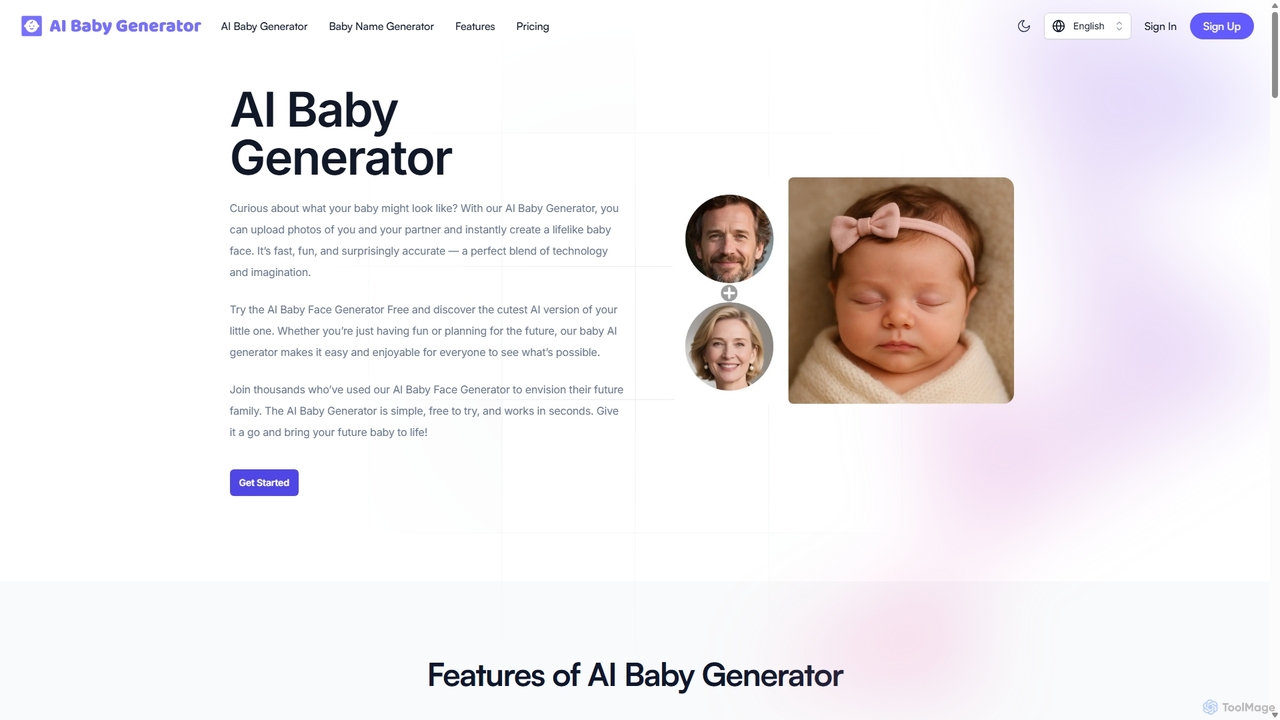
An AI-powered tool that predicts what your future baby might look like by merging two parent photos. It …
An AI-powered tool that predicts what your future baby might look like by merging two parent photos. It also features an advanced AI Baby Name Generator to help you find the perfect name, offering a fun and imaginative experience for expecting couples and curious individuals.
Namely
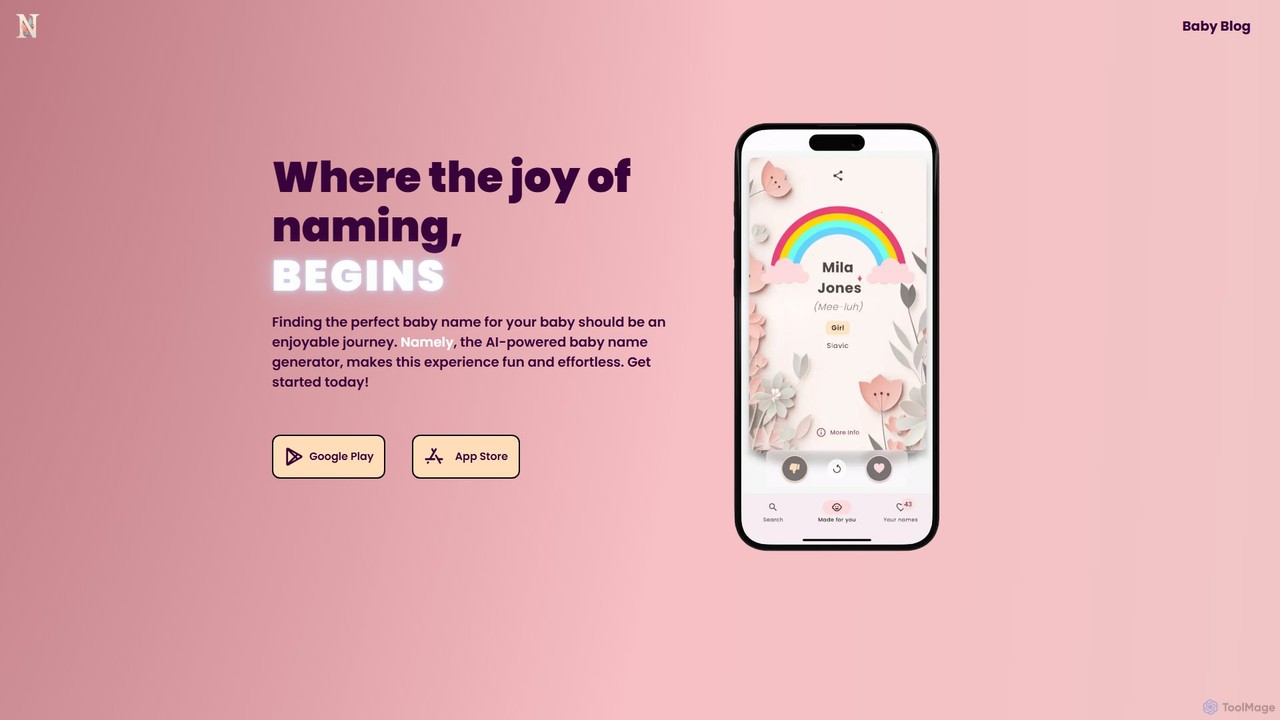
Namely is an AI-powered baby name generator app designed for expecting parents. It transforms the naming process into …
Namely is an AI-powered baby name generator app designed for expecting parents. It transforms the naming process into a fun, collaborative, and stress-free journey. Discover thousands of unique names, use advanced filters, and connect with your partner to swipe, match, and find the perfect name for your baby.
About Generators
AI Generators are tools that leverage artificial intelligence to create new, original content from user inputs. They typically utilize advanced models like GANs, Transformers, or diffusion models to produce a wide range of outputs, including text, images, code, and audio. These tools are designed to automate and scale content creation, enabling users to rapidly prototype ideas, generate creative variations, and overcome creative blocks. Their ability to transform simple prompts into complex, high-quality assets makes them valuable across numerous industries.
Core Features
- Multi-Modal Output: Generate diverse content types such as text, images, audio, video, and code from a single platform.
- Prompt-Driven Interface: Control the generation process using natural language descriptions, commands, and parameters.
- Style and Attribute Control: Fine-tune outputs by specifying style, tone, format, resolution, and other detailed characteristics.
- Iterative Generation: Refine and build upon previous results to achieve the desired outcome with greater precision.
- API Access: Integrate generation capabilities directly into custom applications, workflows, and services.
Use Cases
AI Generators are widely used in content marketing for creating articles and ad copy, in software development for generating boilerplate code and test cases, and in creative fields like game design and digital art for concept visualization. They also serve technical purposes, such as generating synthetic data for training other machine learning models.
How to Choose
When selecting an AI Generator, evaluate the quality and consistency of its output for your specific needs. Consider the range of content types (modalities) it supports and the level of customization and control it offers. For technical users, the availability and documentation of an API are crucial. Finally, analyze the pricing model, including any usage limits or credit systems, to ensure it aligns with your budget and project scale.
GeneratorsUse Cases
Rapid Prototyping for Digital Ad Campaigns
A marketing team needs to launch a new campaign on a tight deadline. They use an AI text generator to create multiple variations of ad headlines and body copy. Simultaneously, they use an AI image generator to produce a dozen distinct visual concepts based on a product description. This allows them to A/B test different combinations of text and visuals in hours instead of days, identifying the most effective ads without extensive manual design work.
Accelerating Software Development with Code Generation
A software developer is building a new feature that requires a complex API client. Instead of writing the boilerplate code manually, they provide the API specification to an AI code generator. The tool generates the necessary data structures, request functions, and error handling logic in their chosen programming language. This saves significant development time, reduces the chance of human error, and allows the developer to focus on implementing the core business logic.
Concept Art and World-Building for Game Design
A small indie game studio is in the pre-production phase. The lead artist uses an AI image generator to explore visual styles for characters, environments, and props. By inputting descriptive prompts like "cyberpunk city street at night, neon signs, rain-slicked pavement, anime style," they can generate hundreds of unique concept images. This process rapidly visualizes the game's world, facilitates team collaboration, and provides a strong foundation for final asset creation.
Creating Synthetic Data for Machine Learning
A data science team is tasked with building a fraud detection model but has a limited amount of real fraud data, which can lead to a biased model. They use a synthetic data generator to create new, realistic data points that mimic the statistical properties of the original dataset. This augmented dataset helps train a more robust and accurate machine learning model without compromising the privacy of real customer information.
Generating Royalty-Free Music and Sound Effects
A content creator produces weekly videos for a popular streaming platform and needs a constant supply of background music and sound effects. Using an AI music generator, they can specify a mood (e.g., "upbeat, electronic"), duration, and tempo to create custom, royalty-free tracks. This avoids copyright issues and the high cost of stock music libraries, providing a unique audio identity for their content.
Automating Voiceover and Narration Production
An e-learning company needs to produce audio versions of its training modules in multiple languages. Instead of hiring voice actors for each language, they use an AI voice generator. They input the script, choose a voice profile (e.g., "professional, female, American English"), and the tool generates a high-quality audio narration. This significantly reduces production costs and time, making it easy to update content as needed.