Frontier Model Forum
The Frontier Model Forum is an industry-led non-profit organization dedicated to ensuring the safe and responsible development of …
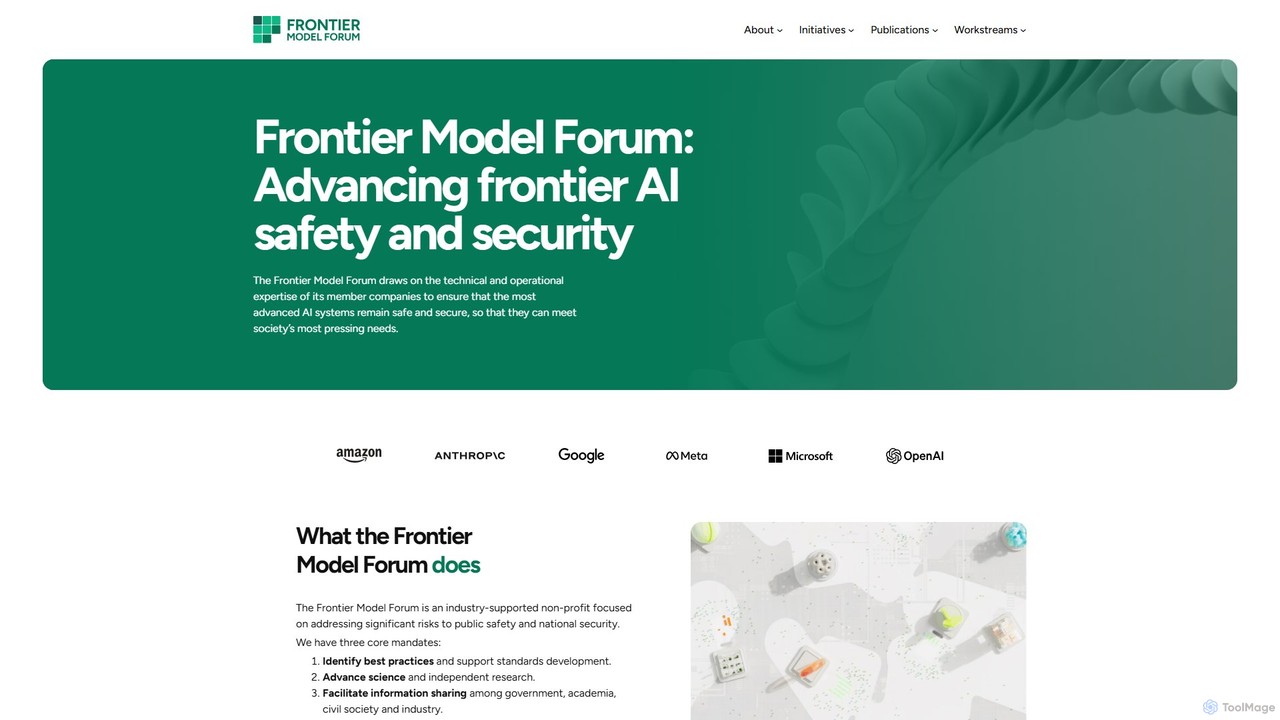
The Frontier Model Forum is an industry-led non-profit organization dedicated to ensuring the safe and responsible development of advanced AI systems. Founded by leading AI companies, it focuses on advancing AI safety research, identifying best practices for security, and facilitating collaboration among industry, government, academia, and civil society to mitigate risks and harness AI's benefits for humanity.
About Governance
AI Governance tools are a class of platforms designed to manage, monitor, and ensure the responsible deployment of artificial intelligence systems. They provide frameworks for risk management, compliance auditing, model lifecycle tracking, and ethical oversight. These tools are crucial for organizations to maintain transparency, accountability, and adherence to regulations like GDPR or the AI Act. By centralizing AI asset management and policy enforcement, they help mitigate operational risks and build trust in AI applications.
Core Features
- Model Lifecycle Management: Tracks models from development and validation to deployment and retirement.
- Risk & Compliance Monitoring: Automates checks against internal policies and external regulations to ensure adherence.
- AI Ethics & Fairness Auditing: Assesses models for bias, transparency, and explainability to uphold ethical standards.
- Centralized Model Inventory: Provides a single source of truth for all AI assets, including metadata and documentation.
- Performance & Drift Tracking: Monitors model accuracy and detects performance degradation or data drift over time.
Applicable Scenarios
These tools are primarily used in highly regulated industries like finance, healthcare, and insurance, as well as large enterprises deploying multiple AI models. Data science leaders, compliance officers, IT administrators, and risk managers use them to establish a centralized system of record and control for all AI activities, ensuring alignment with business objectives and regulatory requirements.
Selection Criteria
When selecting an AI Governance tool, consider its integration capabilities with your existing MLOps stack and data sources. Evaluate the breadth of supported regulations and frameworks, the granularity of its access control features, and its ability to provide clear, actionable reports for both technical and business stakeholders. The quality of its model monitoring and explainability features is also a key factor.
GovernanceUse Cases
Automating AI Compliance for Financial Services
A compliance officer at a bank uses an AI Governance platform to monitor credit scoring models. The tool automatically generates reports demonstrating fairness and lack of bias, ensuring compliance with regulations like the Equal Credit Opportunity Act. It tracks every model version, input data, and prediction, creating an auditable trail for regulators. This process reduces manual reporting efforts by over 70% and minimizes the risk of regulatory fines.
Centralized AI Model Risk Management
An AI/ML team lead in a large corporation manages a portfolio of over 100 models. The governance tool provides a central inventory, tracking each model's performance, owner, and associated risks. When a model's performance drifts below a set threshold, the system sends an automated alert, allowing the team to proactively retrain or retire it. This prevents potential business losses from inaccurate predictions and provides executives with a clear view of the overall AI risk posture.
Auditing Medical AI for Fairness and Bias
A hospital's data science team deploys an AI model for patient diagnosis. Using a governance tool, they conduct regular fairness audits to ensure the model performs equally across different demographic groups (e.g., age, gender, ethnicity). The tool's explainability features help doctors understand the model's reasoning for a specific diagnosis, building trust and ensuring ethical patient care. The audit logs are stored automatically, simplifying compliance with healthcare regulations like HIPAA.
Implementing Role-Based Access Control for AI Assets
A tech company develops proprietary AI models. The IT administrator uses a governance platform to set up granular, role-based access controls. Data scientists can only access training data and development environments, while MLOps engineers can deploy models to production, and business analysts can only view performance dashboards. This prevents unauthorized access to sensitive models and data, enhancing overall security and protecting intellectual property.
Streamlining the AI Model Validation Process
A data science manager implements a standardized workflow for model validation using a governance tool. Before deployment, every new model must pass a series of automated checks for performance, security, and fairness. The results are documented in a central repository, and key stakeholders are automatically notified for approval via the platform. This streamlines the path from development to production, reducing validation time from weeks to days and ensuring all models meet a consistent quality bar.
Proactive Monitoring of Production AI Models
An e-commerce company relies on an AI recommendation engine. The MLOps team uses a governance tool to continuously monitor the model for data drift and concept drift. The platform visualizes key performance metrics in real-time. When it detects that user behavior has changed and the model's recommendations are becoming less accurate, it triggers an automated retraining pipeline to adapt the model to new data, ensuring the recommendation quality remains high and maximizing sales opportunities.