Government Best in category 1 results Policy Simulation AI Tool

Popular AI tools in the Policy Simulation field of Government include CulturePulse, etc., helping you quickly improve efficiency.

CulturePulse

CulturePulse

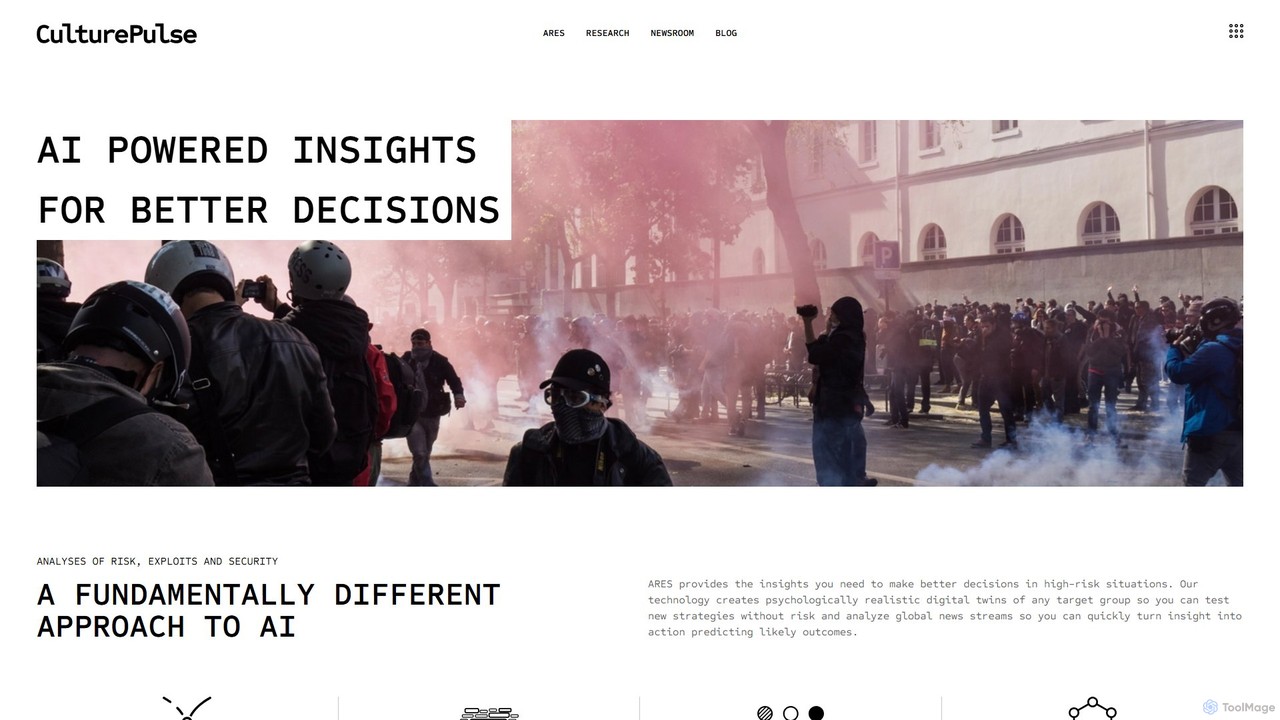
CulturePulse is an advanced AI platform that provides deep insights for high-stakes decision-making. It creates psychologically realistic digital …

4.2K

About Policy Simulation

Policy Simulation tools are a specialized class of AI software used to model, forecast, and analyze the potential impacts of governmental policies before they are implemented. These platforms leverage techniques like agent-based modeling (ABM), system dynamics, and machine learning to create dynamic digital twins of economies, cities, or social systems. By running 'what-if' scenarios, they enable decision-makers to understand complex cause-and-effect relationships, anticipate unintended consequences, and select the most effective policy options based on data-driven evidence. This proactive approach significantly reduces the risks and costs associated with real-world policy experimentation.

Core Features

  • Scenario Modeling: Allows users to define and compare multiple policy alternatives, adjusting variables like tax rates, funding levels, or regulations.
  • Impact Assessment: Quantifies the projected outcomes of a policy on key metrics such as GDP, employment, public health, or environmental quality.
  • Agent-Based Modeling (ABM): Simulates the behavior of individual agents (e.g., citizens, firms) and their interactions to predict emergent, system-level patterns.
  • Data Integration & Synthesis: Combines diverse datasets, including census data, economic indicators, and geographic information, to build a comprehensive model.
  • Result Visualization: Presents complex simulation outputs through intuitive dashboards, heat maps, and charts for clear communication with stakeholders.

Use Cases

Policy Simulation tools are primarily used by government agencies, public policy research institutes, think tanks, and academic institutions. They are applied in fields like urban planning to assess new infrastructure projects, in economic policy to model tax reforms, in public health to simulate disease spread and intervention strategies, and in environmental management to evaluate climate policies.

How to Choose

When selecting a Policy Simulation tool, consider the modeling methodology (e.g., agent-based vs. system dynamics), its data integration capabilities with your existing sources, and the scalability to handle simulations from a local to a national level. Also, evaluate the quality of its visualization features for stakeholder communication and the level of technical expertise required to operate the software effectively.

Policy SimulationUse Cases

1

Evaluating a New Public Transit Line's Impact

An urban planning department needs to decide on the optimal route for a new light rail system. Using a policy simulation tool, planners input geographic data, population density, employment centers, and current traffic patterns. They then model several potential routes, simulating the long-term effects of each. The tool predicts changes in traffic congestion, estimates the reduction in carbon emissions, forecasts the impact on property values near stations, and analyzes how the new line improves access to jobs for residents in underserved communities. The visualized results allow policymakers to present a data-backed proposal to the city council, justifying their chosen route based on maximized economic, social, and environmental benefits.

2

Modeling the Economic Effects of a Carbon Tax

An environmental protection agency is tasked with proposing a carbon tax to meet national emissions targets. Analysts use a policy simulation tool to model the economy. They input data on industry sectors, energy consumption, and household spending patterns. The simulation tests different tax levels and revenue recycling schemes (e.g., lump-sum rebates to citizens or investments in green technology). The model outputs projections on GDP growth, inflation, sector-specific job losses or gains, and the overall reduction in emissions. This allows the agency to identify a tax structure that balances environmental goals with economic stability, providing a robust, evidence-based recommendation to lawmakers.

3

Simulating Pandemic Response Strategies

A public health ministry needs to prepare for future pandemics. Researchers use an agent-based policy simulation tool to model a city's population. Each agent represents a person with attributes like age, occupation, and household size. The model simulates the spread of a novel virus under different policy scenarios: targeted lockdowns, school closures, mask mandates, and various vaccination rollout speeds. The simulation tracks infection rates, hospital capacity, economic disruption, and impacts on different demographic groups. The results help officials develop a nuanced, multi-layered response plan that can be adapted in real-time during a crisis, minimizing both health and economic damage.

4

Analyzing Fiscal Impact of Tax Reform

A national treasury department is considering a major income tax reform. Using a microsimulation policy tool, analysts create a model representing every household in the country based on anonymized census and tax data. They simulate the effects of changing tax brackets, deductions, and credits. The tool calculates the direct impact on the disposable income of different income groups, from the lowest to the highest earners. It also forecasts the overall change in government tax revenue and predicts potential behavioral responses, such as changes in labor supply or investment. This detailed analysis ensures the proposed reform is equitable and fiscally sustainable before being presented to parliament.

5

Forecasting Water Demand for Urban Development

A regional water authority needs to plan for future water infrastructure investments amidst population growth and climate change. They use a system dynamics simulation tool to model the entire water supply system. The model includes factors like population growth projections, per-capita consumption trends, industrial water use, agricultural needs, and climate models predicting rainfall and drought frequency. Planners can test policies such as water conservation campaigns, pricing changes, or building new reservoirs. The simulation forecasts water demand and supply balance over a 30-year horizon, identifying potential future shortages and allowing the authority to prioritize the most cost-effective and resilient infrastructure projects.

6

Assessing Changes to Education Funding Models

A ministry of education wants to implement a more equitable school funding formula. A policy research institute uses a simulation tool to model the entire K-12 education system. The model includes data on student demographics, school resources, teacher qualifications, and historical academic performance. Researchers simulate various funding models, such as weighting funds based on student poverty levels or special needs. The tool projects the impact of each model on resource allocation across different school districts, predicts potential changes in student-teacher ratios, and forecasts long-term effects on graduation rates and standardized test scores. This enables policymakers to design a funding system that effectively targets resources to students who need them most.

Policy SimulationFrequently Asked Questions