mojju
Mojju is a platform offering a curated collection of over 100 unique and powerful custom GPTs. Developed by …
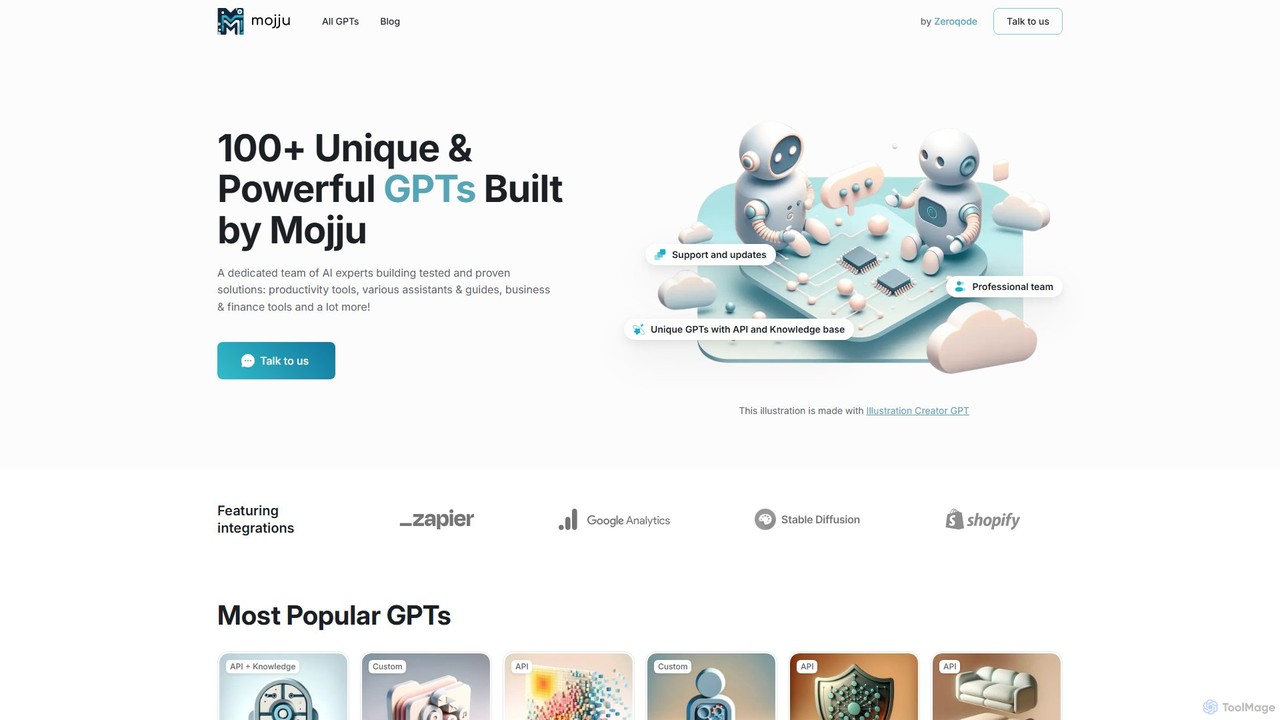
Mojju is a platform offering a curated collection of over 100 unique and powerful custom GPTs. Developed by AI experts at Zeroqode, these tools cater to a wide range of needs, including productivity, business operations, design, software development, learning, and lifestyle. Many GPTs feature API integrations and knowledge bases, providing tested and proven solutions for both personal and professional tasks.
About Gpts
GPTs are custom versions of large language models, designed to perform specific tasks or operate within a defined knowledge domain. They are built upon foundational models like ChatGPT but are tailored with custom instructions, expanded knowledge from uploaded files, and specific skills or actions. This allows users to create specialized AI assistants for personal productivity, professional workflows, or entertainment without needing to write code. The primary value of GPTs lies in their ability to transform a general-purpose AI into a focused, expert tool for a particular purpose.
Core Features
- Custom Instructions: Define the GPT's personality, role, and response guidelines to ensure consistent and context-aware interactions.
- Knowledge Base Integration: Augment the model's knowledge by uploading documents, spreadsheets, or other text-based files.
- Action Capabilities: Connect to external services via APIs, enabling the GPT to perform real-world tasks like booking appointments or searching databases.
- Multi-modal Skills: Leverage built-in capabilities such as web browsing for real-time information, DALL-E for image generation, and data analysis for interpreting files.
- Shareability and Discovery: Share custom GPTs via a direct link or publish them to a public marketplace for others to use.
Use Cases
GPTs are used across various fields. In business, they function as internal knowledge bases, answering employee questions about company policies. Content creators use them as specialized writing assistants trained on their unique style. Educators build them as personalized tutors for students, while developers use them to automate coding tasks and explain complex codebases.
How to Choose
When selecting a public GPT, consider its specific purpose and whether it aligns with your task. Evaluate the reliability of its knowledge base and the capabilities it offers (e.g., web browsing, data analysis). For popular GPTs, check user ratings and reviews. If creating your own, focus on providing clear, detailed instructions and high-quality, relevant knowledge files to ensure optimal performance.
GptsUse Cases
Create an Internal HR Policy Assistant
An HR manager at a mid-sized company needs to reduce the time their team spends answering repetitive employee questions about vacation policies, benefits, and expense reporting. They create a custom GPT and upload all relevant policy documents, employee handbooks, and internal FAQs as its knowledge base. The GPT is instructed to act as a friendly and accurate HR assistant. Now, employees can ask the GPT questions directly, receiving instant, consistent answers 24/7. This frees up the HR team to focus on more strategic tasks like recruitment and employee development.
Develop a Personalized Learning Tutor
A university student studying quantum mechanics finds the standard textbook dense and difficult to understand. They create a custom GPT named 'Quantum Companion'. They upload their lecture notes, supplementary academic papers, and instruct the GPT to explain complex concepts using analogies from popular science fiction. When the student asks, 'Explain quantum entanglement like you're talking about characters in a TV show,' the GPT provides a creative, easy-to-understand explanation. This personalized learning tool helps the student grasp difficult topics faster and makes studying more engaging.
Automate Social Media Content Generation
A marketing team for a sustainable fashion brand needs to consistently create engaging posts for Instagram and Twitter. They build a 'Brand Voice GPT' trained on their past successful marketing campaigns, brand guidelines document, and product descriptions. They instruct it to generate three post variations for each new product launch: one witty, one informative, and one focused on sustainability. By simply inputting a product name and key features, the team receives ready-to-publish content that perfectly matches their brand's tone, saving hours of brainstorming and writing each week.
Streamline Code Review and Documentation
A software developer is working on a large, complex codebase with a distributed team. To ensure consistency and quality, she creates a 'Codebase Expert GPT'. She uploads the project's coding style guide, architectural design documents, and API documentation. When a team member submits new code, they can ask the GPT: 'Review this Python function for compliance with our style guide and check for potential null pointer exceptions.' The GPT provides instant feedback, identifies deviations from best practices, and can even generate documentation strings for new functions, significantly speeding up the review cycle.
Act as a Creative Brainstorming Partner
A novelist is experiencing writer's block while outlining a new fantasy novel. They create a 'Story Weaver GPT' and provide it with the existing plot summary, character profiles, and world-building notes. They instruct the GPT to act as a creative collaborator. The writer can then have a conversation with the GPT, asking questions like, 'Suggest three unexpected plot twists involving the antagonist' or 'Brainstorm five unique magical artifacts for this world.' The GPT generates diverse and creative ideas, helping the writer overcome their block and add depth and complexity to their story.
Generate Meeting Summaries and Action Items
A project manager regularly leads long meetings with multiple stakeholders. To ensure everyone is aligned, she creates a 'Meeting Maven GPT'. After each meeting, she uploads the raw transcript file. The GPT is instructed to: 1) Generate a concise summary of the key discussion points. 2) Identify and list all decisions made. 3) Extract all action items, assigning each to the correct person. This process, which used to take 30 minutes of manual work, is now completed in under a minute. The standardized, accurate summaries are sent out promptly, improving team accountability and project momentum.