TTcare
TTcare is an AI-powered pet health screening solution that allows pet owners and veterinarians to detect early signs …
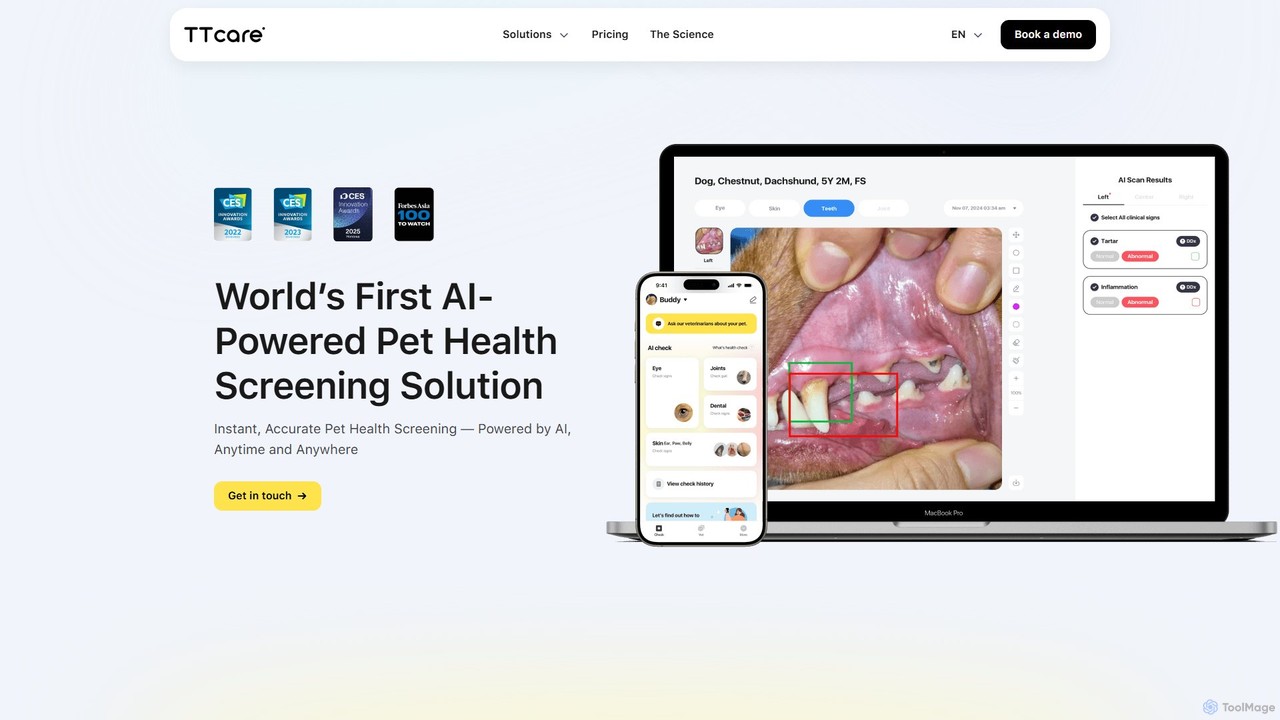
TTcare is an AI-powered pet health screening solution that allows pet owners and veterinarians to detect early signs of health issues in pets. By analyzing a simple photo of a pet's eyes, skin, or teeth, or a video of a horse's gait, TTcare provides instant, accurate health insights and personalized recommendations with 95% accuracy.
About Veterinary Medicine
Veterinary Medicine AI tools are advanced solutions that leverage artificial intelligence to enhance animal healthcare. These tools utilize machine learning, computer vision, and data analytics to assist veterinarians and animal care professionals. They significantly improve diagnostic accuracy, streamline treatment planning, and optimize various aspects of animal health management, contributing to better outcomes for pets and livestock.
Core Features
- AI-Powered Diagnostics: Analyzes medical images (X-rays, ultrasounds, CT scans) and lab results to detect diseases, anomalies, or conditions with high accuracy, aiding veterinarians in faster and more precise diagnoses.
- Predictive Health Analytics: Uses historical data and real-time monitoring to predict disease outbreaks, identify at-risk animals, and forecast health trends in populations, enabling proactive intervention.
- Personalized Treatment Planning: Recommends tailored treatment protocols, drug dosages, and surgical approaches based on individual animal data, species, breed, and medical history.
- Smart Monitoring Systems: Integrates with wearable sensors and environmental monitors to track vital signs, behavior patterns, and environmental factors, alerting professionals to potential health issues.
- Drug Discovery & Development: Accelerates the research and development of new veterinary pharmaceuticals by simulating drug interactions and predicting efficacy and safety profiles.
Use Cases
These tools are invaluable for veterinary clinics, animal hospitals, livestock farms, and research institutions. They are used to enhance diagnostic capabilities, manage large animal populations more effectively, and support the development of new treatments. For instance, a veterinary radiologist might use AI to quickly identify subtle fractures on an X-ray, or a farm manager could employ AI to monitor the health of an entire herd, preventing widespread illness.
How to Choose
When selecting Veterinary Medicine AI tools, consider the specific clinical or operational needs, such as diagnostic imaging support, herd health management, or research acceleration. Evaluate the tool's integration capabilities with existing veterinary software, data privacy and security protocols, and the accuracy and validation of its AI models. User-friendliness, ongoing support, and scalability for future growth are also crucial factors.
Veterinary MedicineUse Cases
Automated X-ray and Ultrasound Analysis
Veterinary radiologists and general practitioners can utilize AI tools to automatically analyze diagnostic images like X-rays and ultrasounds. The AI identifies potential abnormalities, fractures, tumors, or organ changes, highlighting areas of concern for the veterinarian. This significantly reduces interpretation time, improves diagnostic consistency, and helps detect subtle conditions that might be missed by the human eye, leading to earlier and more accurate diagnoses for pets.
Predictive Disease Outbreak Management in Livestock
Large-scale livestock operations, such as dairy or poultry farms, employ AI systems to monitor animal behavior, feed intake, and environmental conditions. By analyzing these data points, the AI can predict the onset of diseases or potential outbreaks within the herd or flock. This allows farm managers and veterinary teams to implement preventative measures, isolate affected animals, and administer early treatments, minimizing economic losses and ensuring animal welfare.
Personalized Drug Dosage Calculation for Animals
Veterinarians can use AI-powered platforms to calculate precise drug dosages for various animal species, breeds, and individual patient conditions. These tools consider factors like weight, age, kidney/liver function, and potential drug interactions, providing highly accurate recommendations. This minimizes the risk of under-dosing or over-dosing, ensuring optimal therapeutic effects and patient safety, especially for exotic animals or those with complex health issues.
Real-time Health Monitoring for Companion Animals
Pet owners and veterinary clinics can deploy smart collars or embedded sensors that continuously monitor a pet's vital signs, activity levels, sleep patterns, and even subtle behavioral changes. AI algorithms analyze this data in real-time, detecting deviations from baseline health. Alerts are sent to owners or vets for potential issues like arrhythmias, sudden lethargy, or unusual scratching, enabling prompt veterinary attention and preventative care.
Accelerated Veterinary Drug Discovery
Pharmaceutical researchers in the animal health sector leverage AI to accelerate the discovery and development of new veterinary drugs. AI models can screen vast libraries of compounds, predict their efficacy against specific animal diseases, and simulate potential side effects. This significantly reduces the time and cost associated with traditional drug development, bringing innovative treatments for animal illnesses to market faster.
Optimizing Surgical Planning and Outcome Prediction
Specialized veterinary surgeons can utilize AI tools for pre-surgical planning, particularly for complex orthopedic or neurological procedures. AI analyzes 3D imaging data to create detailed anatomical models, simulate surgical approaches, and predict potential outcomes or complications. This enhances precision during surgery, reduces risks, and helps veterinarians communicate more effectively with pet owners about expected recovery and prognosis.