memrizz
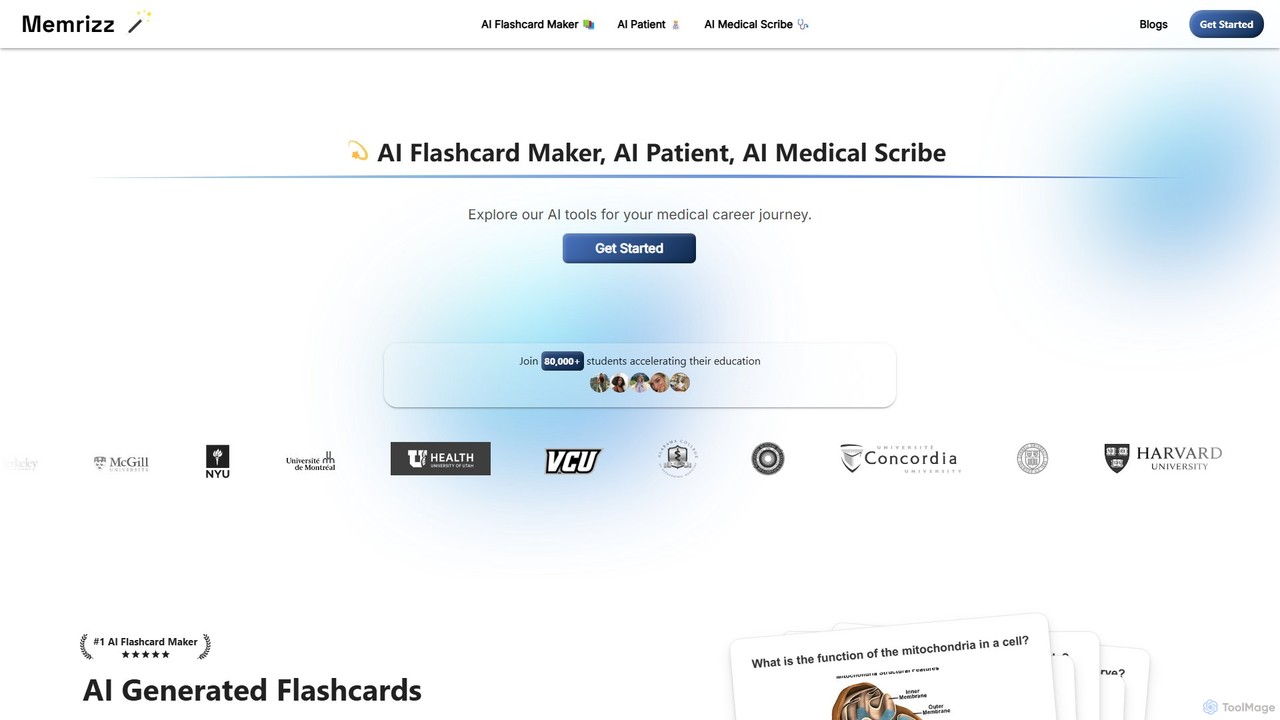
Memrizz is an AI-powered suite for medical students, featuring an AI Flashcard Maker, an AI Patient Simulator, and …
Memrizz is an AI-powered suite for medical students, featuring an AI Flashcard Maker, an AI Patient Simulator, and an AI Medical Scribe. It automates study material creation from lectures, offers realistic clinical practice with virtual patients, and helps master documentation skills, accelerating the medical learning journey.
About Clinical Training
Clinical Training AI tools are advanced platforms leveraging artificial intelligence to create immersive and effective learning environments for healthcare professionals and students. These tools utilize technologies such as virtual reality (VR), augmented reality (AR), and machine learning (ML) to simulate real-world medical scenarios, offering hands-on practice without patient risk. They provide personalized feedback, track performance, and adapt to individual learning paces, significantly enhancing skill acquisition and decision-making capabilities within the broader healthcare sector.
Core Features
- Realistic Simulations: Offers highly detailed virtual environments for practicing surgical procedures, diagnostic examinations, and patient interactions.
- Personalized Feedback: AI algorithms analyze trainee performance, providing immediate, constructive, and tailored guidance for improvement.
- Scenario Customization: Allows educators to create and modify diverse clinical cases, from common conditions to rare emergencies, to meet specific learning objectives.
- Performance Analytics: Tracks and visualizes trainee progress over time, identifying strengths and areas requiring further development.
- Interactive Virtual Patients: Utilizes natural language processing (NLP) to enable realistic communication practice with AI-driven patient avatars.
Applicable Scenarios
These tools are invaluable for medical schools, residency programs, and continuing medical education. They enable students to practice complex surgical techniques repeatedly, allow nurses to refine emergency response protocols in a safe environment, and help experienced physicians stay current with new procedures and diagnostic criteria through realistic, interactive case studies.
How to Choose
When selecting an AI clinical training tool, consider the realism and fidelity of its simulations, the depth and personalization of its feedback mechanisms, and the breadth of its scenario customization options. Evaluate its integration capabilities with existing learning management systems and ensure it aligns with specific curriculum goals and regulatory standards. User-friendliness and technical support are also crucial for effective adoption.
Clinical TrainingUse Cases
Surgical Skill Development in Virtual Reality
Medical residents and surgical trainees can utilize AI-powered VR platforms to repeatedly practice intricate surgical procedures, from laparoscopic appendectomies to complex neurosurgeries. The AI provides real-time haptic feedback and performance metrics, identifying errors in technique, instrument handling, and decision-making, allowing for mastery of skills in a risk-free, controlled environment before operating on actual patients.
Enhancing Diagnostic Acuity with AI Case Studies
Medical students and junior doctors can engage with AI-driven interactive case studies that present patient histories, symptoms, and lab results. The AI guides them through the diagnostic process, prompting critical thinking, evaluating their differential diagnoses, and providing evidence-based explanations for correct and incorrect conclusions. This sharpens their ability to interpret data and arrive at accurate diagnoses efficiently.
Emergency Response and Crisis Management Drills
Healthcare teams, including doctors, nurses, and paramedics, can participate in high-fidelity AI simulations of medical emergencies like cardiac arrest, sepsis, or mass casualty incidents. The AI dynamically adjusts patient vitals and scenario progression based on team actions, allowing for practice in communication, teamwork, and rapid decision-making under pressure, improving readiness for real-life crises.
Practicing Empathetic Patient Communication
Healthcare professionals can refine their communication skills by interacting with AI-powered virtual patients that exhibit diverse personalities, emotional states, and medical conditions. The AI uses natural language processing to understand responses and provides feedback on empathy, clarity, and effectiveness of communication, crucial for building rapport and delivering patient-centered care.
Pharmacology and Drug Interaction Training
Pharmacy students and clinicians can use AI tools to simulate drug administration scenarios, including dosage calculations, potential drug interactions, and adverse effects. The AI presents complex patient profiles and evaluates the safety and efficacy of proposed treatment plans, helping to prevent medication errors and ensure optimal patient outcomes through practical application of pharmacological knowledge.
Interprofessional Team Collaboration Simulation
Different healthcare disciplines (e.g., doctors, nurses, therapists) can train together in AI-simulated environments to improve interprofessional collaboration. These simulations focus on shared decision-making, handover protocols, and conflict resolution in complex patient care scenarios, fostering a cohesive team approach essential for patient safety and quality of care.