RapidAI
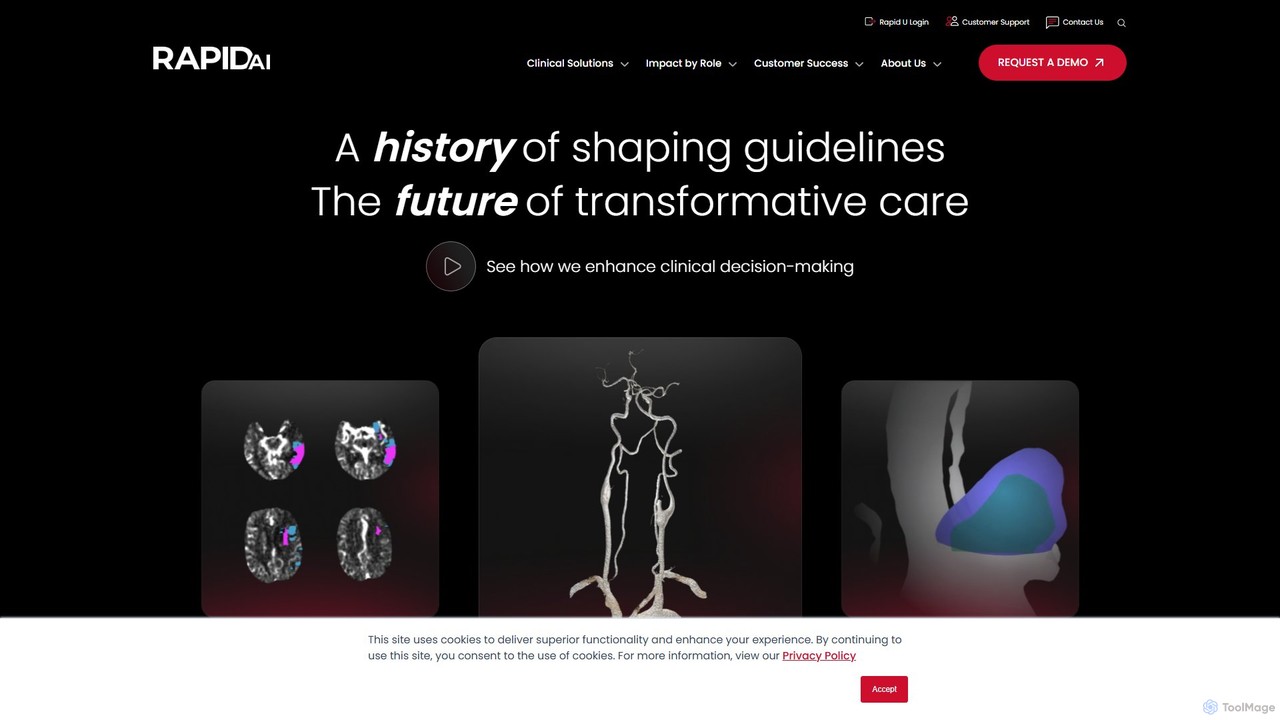
RapidAI is a leading clinical AI platform that enhances medical imaging analysis for life-threatening conditions like stroke and …
RapidAI is a leading clinical AI platform that enhances medical imaging analysis for life-threatening conditions like stroke and aneurysm. It provides healthcare professionals with real-time, actionable insights to accelerate diagnosis, inform treatment decisions, and improve patient outcomes. The platform is backed by extensive clinical validation and multiple FDA clearances.
Rayscape
An AI-powered radiology platform designed to assist medical professionals in analyzing chest X-rays (CXR) and lung CT scans. …
An AI-powered radiology platform designed to assist medical professionals in analyzing chest X-rays (CXR) and lung CT scans. It enhances diagnostic accuracy and efficiency by automatically detecting up to 148 pathologies, including lung nodules and tuberculosis, and seamlessly integrating into existing clinical workflows.

audeering
audeering is a leading Voice AI technology platform that enables machines to understand human emotion and expression through …
audeering is a leading Voice AI technology platform that enables machines to understand human emotion and expression through advanced voice analysis. By detecting over 7,000 acoustic parameters, it provides deep insights for applications in automotive, healthcare, robotics, market research, and gaming, fostering a new era of empathetic human-machine interaction.
About Diagnostics
AI Diagnostics tools are a specialized category within healthcare AI, leveraging artificial intelligence to analyze medical data for the identification, classification, and prediction of diseases. These tools employ advanced machine learning algorithms, including deep learning for image recognition and natural language processing for clinical notes, to assist medical professionals in making more accurate and timely diagnostic decisions. Their primary value lies in enhancing diagnostic precision, enabling earlier disease detection, and supporting personalized treatment strategies, ultimately improving patient outcomes and operational efficiency in healthcare.
Core Features
- Advanced Image Analysis: Utilizes deep learning to detect subtle anomalies in medical images like X-rays, CT, MRI, and pathology slides, often surpassing human visual capabilities.
- Predictive Modeling: Analyzes patient data (genomic, EHR, lifestyle) to assess disease risk, predict progression, and forecast treatment responses.
- Early Disease Detection: Identifies early indicators of conditions such as cancer, neurological disorders, or cardiovascular diseases, facilitating timely intervention.
- Data Integration & Interpretation: Aggregates and interprets complex data from various sources, providing comprehensive diagnostic insights and supporting clinical decision-making.
- Automated Reporting: Generates structured reports based on AI analysis, streamlining documentation and reducing administrative burden for clinicians.
Applicable Scenarios
AI Diagnostics tools are indispensable for radiologists, pathologists, oncologists, and general practitioners. They are used in scenarios requiring high-volume data analysis, such as large-scale screening programs for breast cancer or diabetic retinopathy, and in complex cases where subtle patterns are difficult for humans to discern. These tools also support remote diagnostics, enabling specialists to analyze data from distant locations, expanding access to expert medical opinions.
How to Choose
When selecting an AI Diagnostics tool, prioritize accuracy and validation through rigorous clinical trials, ensuring regulatory compliance (e.g., FDA, CE Mark). Consider its integration capabilities with existing hospital information systems (HIS) and electronic health records (EHR), and evaluate the interpretability of its AI models. Data privacy and security features are paramount, alongside the tool's scalability to handle varying patient loads and its ability to adapt to new data types or disease patterns.
DiagnosticsUse Cases
Early Cancer Detection in Radiology
Radiologists utilize AI Diagnostics tools to enhance the detection of early-stage cancers in medical imaging. For instance, an AI system can analyze mammograms or lung CT scans, highlighting suspicious nodules or microcalcifications that might be missed by the human eye, thereby improving screening accuracy and enabling earlier intervention for patients.
Automated Analysis of Pathology Slides
Pathologists employ AI to rapidly and accurately analyze vast numbers of tissue samples. The AI tool can identify and quantify cancer cells, grade tumor aggressiveness, or detect specific biomarkers on whole-slide images, significantly reducing manual review time and ensuring consistent diagnostic quality across different cases.
Predictive Risk Assessment for Cardiovascular Disease
Clinicians leverage AI Diagnostics to assess a patient's long-term risk of cardiovascular events. By analyzing a combination of genetic data, electronic health records (EHR), lifestyle factors, and lab results, the AI can identify high-risk individuals, allowing for proactive lifestyle interventions or preventative treatments before symptoms manifest.
Neurological Disorder Identification from Brain Scans
Neurologists use AI to detect subtle changes in brain MRI or CT scans indicative of conditions like Alzheimer's disease, Parkinson's, or multiple sclerosis. The AI can quantify atrophy, lesion load, or structural abnormalities with high precision, aiding in early diagnosis and monitoring disease progression more objectively than traditional methods.
Personalized Treatment Response Prediction
Oncologists integrate AI Diagnostics to predict how individual cancer patients will respond to specific therapies. By analyzing tumor genomics, proteomic profiles, and historical treatment data, the AI can suggest the most effective drug regimens, minimizing trial-and-error and optimizing treatment outcomes for personalized medicine.
Real-time Anomaly Detection in Remote Patient Monitoring
Healthcare providers deploy AI Diagnostics in remote patient monitoring systems. AI algorithms continuously analyze physiological data from wearable sensors (e.g., heart rate, blood pressure, glucose levels), automatically detecting subtle deviations from a patient's baseline that could indicate an impending health crisis, triggering timely alerts for intervention.