Aiviue
Aiviue is an AI hiring copilot designed to automate and accelerate recruitment for frontline teams across various industries. …
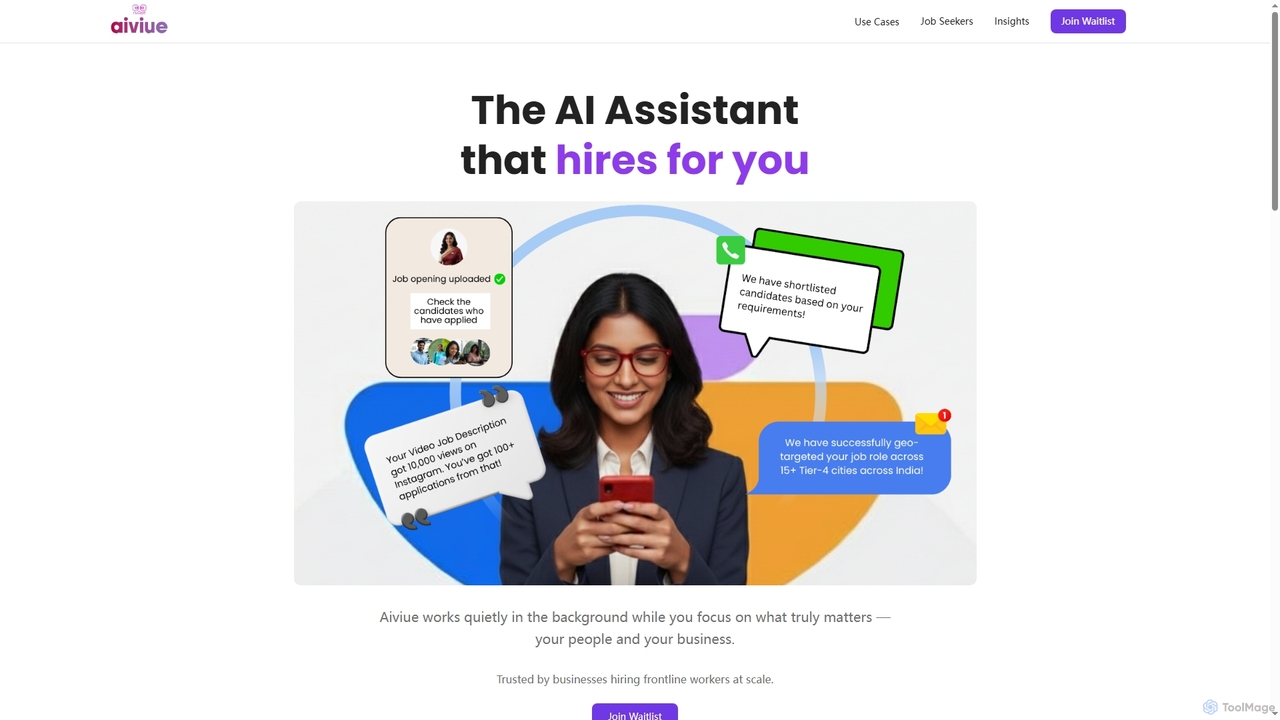
Aiviue is an AI hiring copilot designed to automate and accelerate recruitment for frontline teams across various industries. It instantly screens, engages, and shortlists high-fit candidates using AI-powered conversations, multilingual support, and geo-targeted campaigns, helping businesses hire faster and smarter.
About Logistics & Supply Chain
AI Logistics & Supply Chain tools are specialized platforms that use artificial intelligence to optimize the movement, storage, and management of goods. These tools leverage machine learning, predictive analytics, and computer vision to analyze vast datasets, identify patterns, and automate complex decisions. They are designed to increase efficiency, reduce operational costs, and enhance visibility across the entire supply chain, from procurement to final delivery. By transforming raw data into actionable insights, these AI solutions help businesses build more resilient and responsive logistics networks.
Core Features
- Demand Forecasting: Utilizes historical data and external factors to predict future product demand with high accuracy.
- Route Optimization: Employs algorithms to calculate the most efficient delivery routes in real-time, considering traffic, weather, and vehicle capacity.
- Warehouse Automation: Manages robotic systems for picking, packing, and sorting, and uses AI to optimize storage layout and inventory placement.
- Predictive Maintenance: Analyzes equipment and vehicle data to forecast potential failures, enabling proactive maintenance and reducing downtime.
- Supplier Risk Management: Assesses potential disruptions by monitoring geopolitical, financial, and environmental data related to suppliers.
Use Cases
These tools are essential for logistics managers, e-commerce companies, freight forwarders, and manufacturing firms. For instance, a retail company can use AI to prevent stockouts by accurately forecasting seasonal demand. A third-party logistics (3PL) provider can optimize its entire delivery fleet to reduce fuel consumption and meet tight delivery windows.
How to Choose
When selecting an AI Logistics & Supply Chain tool, consider its integration capabilities with your existing ERP, WMS, or TMS systems. Evaluate the accuracy and transparency of its predictive models. Assess its scalability to handle your operational volume and data complexity. Finally, review the data security protocols and ensure they comply with industry standards.
Logistics & Supply ChainUse Cases
Predictive Demand Forecasting for E-commerce
An e-commerce inventory manager is tasked with maintaining optimal stock levels for thousands of SKUs, facing challenges with seasonal spikes and unpredictable trends. Using an AI-powered demand forecasting tool, they input historical sales data, marketing campaign schedules, and external factors like holidays. The AI analyzes these variables to generate highly accurate sales predictions for the next quarter. This allows the manager to automate purchase orders, preventing costly overstocking of slow-moving items and avoiding stockouts of popular products, ultimately improving cash flow and customer satisfaction.
Dynamic Route Optimization for Delivery Fleets
A logistics coordinator for a regional delivery service manages a fleet of 50 vehicles with hundreds of daily stops. Manually planning routes is time-consuming and inefficient. By implementing an AI route optimization tool, the system automatically ingests all delivery addresses and constraints, such as delivery windows and vehicle capacity. The AI calculates the most efficient multi-stop routes in real-time, adapting to live traffic and weather conditions. This results in a significant reduction in fuel costs, lower carbon emissions, and an increase in on-time delivery rates, enhancing overall operational efficiency.
Automated Inventory Audits in Warehouses
A warehouse manager needs to conduct frequent and accurate inventory counts, a process that is typically manual, labor-intensive, and prone to human error. They deploy an AI system that uses autonomous drones equipped with high-resolution cameras. The drones fly through the warehouse, scanning barcodes and QR codes on pallets and shelves. The AI's computer vision algorithm processes the images, identifies products, counts quantities, and reconciles the data with the Warehouse Management System (WMS) in near real-time. This automates the audit process, providing over 99% accuracy and freeing up staff for more value-added tasks.
Predictive Maintenance for a Trucking Fleet
A fleet manager for a long-haul trucking company struggles with unexpected vehicle breakdowns, leading to delivery delays and expensive repairs. They integrate an AI predictive maintenance platform that connects to sensors on each truck's engine, tires, and brakes. The AI continuously analyzes this sensor data to detect subtle anomalies that precede a component failure. It then alerts the manager about a potential issue, specifying the component and the recommended maintenance window. This shifts their strategy from reactive repairs to proactive maintenance, minimizing unplanned downtime and extending the lifespan of the fleet.
AI-Powered Supplier Risk Assessment
A procurement specialist at a global manufacturing company needs to ensure the stability of their supply chain. They use an AI tool that continuously monitors thousands of data points related to their key suppliers, including financial reports, news articles, social media sentiment, and shipping data. The AI algorithm assesses these factors to generate a dynamic risk score for each supplier, flagging potential disruptions like factory shutdowns, financial instability, or logistical bottlenecks. This enables the specialist to proactively diversify their sourcing or work with at-risk suppliers to mitigate issues before they impact production.
Automated Customs Document Processing
A customs brokerage firm handles thousands of international shipments, each requiring meticulous processing of documents like commercial invoices, packing lists, and bills of lading. This manual data entry is repetitive and susceptible to errors that can cause costly delays at the border. The firm adopts an AI tool with Optical Character Recognition (OCR) and Natural Language Processing (NLP). The system automatically extracts relevant data from scanned documents, validates it against customs regulations, and populates the required declaration forms. This reduces processing time per shipment by over 70% and minimizes compliance risks.