
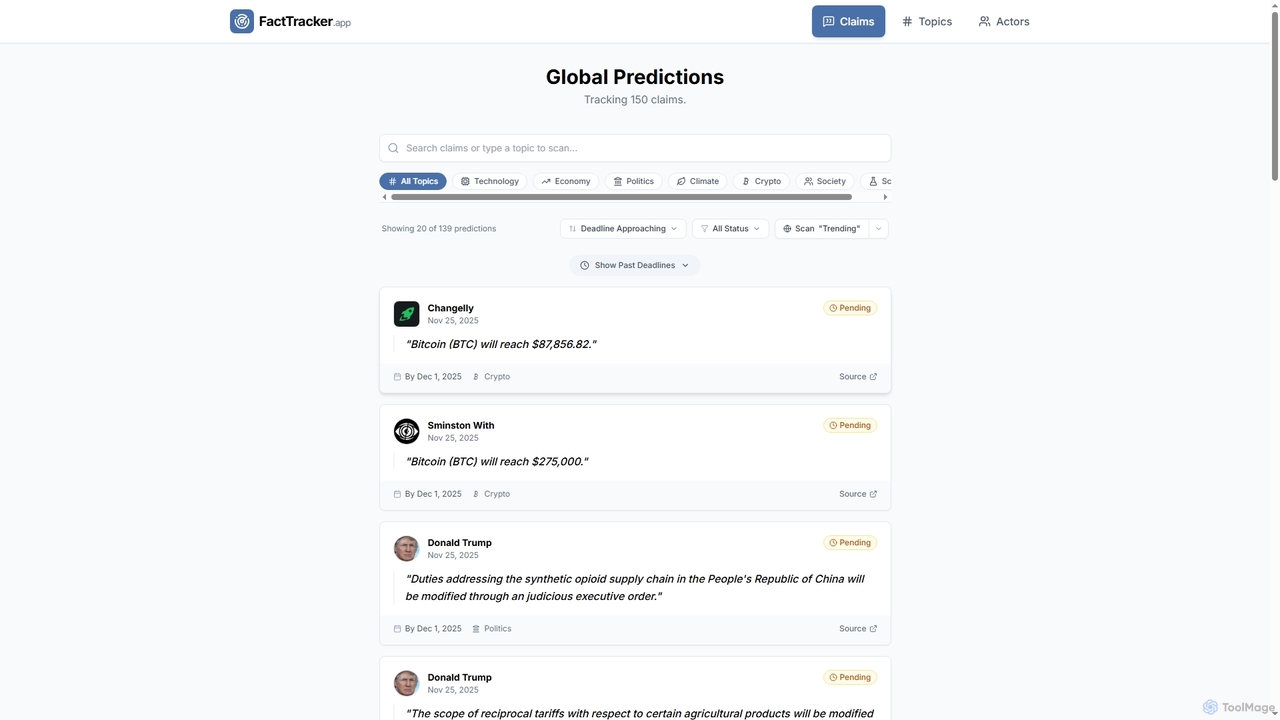
Information Verification Best in category 1 results Prediction Tracking AI Tool

Popular AI tools in the Prediction Tracking field of Information Verification include FactTracker, etc., helping you quickly improve efficiency.

FactTracker

FactTracker

FactTracker is a platform that monitors and evaluates predictions and claims made by various sources across diverse global …

3.2K

About Prediction Tracking

Prediction Tracking tools are AI-powered platforms designed to monitor, analyze, and verify the accuracy of forecasts and predictions over time. These tools leverage machine learning algorithms to compare predicted outcomes against actual results, providing critical insights into the reliability of various forecasting models. They are essential for organizations and individuals seeking to improve decision-making, assess risk, and refine their predictive capabilities within the broader context of information verification.

Core Features

  • Prediction Input & Storage: Securely record diverse predictions, including their source, date, and confidence levels.
  • Outcome Verification: Automatically compare recorded predictions with real-world events and data as they unfold.
  • Accuracy Metrics & Reporting: Generate detailed reports on prediction accuracy, bias, and performance over various timeframes.
  • Model Performance Analysis: Evaluate the effectiveness of different forecasting models or human predictors based on historical accuracy.
  • Alerts & Notifications: Receive automated alerts when predictions are confirmed, disproven, or nearing their verification deadline.

Use Cases

These tools are vital across sectors where future outcomes significantly impact strategy and operations. Financial analysts use them to track market forecasts, assessing the performance of investment models. Supply chain managers apply them to verify demand predictions, optimizing inventory and logistics. Similarly, data scientists leverage prediction tracking to validate and improve their machine learning models' forecasting capabilities.

How to Choose

When selecting a Prediction Tracking tool, prioritize its ability to integrate with your existing data sources and prediction platforms. Evaluate the range of accuracy metrics offered and the flexibility of its reporting features. Consider the scalability for handling large volumes of predictions and the level of automation in outcome verification. User interface and ease of setting up new prediction tracking workflows are also crucial for adoption.

Prediction TrackingUse Cases

1

Assess Accuracy of Financial Market Forecasts

Financial analysts and portfolio managers utilize prediction tracking tools to systematically monitor the accuracy of various market predictions, from stock price movements to economic indicators. By inputting forecasts from different sources and comparing them against actual market data over time, they can identify reliable prediction models, understand biases, and refine investment strategies, leading to more informed and less risky financial decisions.

2

Refine Supply Chain Demand Predictions

Supply chain managers employ these tools to verify the accuracy of their demand forecasts for products and raw materials. By tracking predicted demand versus actual sales and consumption, businesses can pinpoint discrepancies, adjust inventory levels, and optimize production schedules. This leads to reduced waste, improved stock availability, and more efficient logistics operations, directly impacting profitability and customer satisfaction.

3

Validate and Enhance ML Model Predictions

Data scientists and AI developers use prediction tracking to rigorously evaluate the real-world performance of their machine learning models. After deploying a model, they track its predictions (e.g., customer churn, fraud detection scores) against actual outcomes. This continuous feedback loop helps identify model drift, improve feature engineering, and retrain models for higher accuracy and reliability in dynamic environments.

4

Monitor Project Risk and Milestone Accuracy

Project managers and risk analysts leverage prediction tracking to monitor the accuracy of project timelines, budget forecasts, and risk assessments. By recording initial estimates for task completion or potential risks and comparing them with actual project progress, teams can identify areas of consistent over-optimism or underestimation. This enables proactive adjustments, better resource allocation, and more realistic future project planning.

5

Track Public Policy and Economic Forecasts

Government agencies, think tanks, and economists use these tools to verify the accuracy of public policy impact predictions or broader economic forecasts. By systematically tracking predicted outcomes (e.g., unemployment rates, GDP growth after a policy change) against official statistics, they can evaluate the effectiveness of interventions and improve the robustness of future policy modeling and economic analysis.

6

Improve Personal Decision-Making Accuracy

Individuals can apply prediction tracking to personal goals and decisions, such as career path predictions, health outcomes, or even daily task completion estimates. By recording personal forecasts and later verifying them, individuals gain insights into their own biases and predictive abilities. This self-assessment fosters more realistic goal setting, better planning, and continuous improvement in personal decision-making processes.

Prediction TrackingFrequently Asked Questions