Protocol Labs
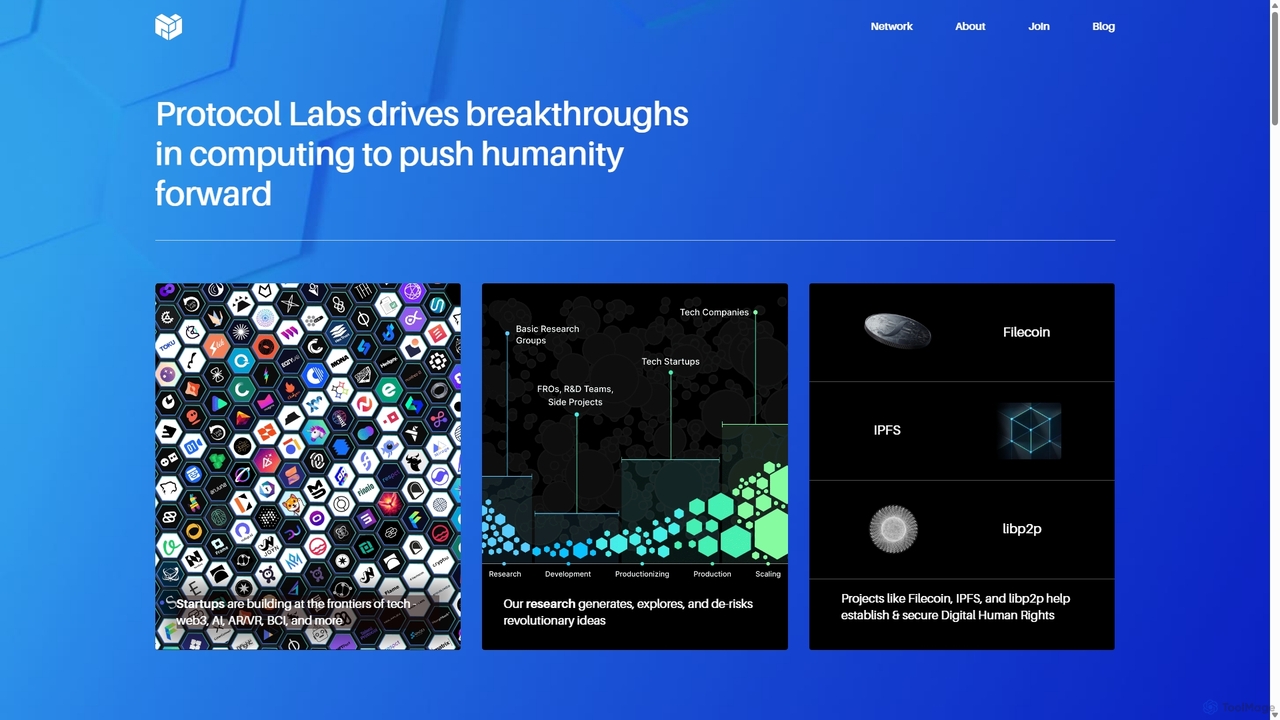
Protocol Labs is a research, development, and deployment lab for network protocols. It drives breakthroughs in computing, focusing …
Protocol Labs is a research, development, and deployment lab for network protocols. It drives breakthroughs in computing, focusing on Web3, AI, and decentralized infrastructure. It's the creator of foundational technologies like IPFS and Filecoin, fostering a global innovation network of over 600 startups and organizations to build a more resilient and open internet.
About Decentralized Networks
Decentralized Networks are a type of infrastructure where control and data are distributed across multiple nodes rather than managed by a single central entity. These networks often leverage blockchain or peer-to-peer (P2P) protocols to ensure transparent, secure, and tamper-proof operations. Their primary value lies in creating censorship-resistant, highly resilient systems that give users true ownership over their data and digital assets. This architecture is foundational for building decentralized applications (dApps), autonomous AI agents, and privacy-preserving data ecosystems.
Core Features
- Distributed Control: No single point of failure or control, enhancing resilience and preventing censorship by a central authority.
- Data Sovereignty: Users retain ownership and control over their personal data, deciding how it is shared and used.
- Trustless Operation: Interactions are governed by code (e.g., smart contracts) and consensus algorithms, removing the need for trusted intermediaries.
- Transparency and Immutability: Transactions and data recorded on the network are often publicly verifiable and cannot be altered once confirmed.
- Permissionless Access: Anyone can typically participate in the network, use its services, or build applications on top of it without requiring approval.
Use Cases
Decentralized Networks are ideal for developers and organizations building Web3 applications, decentralized finance (DeFi) platforms, and systems requiring high levels of security and user autonomy. They are used to create censorship-resistant social media, secure digital identity solutions, and transparent supply chain management systems. AI researchers also use them for federated learning and creating decentralized data marketplaces.
How to Choose
When selecting a Decentralized Network, consider its consensus mechanism (e.g., Proof-of-Work vs. Proof-of-Stake) and its impact on speed and energy consumption. Evaluate its scalability, measured by transactions per second (TPS), and transaction costs (gas fees). Also, assess the strength of its developer community, available documentation, and compatibility with existing programming languages and tools.

Decentralized NetworksUse Cases
Building Censorship-Resistant dApps
A team of developers aims to create a social media platform that cannot be controlled or censored by any single government or corporation. They use a decentralized network as the backend infrastructure. User profiles, posts, and interactions are stored across a distributed network of nodes, not on a central server. Smart contracts are used to enforce content moderation rules in a transparent, community-governed manner. The result is a platform where free speech is protected, and users have full control over their accounts and data, immune to arbitrary takedowns or manipulation.
Decentralized AI Model Training and Inference
An AI research collective wants to train a powerful model but lacks the centralized computational resources. They utilize a decentralized network that connects computing power from participants worldwide. The model training process is broken down into smaller tasks and distributed across the network. Participants are rewarded with cryptocurrency for contributing their GPU cycles. This approach not only makes large-scale AI training more accessible but also ensures that the resulting AI model is not owned or controlled by a single entity, promoting a more open and collaborative AI ecosystem.
Creating a Secure Digital Identity System
An organization wants to provide users with a self-sovereign identity (SSI) solution. Instead of storing user data in a central database vulnerable to hacks, they build the system on a decentralized network. Each user is issued a decentralized identifier (DID) that they control with their private keys. They can selectively share verifiable credentials (like a driver's license or university degree) with third parties without revealing unnecessary personal information. This empowers users with full control over their digital identity, enhances privacy, and reduces the risk of large-scale data breaches.
Establishing a Transparent Supply Chain
A fair-trade coffee company wants to provide consumers with full transparency about their product's journey from farm to cup. They implement a supply chain tracking system on a decentralized network. Each step of the process—harvesting, processing, shipping, and roasting—is recorded as an immutable transaction on the blockchain. Consumers can scan a QR code on the packaging to view the entire history of their coffee beans, verifying its origin and ethical sourcing. This builds consumer trust and provides a verifiable record that is resistant to fraud or manipulation by any single party in the supply chain.
Running Autonomous AI Agents
A developer creates an autonomous AI agent designed to perform tasks like monitoring DeFi markets and executing trades based on predefined strategies. To ensure the agent runs continuously and cannot be shut down by a single entity (like a cloud service provider), it is deployed on a decentralized compute network. The agent's code and state are managed by smart contracts, and its operational costs are paid for using the network's native token. This setup guarantees high uptime and operational sovereignty, allowing the agent to function truly autonomously without reliance on centralized infrastructure.
Creating a Decentralized Data Marketplace
A consortium of healthcare institutions wants to create a marketplace for medical data to accelerate AI research while preserving patient privacy. They build this marketplace on a decentralized network. Data providers can list anonymized datasets for sale or for specific research use. AI developers can browse and purchase access to this data using smart contracts that automatically enforce usage terms and payments. The decentralized nature ensures that no single company controls the marketplace, fostering a fair and transparent environment for data sharing and collaboration in sensitive fields.