Give Me A Prompt
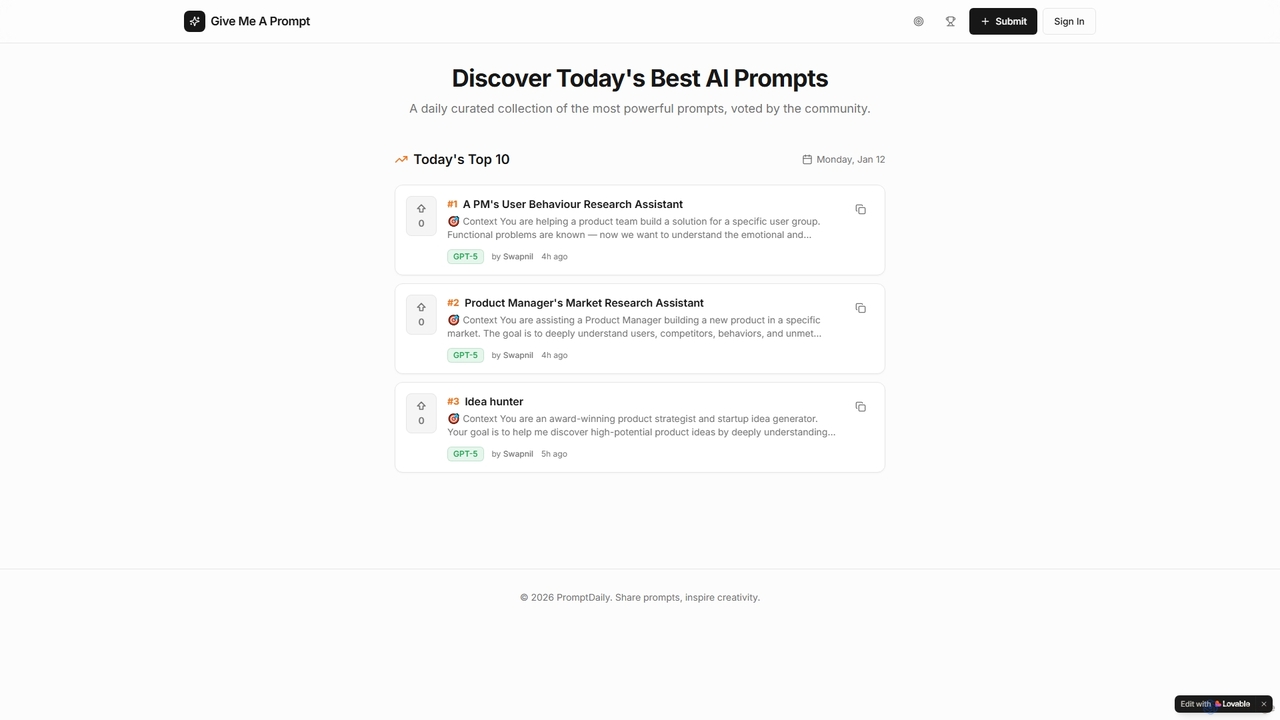
Give Me A Prompt is a platform offering a daily curated collection of powerful AI prompts, voted by …
Give Me A Prompt is a platform offering a daily curated collection of powerful AI prompts, voted by its community. It provides structured inspiration for tasks like product management, market research, and idea generation, helping users leverage AI more effectively for in-depth analysis and creative problem-solving.
Aicofounder
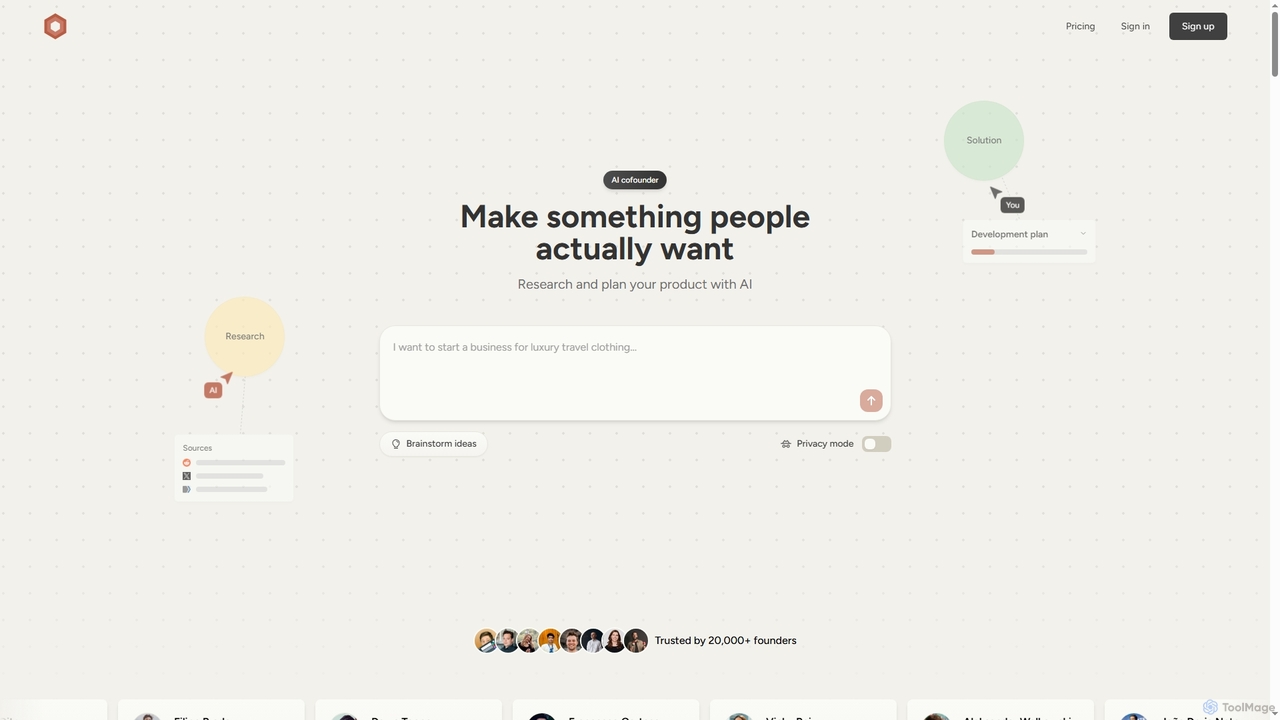
Aicofounder is an AI-powered platform designed to guide founders and entrepreneurs through the entire product development lifecycle, from …
Aicofounder is an AI-powered platform designed to guide founders and entrepreneurs through the entire product development lifecycle, from initial idea generation and market research to validation and structured planning. It acts as an intelligent co-founder, helping users build products people truly want.
GapNix
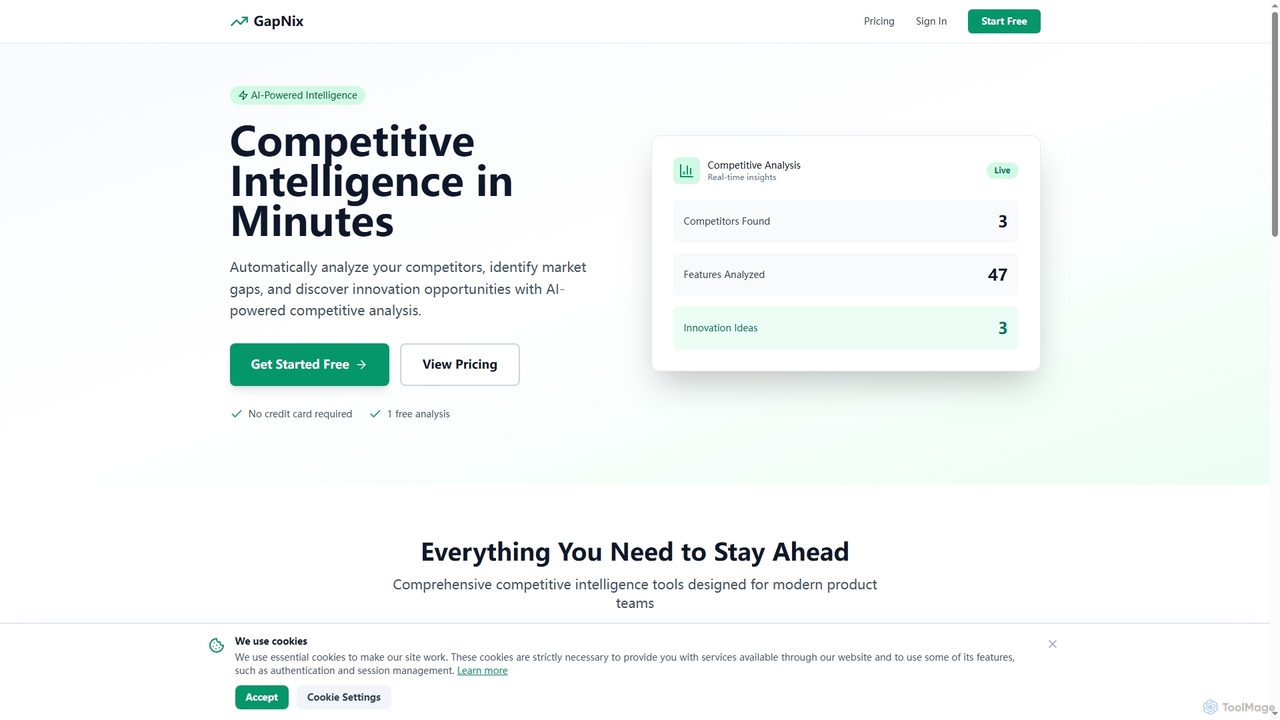
GapNix is an AI-powered competitive intelligence platform that helps product teams, marketers, and business leaders quickly analyze competitors, …
GapNix is an AI-powered competitive intelligence platform that helps product teams, marketers, and business leaders quickly analyze competitors, identify market gaps, and discover innovation opportunities. It automates research to provide actionable insights in minutes, enabling data-driven decision-making and strategic planning.
Oxtak
Oxtak integrates retro-futuristic hardware with advanced AI to craft seamless, intuitive tools designed to simplify daily tasks and …
Oxtak integrates retro-futuristic hardware with advanced AI to craft seamless, intuitive tools designed to simplify daily tasks and significantly boost efficiency. Led by experienced tech innovators, Oxtak focuses on user-centric design, enabling users to stay fully engaged in the present moment.
About Innovation
Innovation tools are AI-powered solutions designed to foster creativity, accelerate discovery, and optimize the development of new ideas, products, and services. These tools leverage advanced machine learning, natural language processing, and generative AI to analyze vast datasets, identify emerging trends, and simulate future scenarios. They empower individuals and organizations to move beyond traditional boundaries, enabling rapid prototyping, strategic foresight, and the generation of novel concepts across various industries.
Core Features
- Idea Generation: Automatically brainstorm and suggest novel concepts, names, or solutions based on user input and market data.
- Trend Analysis: Identify emerging patterns, market shifts, and consumer behaviors from large datasets to inform strategic decisions.
- Scenario Planning: Simulate potential future outcomes and evaluate the impact of different strategies or innovations.
- Design & Prototyping: Generate initial designs, mockups, or code snippets to accelerate the early stages of product development.
- Problem Solving: Analyze complex challenges and propose innovative solutions by drawing insights from diverse knowledge bases.
Use Cases
Businesses utilize innovation tools to explore new market opportunities, develop disruptive products, and enhance their competitive edge. R&D teams leverage them for scientific discovery and experimental design, while marketing departments use them to craft unique campaign concepts. Startups can rapidly iterate on business models and product features, significantly reducing time-to-market and fostering a culture of continuous innovation.
How to Choose
When selecting an AI innovation tool, consider its core functionality (idea generation, trend analysis, or design), the industry-specific data it can process, and its integration capabilities with existing workflows. Evaluate the level of customization offered, the accuracy of its insights, and the user-friendliness of its interface. Scalability and pricing models that align with your organizational needs are also crucial factors for long-term adoption.

InnovationUse Cases
Generating Novel Product Concepts for Market Expansion
Product development teams can leverage AI innovation tools to explore untapped market niches. By inputting existing product data, customer feedback, and competitor analysis, the AI generates hundreds of unique product ideas, feature sets, and even potential branding concepts. This allows teams to rapidly identify promising directions, prioritize development efforts, and reduce the time spent on initial ideation, leading to a more agile and market-responsive product pipeline.
Strategic Foresight and Future Scenario Planning
Business strategists and executives use innovation platforms to anticipate future market shifts and potential disruptions. The AI analyzes global economic indicators, technological advancements, and geopolitical trends to construct multiple plausible future scenarios. This enables organizations to proactively develop contingency plans, identify emerging opportunities, and make informed long-term investment decisions, enhancing resilience and strategic adaptability in a volatile environment.
Accelerating Scientific Discovery and Research
Researchers in fields like pharmaceuticals or materials science can utilize AI innovation tools to accelerate hypothesis generation and experimental design. By feeding the AI vast amounts of scientific literature, experimental data, and molecular structures, it can suggest novel compounds, predict material properties, or identify potential drug targets. This significantly reduces the trial-and-error phase, leading to faster breakthroughs and more efficient allocation of research resources.
Enhancing Creative Content and Marketing Campaigns
Marketing and advertising agencies employ AI innovation tools to brainstorm fresh and engaging campaign ideas. The AI can analyze current cultural trends, audience demographics, and past campaign performance to generate unique slogans, visual concepts, and narrative structures. This helps creative teams overcome creative blocks, produce a wider range of diverse content options, and develop campaigns that resonate more deeply with target audiences, improving engagement rates.
Optimizing Business Processes and Operational Efficiency
Operations managers can use AI innovation tools to identify bottlenecks and propose novel solutions for process optimization. By analyzing operational data, supply chain logistics, and resource allocation, the AI can suggest innovative ways to streamline workflows, reduce waste, or reconfigure production lines. This leads to significant cost savings, improved throughput, and a more efficient and sustainable operational framework.
Rapid Prototyping and Iteration for Startups
Early-stage startups benefit immensely from AI innovation tools for rapid product prototyping and iteration. Founders can input their core idea and target market, and the AI can generate initial wireframes, user interface concepts, or even basic code structures. This allows startups to quickly test assumptions, gather early user feedback, and pivot their product development with minimal investment, accelerating their journey from concept to market-ready solution.