Onetab AI
Onetab AI is an all-in-one AI agent platform designed for developers and enterprises. It centralizes tools, automates workflows …
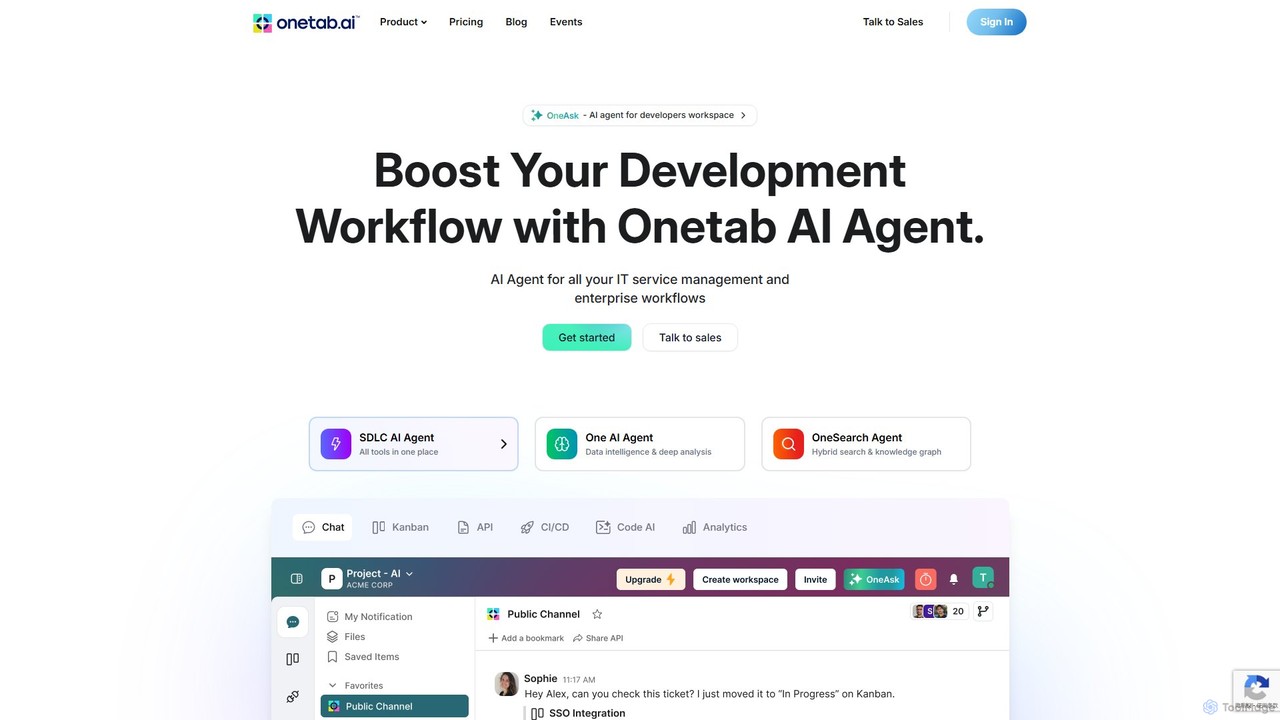
Onetab AI is an all-in-one AI agent platform designed for developers and enterprises. It centralizes tools, automates workflows across the software development lifecycle (SDLC) and IT service management, and acts as a single source of truth to boost team productivity and efficiency.
About It Service Management
AI-powered IT Service Management (ITSM) tools are platforms that use artificial intelligence to automate and optimize the delivery of IT services within an organization. These tools leverage machine learning and natural language processing to proactively manage incidents, analyze root causes, and predict potential issues before they impact users. By automating routine tasks and providing intelligent insights, AI ITSM solutions transform traditional IT support into a more efficient, predictive, and responsive operation. They enhance the capabilities of IT teams, reduce resolution times, and improve the overall employee service experience.
Core Features
- Intelligent Incident Management: Automatically categorizes, prioritizes, and routes tickets, suggesting solutions based on historical data.
- Predictive Problem Management: Analyzes trends and patterns to identify and address potential systemic issues before they cause major incidents.
- AI-Powered Service Desk: Deploys conversational AI chatbots to resolve common user requests like password resets or software access 24/7.
- Automated Change Risk Assessment: Uses AI to evaluate the potential impact and risk of proposed changes to the IT environment, preventing service disruptions.
- Proactive Monitoring & Alerting: Intelligently monitors system performance, filtering out noise to provide actionable alerts on critical events.
Use Cases
These tools are essential for medium to large enterprises with complex IT infrastructures, especially in sectors like finance, technology, and healthcare where service availability is critical. IT operations teams, service desk managers, and system administrators use AI ITSM to reduce manual workloads, prevent service outages, and ensure IT services effectively support business objectives.
How to Choose
When selecting an AI ITSM tool, consider its integration capabilities with your existing systems (e.g., cloud platforms, monitoring tools). Evaluate the sophistication of its AI models for automation and prediction. Also, assess the platform's scalability to handle your organization's volume of data and service requests, and consider the user interface's intuitiveness for both IT staff and end-users.

It Service ManagementUse Cases
Automating L1 Support with an AI Service Desk
An IT support manager at a large corporation is struggling with a high volume of repetitive Tier 1 tickets, such as password resets and software access requests. This ties up human agents, preventing them from focusing on more complex issues. By implementing an AI ITSM tool, they deploy a conversational AI chatbot integrated into their communication platform. The chatbot handles thousands of these routine requests daily, authenticating users and automatically fulfilling requests 24/7. This reduces the L1 ticket volume for human agents by over 60%, improves employee satisfaction with instant resolutions, and allows the support team to focus on high-impact problem-solving.
Predicting and Preventing System Outages
An IT operations team for an e-commerce platform needs to ensure maximum uptime, especially during peak shopping seasons. Instead of reacting to failures, they use an AI ITSM tool for predictive problem management. The tool continuously analyzes performance metrics, server logs, and network traffic data. It identifies subtle patterns that indicate a potential database overload or network bottleneck. The system then automatically generates a high-priority problem ticket with detailed diagnostics and recommended actions, such as scaling resources. This allows the team to proactively address the issue before it causes a site-wide outage, saving potentially millions in lost revenue.
Accelerating Incident Root Cause Analysis
Following a critical application failure, an IT incident response team is under pressure to identify the root cause quickly. Manually sifting through gigabytes of logs from multiple systems is slow and error-prone. They use their AI ITSM tool's root cause analysis (RCA) feature. The AI ingests and correlates logs, performance data, and recent change records in minutes. It identifies an anomaly—a recent software patch that conflicted with a specific server configuration—as the most probable cause. The tool presents this finding with supporting evidence, reducing the RCA time from hours or days to under 30 minutes, enabling a faster, more accurate fix.
Intelligent Ticket Routing for a Managed Service Provider
A Managed Service Provider (MSP) handles IT support for dozens of clients, receiving hundreds of tickets daily with varying urgency and complexity. Manual triage is a bottleneck, causing delays in response times. They adopt an AI ITSM platform that analyzes the text of each incoming ticket using natural language processing. The AI understands the user's intent, identifies the affected service and client, and assesses urgency. It then automatically routes the ticket to the appropriate specialist team (e.g., network, security, cloud) without human intervention. This intelligent routing cuts ticket assignment time by 90% and ensures that critical issues are addressed by the right experts immediately.
Automating Change Management Risk Assessment
A financial services company needs to deploy frequent updates to its trading platform but must minimize the risk of service disruption. Their change advisory board (CAB) spends hours manually assessing the risk of each proposed change. By integrating an AI ITSM tool, the change management process is enhanced. The AI analyzes the proposed change, cross-references it with system dependencies, historical change success/failure rates, and current system performance. It then provides an automated risk score and highlights potential conflicts. This allows the CAB to focus their review on high-risk changes, approving low-risk, routine changes automatically. This accelerates deployment cycles while improving system stability.
Creating a Self-Service Knowledge Base
A rapidly growing tech company finds its IT team is constantly answering the same questions about software setup, VPN access, and printer configuration. To empower employees and reduce repetitive queries, they use an AI ITSM tool to build a dynamic knowledge base. The AI analyzes resolved tickets to identify common problems and automatically suggests new knowledge base articles. It also powers a smart search function that understands natural language, helping employees find relevant articles easily. When an employee searches for an issue, the AI can present a step-by-step guide, effectively deflecting a potential ticket and promoting a self-service culture.