Ozgar
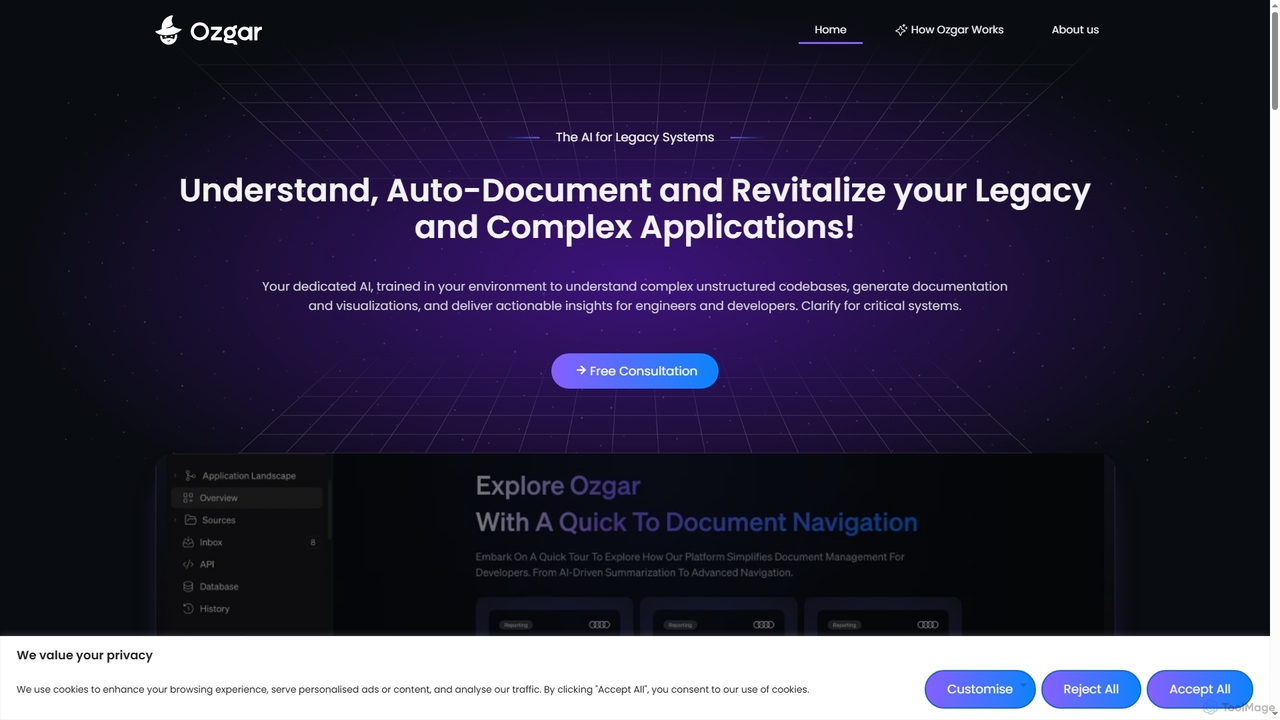
Ozgar is an enterprise code intelligence platform designed to understand, auto-document, and revitalize legacy and complex software systems. …
Ozgar is an enterprise code intelligence platform designed to understand, auto-document, and revitalize legacy and complex software systems. It leverages advanced AI to transform unstructured codebases into a smart, searchable knowledge hub, providing developers and teams with instant insights, automated documentation, and enhanced code navigation. Ozgar aims to reduce technical debt, accelerate onboarding, and streamline maintenance without disrupting existing operations.
About Legacy System Management
AI-powered Legacy System Management tools are specialized solutions designed to analyze, maintain, and modernize outdated software and infrastructure. These tools leverage machine learning and advanced code analysis to understand complex, often poorly documented legacy codebases written in languages like COBOL or PL/I. Their primary value lies in reducing the risks and costs associated with system modernization, enabling businesses to unlock data from old systems and integrate them with modern applications. By automating tasks like code conversion and dependency mapping, they accelerate digital transformation initiatives.
Core Features
- Code Analysis and Understanding: Automatically scans legacy code to map application architecture, identify dependencies, and discover business logic.
- Automated Modernization: Provides tools for refactoring, re-platforming, or automatically converting legacy code to modern languages like Java or Python.
- API Generation: Creates modern REST APIs on top of legacy systems, allowing new applications to access legacy data and functions without a full rewrite.
- Knowledge Extraction: Extracts and documents business rules embedded within the legacy code, preserving critical institutional knowledge.
- Predictive Maintenance: Analyzes system logs and performance metrics to predict potential failures in aging hardware and software components.
Use Cases
These tools are crucial for industries heavily reliant on legacy systems, such as banking, insurance, government, and manufacturing. They are used by IT leaders, enterprise architects, and development teams to plan and execute complex modernization projects, such as migrating mainframe applications to the cloud, replacing monolithic architectures with microservices, or simply making legacy data accessible for modern analytics platforms.
How to Choose
When selecting a tool, consider its support for your specific legacy languages and platforms (e.g., mainframe, AS/400). Evaluate its modernization capabilities—whether it focuses on analysis, code conversion, or API wrapping. Assess the depth of its code analysis and the accuracy of its business rule extraction. Finally, consider its integration with modern development environments and CI/CD pipelines to ensure a smooth transition.

Legacy System ManagementUse Cases
Planning Mainframe to Cloud Migration
An enterprise architect at a major bank is tasked with planning the migration of a core banking system from a mainframe to a cloud environment. They use an AI Legacy System Management tool to perform a deep analysis of millions of lines of COBOL code. The tool automatically generates detailed dependency maps, identifies dead code paths, and extracts critical business logic. This provides a clear roadmap for the migration, highlighting high-risk components and allowing the team to accurately estimate the project's scope and cost, reducing the risk of failure by over 40%.
Automating Code Conversion Projects
An insurance company needs to modernize its 30-year-old claims processing system written in a proprietary language. A manual rewrite would take years and be prone to errors. Instead, they employ an AI tool that specializes in automated code conversion. The tool analyzes the source code, understands its structure and logic, and automatically translates it into modern Java. While human oversight is still needed for validation, the tool automates over 80% of the conversion process, reducing the project timeline from three years to under one year and ensuring business logic is preserved accurately.
Creating APIs for Legacy Data Access
A manufacturing firm relies on an AS/400 system for inventory management. To build a modern e-commerce platform, they need real-time access to this inventory data. Instead of a risky database migration, the IT team uses an AI tool to automatically generate a layer of secure REST APIs on top of the existing system. The AI analyzes the system's data structures and program calls to create well-documented, high-performance APIs. This allows the new e-commerce site to seamlessly query stock levels and process orders without ever directly touching the legacy system, achieving modernization in weeks instead of years.
Extracting Undocumented Business Rules
A logistics company is replacing its old transportation management system, but the complex pricing and routing rules are not documented anywhere; they only exist within the legacy code. A development team uses an AI knowledge extraction tool to scan the application. The tool identifies and translates the convoluted code logic into human-readable business rules, such as 'If shipment weight > 500kg and destination is Zone C, apply a 15% surcharge.' This extracted knowledge is invaluable, ensuring that critical business functions are not lost during the transition to the new system and saving thousands of hours of manual analysis.
Reducing Technical Debt in Monolithic Applications
A government agency maintains a large, monolithic application for citizen services that has accumulated significant technical debt over 20 years. Maintenance is slow and costly. They use an AI-powered analysis tool to scan the entire codebase. The tool visualizes the application's architecture, identifies highly coupled modules, pinpoints unused code, and suggests specific refactoring opportunities to break the monolith into more manageable services. This data-driven approach allows the agency to strategically pay down technical debt, improving system stability and making future updates faster and less risky.
Predictive Maintenance for Aging Infrastructure
A utility company operates a critical control system with hardware and software components that are over 25 years old and no longer supported by the original vendor. To prevent unexpected outages, they deploy an AI monitoring tool. The tool analyzes system logs, performance data, and error patterns in real-time. By identifying subtle anomalies that precede failures, the AI predicts when a specific hardware component is likely to fail. This allows the operations team to schedule proactive maintenance and replace parts before a critical failure occurs, ensuring service reliability and public safety.