Unthread
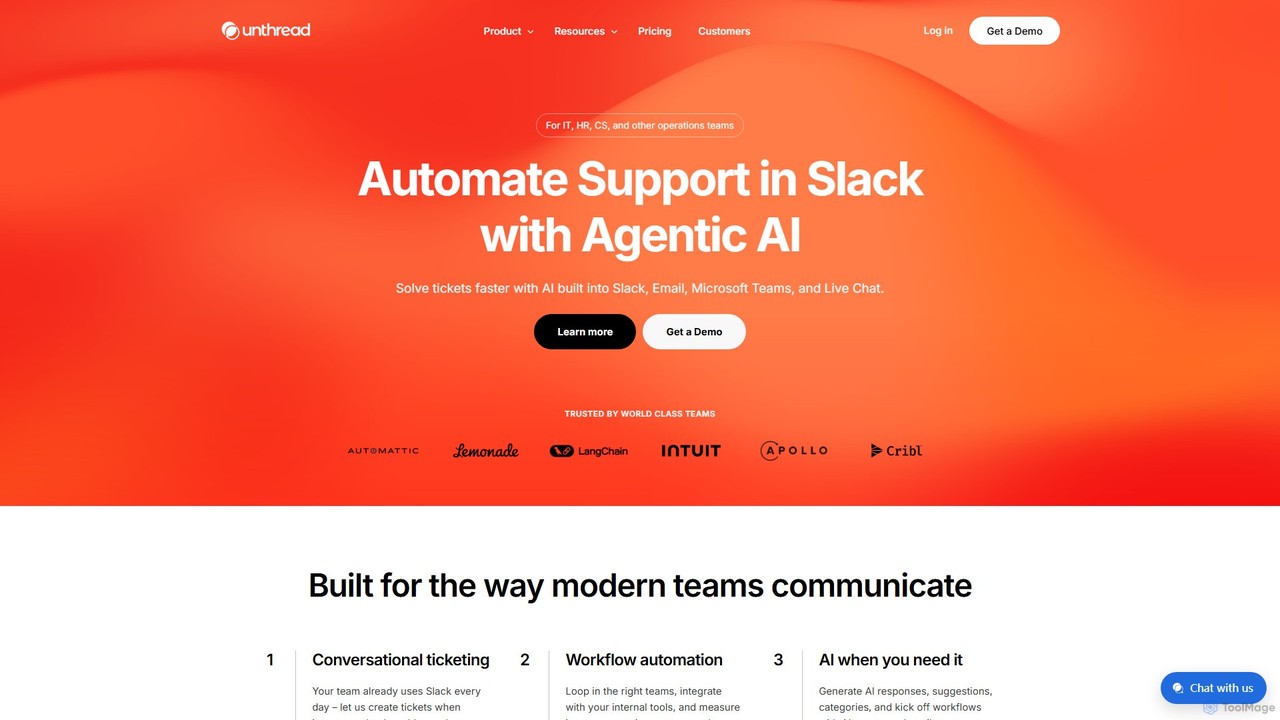
Unthread is an AI-powered support platform designed for modern teams using Slack, Microsoft Teams, and Email. It automates …
Unthread is an AI-powered support platform designed for modern teams using Slack, Microsoft Teams, and Email. It automates conversational ticketing, deflects common queries with AI agents, and provides a unified inbox to streamline workflows for IT, HR, and customer support teams, significantly improving response and resolution times.
About Service Management
Service Management AI tools are specialized platforms that leverage artificial intelligence to optimize the delivery, support, and management of IT and business services. These tools integrate machine learning, natural language processing, and automation to streamline operations, enhance user experience, and proactively address service issues. They empower organizations to improve efficiency, reduce operational costs, and ensure high-quality service delivery across various departments.
Core Features
- Intelligent Incident Management: Automates incident classification, routing, and resolution suggestions, reducing downtime.
- Predictive Service Analytics: Uses AI to forecast potential service outages or performance degradation, enabling proactive intervention.
- AI-Powered Virtual Agents: Provides instant, self-service support for common queries and requests, freeing up human agents.
- Automated Workflow Orchestration: Streamlines complex service processes, from request fulfillment to change management, through intelligent automation.
- Knowledge Base Optimization: Enhances searchability and relevance of knowledge articles using AI, improving self-service success rates.
Applicable Scenarios
Organizations across various sectors, particularly IT departments, customer service centers, and HR teams, utilize AI-powered Service Management tools. They are crucial for managing complex IT infrastructures, automating help desk operations, and ensuring seamless service delivery to employees and customers. For instance, a large enterprise uses these tools to automatically prioritize IT tickets and suggest solutions to technicians.
How to Choose
When selecting Service Management AI tools, consider the scope of automation (e.g., incident, request, problem management), integration capabilities with existing IT systems (CRM, ERP), the robustness of AI models for predictive analytics and NLP, and scalability to meet future demands. Evaluate the user interface for both agents and end-users, and assess vendor support and implementation services.

Service ManagementUse Cases
Automate IT Help Desk Support with AI Virtual Agents
For IT departments overwhelmed by routine queries, AI-powered virtual agents can provide instant, 24/7 support. Users submit tickets or chat with the AI, which automatically classifies issues, provides solutions from the knowledge base, or routes complex problems to the appropriate human agent. This significantly reduces response times, improves user satisfaction, and allows IT staff to focus on critical issues.
Proactively Prevent Service Outages with Predictive AI
IT operations teams can leverage AI Service Management tools to analyze historical data, system logs, and network performance metrics. The AI identifies patterns and anomalies that indicate potential service degradation or outages before they occur. This enables teams to take proactive measures, such as resource allocation or system adjustments, preventing downtime and maintaining service continuity.
Streamline Employee Service Request Fulfillment
HR and IT departments often handle numerous employee service requests, from software access to equipment provisioning. AI tools automate the entire request lifecycle, from submission and approval workflows to fulfillment. AI can verify user permissions, trigger automated provisioning tasks, and provide real-time status updates, drastically speeding up service delivery and reducing manual administrative burden.
Optimize Knowledge Base for Enhanced Self-Service
For organizations aiming to improve self-service, AI Service Management tools analyze user search queries and knowledge article effectiveness. The AI identifies gaps in content, suggests improvements, and ensures that relevant articles are easily discoverable. This leads to a more comprehensive and accessible knowledge base, empowering users to find answers independently and reducing the volume of support tickets.
Enhance Change Management with AI-Driven Impact Analysis
Large enterprises frequently implement changes to their IT infrastructure. AI Service Management tools can assess the potential impact of proposed changes by analyzing dependencies, historical change data, and system configurations. The AI provides risk assessments and recommends optimal deployment schedules, minimizing the likelihood of service disruption and ensuring smoother, more controlled changes.
Automate Problem Identification and Root Cause Analysis
When recurring incidents occur, AI tools can correlate multiple incidents, identify underlying problems, and assist in root cause analysis. The AI analyzes incident data, error messages, and system performance to pinpoint common issues. This automation helps problem managers quickly identify and resolve systemic issues, preventing future incidents and improving overall service stability.