hubbleiq
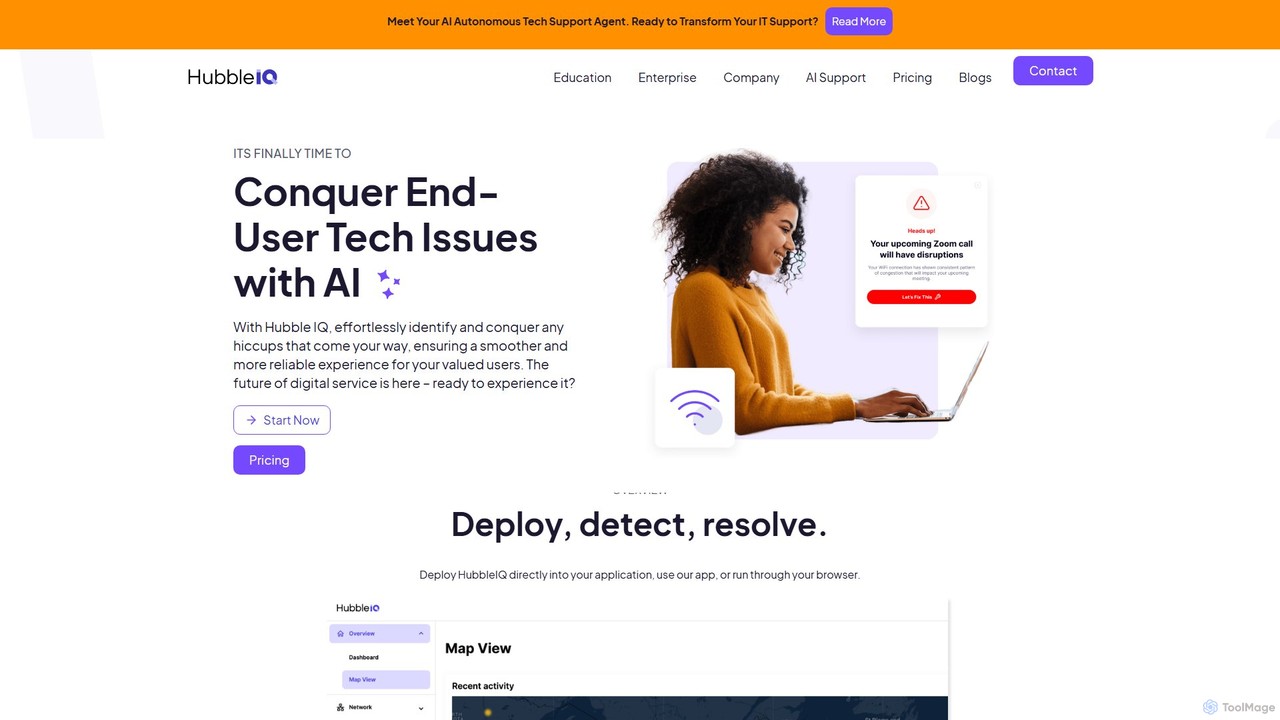
HubbleIQ is an AI-powered IT support platform that proactively detects, diagnoses, and resolves technology issues for end-users. It …
HubbleIQ is an AI-powered IT support platform that proactively detects, diagnoses, and resolves technology issues for end-users. It automates troubleshooting for networks, devices, and applications, significantly reducing helpdesk tickets and resolution times for businesses, educational institutions, and telehealth providers.
techxperts.tech
An AI-powered co-pilot for developers and IT professionals, designed to accelerate technical problem-solving. It provides instant diagnostics, intelligent …
An AI-powered co-pilot for developers and IT professionals, designed to accelerate technical problem-solving. It provides instant diagnostics, intelligent solution generation, and code analysis to resolve complex technical issues efficiently.
About Support
AI Support tools are a class of software that uses artificial intelligence to automate, augment, and analyze customer service and IT helpdesk operations. These tools leverage technologies like Natural Language Processing (NLP) and machine learning to understand user inquiries, provide instant answers, and intelligently route complex issues. Their primary value lies in increasing the efficiency of support teams, reducing response times, and improving overall customer satisfaction through 24/7 automated assistance. They transform traditional support from a reactive function into a proactive, data-driven operation.
Core Features
- Automated Ticket Triage: Automatically categorizes, prioritizes, and routes incoming support tickets based on content and urgency.
- Intelligent Knowledge Base: Provides AI-powered search and suggests relevant articles to both users and agents in real-time.
- AI Chatbots & Virtual Assistants: Offers immediate, 24/7 responses to common user queries on websites and messaging apps.
- Sentiment Analysis: Analyzes the emotional tone of customer communications to prioritize urgent or dissatisfied customers.
- Agent Assist: Delivers real-time suggestions, response templates, and relevant data to human agents during conversations.
Use Cases
AI Support tools are widely used in industries with high customer interaction volumes, such as e-commerce, SaaS, finance, and telecommunications. They are essential for IT helpdesks managing internal employee requests and for customer service departments aiming to scale their operations without proportionally increasing headcount. For example, a SaaS company can use an AI chatbot to handle common account questions, freeing up human agents for complex technical troubleshooting.
How to Choose
When selecting an AI Support tool, consider its integration capabilities with your existing CRM or helpdesk software (e.g., Zendesk, Salesforce). Evaluate the sophistication of its NLP for understanding your specific industry jargon. Assess the customization options for chatbots and automated workflows to ensure they align with your brand voice and support processes. Finally, consider the analytics and reporting features to measure performance and identify areas for improvement.

SupportUse Cases
Automated IT Helpdesk Ticket Triage
An IT manager in a large corporation uses an AI Support tool to handle the high volume of internal employee requests. When an employee submits a ticket for a password reset, software access, or hardware issue, the AI instantly analyzes the text. It correctly categorizes the ticket, assigns a priority level, and routes it to the appropriate support queue—password resets are handled by an automated workflow, while hardware issues go to the on-site tech team. This eliminates manual sorting, reduces resolution time for common issues from hours to minutes, and allows the IT staff to focus on more complex problems.
24/7 Customer Support for E-commerce
An online retail store deploys an AI chatbot on its website and messaging channels. The chatbot handles common customer inquiries around the clock, such as 'Where is my order?', 'What is your return policy?', and 'Do you ship to my country?'. By integrating with the store's backend systems, it can provide personalized order status updates. For complex issues like a damaged product, the chatbot collects initial information and seamlessly transfers the conversation, along with the full context, to a human agent. This provides instant support to customers globally and reduces the support team's workload by over 40%.
Proactive Issue Detection with Sentiment Analysis
A telecommunications company uses an AI Support platform to monitor customer interactions across email, chat, and social media. The system's sentiment analysis feature flags conversations with negative language or tones of frustration in real-time. A support team lead receives an alert about a customer who is repeatedly expressing dissatisfaction with their internet speed. Instead of waiting for a formal complaint, the team lead proactively reaches out to the customer, acknowledges their frustration, and escalates the issue to a senior technician. This proactive intervention prevents customer churn and turns a negative experience into a positive one.
Empowering Agents with an Intelligent Knowledge Base
A customer support agent at a SaaS company is handling a complex technical query via live chat. As the customer describes the issue, the AI Support tool's 'Agent Assist' feature listens in. It automatically searches the company's extensive knowledge base, developer documentation, and past ticket resolutions. It then presents the agent with three highly relevant articles and a code snippet directly within their support console. The agent quickly finds the solution without needing to manually search or escalate to a Tier 2 engineer, resolving the customer's issue on the first contact and significantly reducing the average handling time.
Automating Employee Onboarding IT Requests
The HR department of a fast-growing tech company uses an AI-powered workflow integrated with their IT support system. When a new employee is hired, an automated process is triggered. The AI tool creates tickets for the IT department to set up a new laptop, create user accounts in various systems (like email, Slack, and Jira), and assign necessary software licenses. The tool pre-populates all required information from the HR system, tracks the progress of each task, and notifies the HR manager and the new employee upon completion. This automates a complex, multi-step process, ensuring new hires are ready to work on day one and reducing the administrative burden on both HR and IT.
Analyzing Support Trends for Service Improvement
A product manager for a mobile app uses the analytics dashboard of their AI Support tool. The tool automatically clusters thousands of support tickets into topics like 'login issues,' 'payment failures,' and 'feature requests for dark mode.' The manager observes a 30% spike in tickets related to 'payment failures' after a recent app update. They drill down to see the specific error messages customers are reporting. Armed with this data, they work with the development team to quickly identify and fix the bug. The AI tool helped turn unstructured customer feedback into an actionable insight, leading to a rapid product improvement and preventing further negative customer experiences.