
Custraxx
Custraxx is an AI-powered customer support platform designed to transform customer experience by delivering instant, accurate support across …
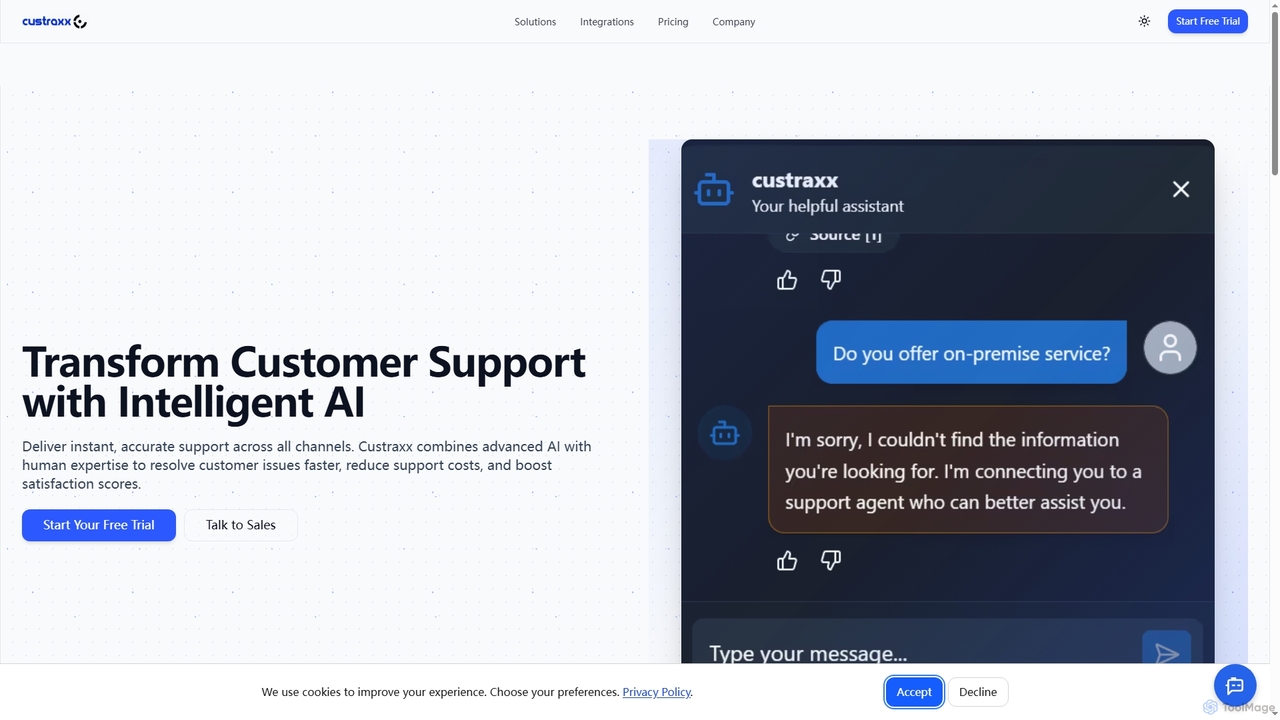
Custraxx is an AI-powered customer support platform designed to transform customer experience by delivering instant, accurate support across all channels. It combines advanced AI with human expertise to resolve issues faster, reduce support costs, and significantly boost customer satisfaction.
About Self Service
AI Self-Service tools are platforms designed to empower users to find information and resolve issues independently, without direct human assistance. These tools leverage artificial intelligence, such as natural language processing, to understand user queries and provide instant, relevant answers from a centralized knowledge base. They are built to automate responses, guide users through complex processes, and offer 24/7 support. By making information highly accessible and actionable, these platforms significantly reduce the workload on support teams and enhance overall user satisfaction.
Core Features
- AI-Powered Search: Understands user intent and natural language to deliver precise answers, not just link lists.
- Conversational Chatbots: Engage users in dialogue to troubleshoot problems, answer questions, or guide them to solutions.
- Automated Workflows: Enable users to complete tasks like password resets, order tracking, or appointment scheduling automatically.
- Knowledge Base Integration: Seamlessly surfaces articles, guides, and FAQs from existing knowledge management systems.
- Performance Analytics: Provides insights into common user questions, search success rates, and content gaps to drive improvement.
Use Cases
These tools are essential for customer support departments aiming to deflect common inquiries and for internal IT helpdesks automating employee support. HR teams use them for employee onboarding and answering policy questions, while SaaS companies deploy them for in-app user guidance and feature education.
How to Choose
When selecting a Self-Service tool, evaluate its integration capabilities with your existing CRM or helpdesk software. Assess the sophistication of its AI search and chatbot, the ease of content management for non-technical users, and the depth of its analytics for measuring performance and user behavior.
Self ServiceUse Cases
Automating Customer Support FAQs
An e-commerce company implements an AI self-service portal on its website. When customers have common questions about shipping, returns, or product specifications, they interact with a chatbot instead of contacting an agent. The chatbot uses natural language understanding to provide instant, accurate answers from the knowledge base, 24/7. This approach deflects over 50% of repetitive inquiries, allowing human agents to focus on complex, high-value customer issues and significantly reducing average response times.
Internal IT Helpdesk Automation
A large corporation deploys an internal self-service portal for its employees. When an employee encounters a common IT issue, like a password reset or a VPN connection problem, they use the portal's virtual assistant. The assistant guides them through a step-by-step troubleshooting workflow or automatically processes their request. This resolves issues in minutes, reduces the number of tickets submitted to the IT department, and empowers employees to solve minor technical problems independently, improving overall productivity.
Streamlining New Employee Onboarding
An HR department uses a self-service platform to create an onboarding hub for new hires. Instead of asking repetitive questions, new employees can ask a chatbot about company policies, benefits enrollment, or how to set up their equipment. The platform provides instant answers and links to relevant documents or video tutorials from the knowledge base. This creates a consistent and efficient onboarding experience, reduces the administrative burden on HR staff, and helps new hires become productive faster.
In-App Guidance for SaaS Users
A SaaS company embeds a self-service widget directly into its software application. When users are unsure how to use a specific feature, they can click the widget and ask a question like, 'How do I export a report?' The AI assistant provides a concise answer, a link to a detailed guide, or even launches an interactive product tour that walks them through the process step-by-step. This proactive, in-context support improves feature adoption, reduces user frustration, and lowers the number of support tickets related to usability questions.
Managing E-commerce Orders and Returns
A customer who recently made a purchase on an online retail site wants to check their order status. Instead of logging in or calling support, they interact with a chatbot on the homepage. They provide their order number, and the bot instantly retrieves and displays the current shipping status. The customer can also ask the bot to initiate a return, and it will guide them through the process, generate a shipping label, and confirm the return request, all within a single automated conversation.
Providing Public Sector Information
A government agency's website uses an AI-powered self-service portal to help citizens find information about public services. A user wanting to know the requirements for renewing a driver's license can ask the virtual assistant in plain language. The assistant provides a clear checklist of required documents, links to the necessary forms, and information on office locations and hours. This makes critical government information more accessible to the public and reduces call volumes to administrative offices.