ToolMage
Sign in

Best 1 Q&A AI tools for Knowledge

Popular Q&A AI tools in Knowledge include tswift, helping you work more efficiently.

Free

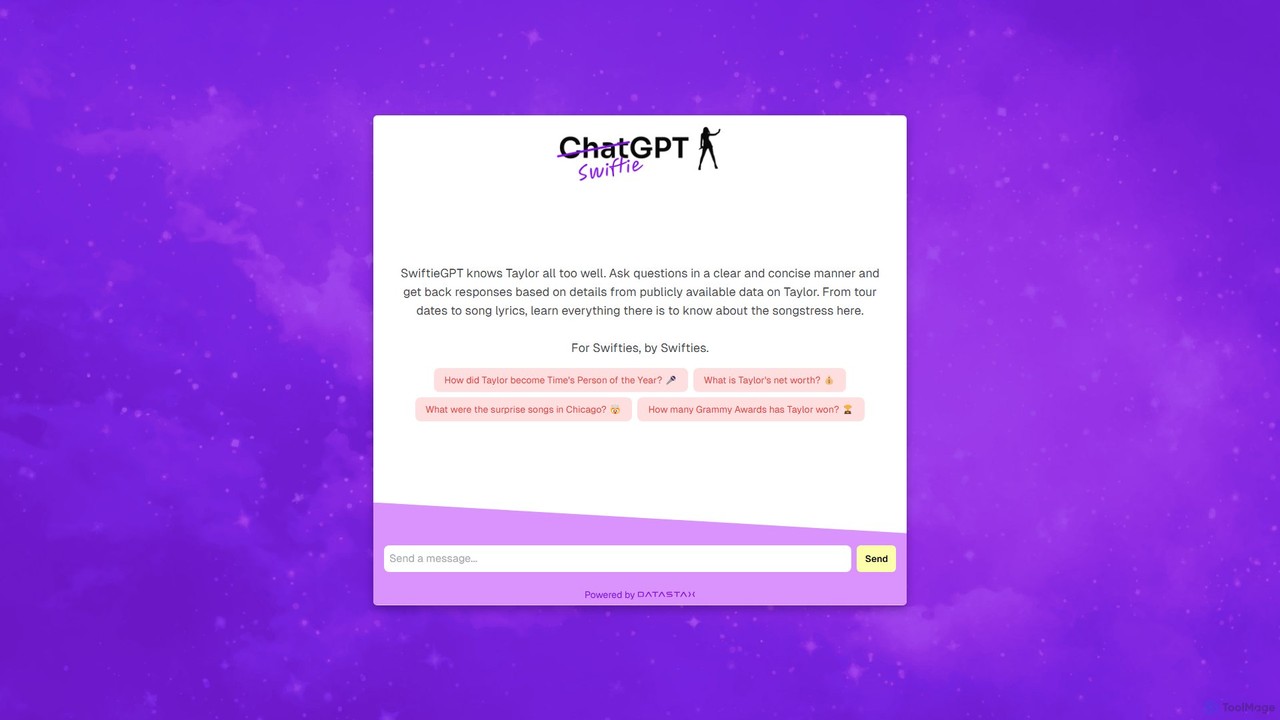
tswift

tswift, also known as SwiftieGPT, is a specialized AI chatbot designed for Taylor Swift fans. It provides instant, accurate answers to any question about her life, career, music, and achievements, drawing from a vast database of public information. It's the ultimate go-to resource for trivia, facts, and deep dives into the world of Taylor Swift.

Music
Visits 3.3KFavorites 112Likes 109

About Q&A

AI Q&A tools are applications designed to understand natural language questions and provide direct, accurate answers from a specific knowledge base. These tools utilize Natural Language Processing (NLP) and semantic search to analyze user queries and retrieve relevant information from documents, websites, or databases. This allows users to find precise information instantly without manually sifting through large volumes of content. Unlike general search engines, AI Q&A tools operate on a curated dataset, ensuring the answers are contextual, reliable, and directly sourced.

Core Features

  • Natural Language Querying: Understands complex, conversational questions instead of just keywords.
  • Source-Cited Answers: Provides answers along with direct links to the source documents for verification and trust.
  • Knowledge Base Integration: Connects with various data sources like PDFs, websites, Notion, or Confluence.
  • Semantic Search: Finds information based on contextual meaning and intent, not just word matching.
  • Answer Synthesis: Combines information from multiple sources to generate a single, comprehensive answer.

Use Cases

These tools are widely used for creating internal knowledge bases for employees, enabling them to quickly find information on company policies or technical procedures. They are also deployed as customer support chatbots on websites to provide 24/7 automated assistance. Researchers and legal professionals use them to accelerate document analysis and evidence discovery.

How to Choose

When selecting an AI Q&A tool, consider its compatibility with your existing data sources (e.g., PDF, DOCX, web pages). Evaluate the accuracy of its answers and whether it provides clear source citations. Assess its integration capabilities, such as website widgets or Slack bots. Finally, review the security protocols to ensure your sensitive data is protected.

Featured tool rankings

Q&A use cases

1

Automate Customer Support with a Website Chatbot

An e-commerce company embeds an AI Q&A chatbot on its website, trained on its entire knowledge base of product specifications, shipping policies, and return procedures. When a customer asks, 'What is the warranty on model X?' or 'How long does shipping to California take?', the bot instantly provides a precise answer sourced directly from the official documents. This reduces the workload on human support agents by over 40% and provides customers with 24/7 instant support, improving overall satisfaction.

2

Create an Internal Knowledge Base for Employees

A large corporation uploads hundreds of internal documents, including HR policies, IT security guidelines, and project management frameworks, into an AI Q&A platform. A new employee can simply ask, 'What is the process for requesting new software?' instead of searching through a complex intranet or asking colleagues. The tool provides a step-by-step answer with links to the relevant policy documents, streamlining onboarding and improving internal operational efficiency.

3

Accelerate Academic and Legal Research

A legal team uploads thousands of pages of case law documents related to a specific lawsuit. Instead of manually reading each document, paralegals can ask the AI Q&A tool questions like, 'List all cases where 'negligence' was a deciding factor in the verdict.' The system instantly scans all documents and provides a synthesized list with direct quotes and citations to the source pages. This drastically reduces research time from weeks to hours, allowing the team to build stronger cases faster.

4

Analyze Customer Feedback and Reviews

A product manager uploads hundreds of customer reviews and support tickets into a Q&A tool. They can then ask high-level questions like, 'What are the most common complaints about the user interface?' or 'Summarize feedback related to battery life.' The AI analyzes the unstructured text data and provides a concise summary of key themes and recurring issues. This allows the product team to quickly identify areas for improvement without manually reading every piece of feedback.

5

Streamline Technical Documentation Search

A software development team integrates an AI Q&A tool with their extensive technical documentation in Confluence. A developer, instead of navigating a complex hierarchy of pages, can ask, 'What are the API rate limits for the user authentication endpoint?' The tool directly extracts the specific numbers and usage policies from the relevant documentation page, providing an immediate and accurate answer. This saves developers significant time and reduces interruptions in their workflow.

6

Create Interactive Educational Content

An online learning platform uploads its entire curriculum, including textbooks and lecture notes, into a Q&A system. Students can use it as a 24/7 virtual tutor, asking specific questions like 'Explain the concept of photosynthesis in simple terms' or 'What were the main causes of World War I?'. The tool provides clear, synthesized answers based on the course materials, helping students reinforce their learning and get instant clarification on complex topics outside of class hours.

Q&A FAQ

What are AI Q&A tools?

AI Q&A tools are specialized applications that use artificial intelligence to provide direct answers to questions from a specific set of documents or data. Unlike a general search engine that returns a list of links, these tools read, understand, and synthesize information to give a concise, relevant answer. They are commonly used to create chatbots for websites, internal knowledge bases for companies, and research assistants for analyzing large document sets.

How to choose the right AI Q&A tool?

To choose the right AI Q&A tool, consider these factors:

  • Data Sources: Ensure the tool supports your file types (PDF, DOCX, etc.) and platforms (Notion, websites, Slack).
  • Accuracy & Citation: Check if the tool provides accurate answers and cites its sources, which is crucial for verifying information.
  • Integration: Determine if you need to embed it on a website, integrate with messaging apps, or use it via an API.
  • Security: For sensitive data, verify the tool's security policies and data handling procedures.
  • Ease of Use: Select a tool with an intuitive interface for uploading documents and managing your knowledge base.
What's the difference between an AI Q&A tool and a general chatbot?

The key difference is grounding. An AI Q&A tool is 'grounded' in a specific knowledge base you provide, meaning its answers are based solely on that information, making them factual and verifiable. A general chatbot (like a base large language model) generates responses based on its vast, general training data. While creative, it can 'hallucinate' or provide information that isn't specific to your company or documents. Many AI Q&A tools are a specialized type of chatbot that uses a technique called Retrieval-Augmented Generation (RAG) to ensure factual accuracy.

What types of data can AI Q&A tools work with?

Most AI Q&A tools are versatile and can handle a wide range of data types. Common supported formats include:

  • Text Documents: PDF, Microsoft Word (.docx), Plain Text (.txt).
  • Web Content: Public websites, specific URLs, or entire domains.
  • Structured Data: Spreadsheets (.csv) and sometimes direct database connections.
  • Platform Integrations: Many tools connect directly to platforms like Notion, Confluence, Slack, and Zendesk to use their content as a knowledge base.

The ability to process multiple formats allows you to create a comprehensive knowledge base from all your existing information sources.

Is my data secure when using an AI Q&A tool?

Security is a primary concern for reputable AI Q&A tool providers. Most high-quality tools offer robust security features, such as data encryption both in transit and at rest, and compliance with standards like GDPR and SOC 2. Many also provide options for data residency to keep your information within a specific geographic region. However, it is always crucial to review the specific privacy policy and security documentation of any tool before uploading sensitive or proprietary information. For highly confidential data, consider on-premise or private cloud deployment options if available.