ToolMage
Sign in

Best 1 Proofreading AI tools for Language

Popular Proofreading AI tools in Language include RewriteWise, helping you work more efficiently.

Freemium

RewriteWise

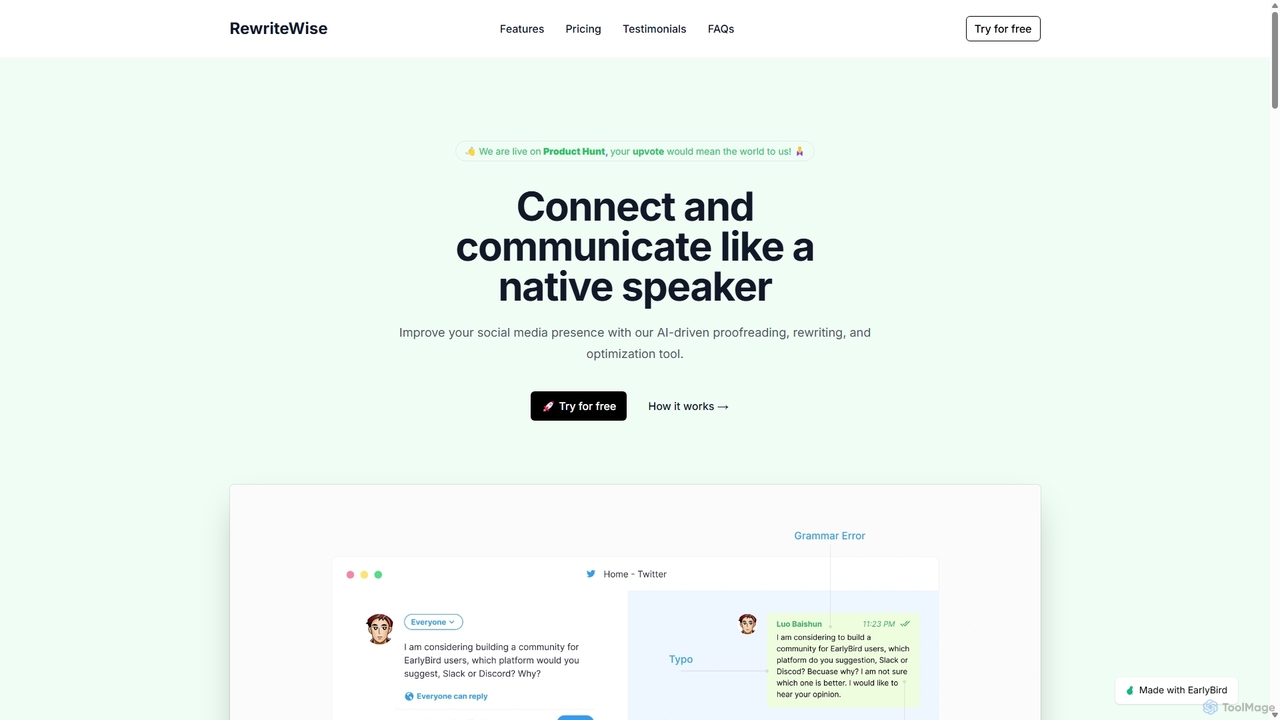
RewriteWise is an AI-powered Telegram bot designed for non-native speakers to enhance their social media presence. It offers advanced proofreading, rewriting for native-level fluency, and content optimization. The tool corrects grammar, spelling, and punctuation, refines tone and readability, and suggests keywords to maximize engagement and growth across multiple languages.

Proofreading
Visits 3.4KFavorites 124Likes 120

About Proofreading

AI Proofreading tools are specialized software applications designed to meticulously review written content for errors in grammar, spelling, punctuation, style, and consistency. Leveraging advanced natural language processing (NLP) and machine learning algorithms, these tools analyze text to identify potential mistakes and suggest improvements. They empower writers, editors, and professionals to refine their documents, ensuring clarity, accuracy, and adherence to specific linguistic standards before publication or submission.

Core Features

  • Grammar and Spelling Correction: Automatically identifies and suggests corrections for grammatical errors, typos, and misspellings.
  • Punctuation Check: Ensures correct usage of commas, periods, semicolons, apostrophes, and other punctuation marks.
  • Style and Tone Analysis: Provides recommendations for improving sentence structure, word choice, clarity, conciseness, and maintaining a consistent tone.
  • Consistency Checks: Detects inconsistencies in formatting, capitalization, hyphenation, and numerical expressions across a document.
  • Plagiarism Detection: Some advanced tools offer features to check for originality and identify potential instances of plagiarism.

Use Cases

AI proofreading tools are invaluable across various sectors. Academic professionals use them to ensure their research papers and theses are free from errors and adhere to academic writing standards. Marketing teams leverage these tools to refine ad copy, website content, and social media posts, ensuring brand voice consistency and error-free communication. Legal professionals utilize them to meticulously review contracts and legal documents, minimizing the risk of misinterpretation due to linguistic inaccuracies.

How to Choose

When selecting an AI proofreading tool, consider its accuracy in detecting errors across different text types and languages. Evaluate its integration capabilities with your existing writing platforms (e.g., Microsoft Word, Google Docs). Assess the level of customization offered, such as the ability to create custom style guides or dictionaries. Finally, compare pricing models and ensure the tool provides comprehensive feedback beyond basic corrections, offering explanations and learning opportunities.

Featured tool rankings

Proofreading use cases

1

Refining Academic Papers for Publication

University students and researchers utilize AI proofreading tools to meticulously review their essays, dissertations, and journal articles. The tools help identify complex grammatical errors, ensure consistent citation styles, correct punctuation, and suggest improvements for academic tone and clarity, significantly reducing the time spent on manual proofreading and increasing the likelihood of acceptance for publication.

2

Ensuring Consistency in Brand Communications

Marketing and communications teams employ AI proofreaders to maintain a unified brand voice and style across all external content, including website copy, blog posts, email newsletters, and social media updates. These tools enforce specific style guide rules, check for consistent terminology, and correct any grammatical or spelling mistakes, ensuring professional and error-free brand messaging.

3

Streamlining Legal Document Review

Legal professionals, such as paralegals and lawyers, use AI proofreading to scrutinize contracts, briefs, and other critical legal documents. The tools help catch subtle errors in grammar, punctuation, and formatting that could lead to ambiguity or legal disputes. This significantly enhances accuracy and saves valuable time compared to traditional manual review processes.

4

Optimizing Content for Non-Native Speakers

Individuals writing in a language that is not their native tongue, such as international business professionals or ESL students, rely on AI proofreading tools to enhance their written communication. These tools not only correct basic errors but also offer suggestions for more natural phrasing, idiomatic expressions, and improved sentence structure, boosting confidence and clarity.

5

Accelerating Technical Documentation Creation

Technical writers use AI proofreading to ensure accuracy and clarity in user manuals, software documentation, and technical specifications. The tools help maintain consistent terminology, check for grammatical precision, and ensure that complex instructions are easy to understand, reducing potential user confusion and support requests.

6

Enhancing Professional Email and Report Quality

Business professionals across various roles leverage AI proofreaders to polish their daily communications, from important client emails to internal reports and presentations. The tools quickly catch typos, grammatical errors, and awkward phrasing, ensuring that all written output is professional, clear, and makes a positive impression.

Proofreading FAQ

What are AI Proofreading tools?

AI Proofreading tools are software applications that use artificial intelligence, specifically natural language processing (NLP) and machine learning, to automatically detect and suggest corrections for errors in written text. They go beyond basic spell-checkers by identifying grammar mistakes, punctuation errors, style inconsistencies, and even offering suggestions for clarity and conciseness, helping users refine their writing quality.

How to choose the best AI Proofreading tool?

To choose the best AI proofreading tool, consider its accuracy across different writing styles and languages you use. Evaluate its feature set, looking for advanced grammar checks, style suggestions, and integration with your preferred writing platforms. Check user reviews for reliability and ease of use, and compare pricing models (free vs. premium) based on your budget and required functionalities. Finally, assess its ability to learn from your feedback or custom style guides.

What's the difference between AI Proofreading and AI Writing Assistants?

AI Proofreading primarily focuses on correcting and refining existing text by identifying errors in grammar, spelling, punctuation, and style. Its goal is to enhance the quality of human-written content. In contrast, AI Writing Assistants (part of the broader "Language" category) are designed to generate new text, assist with brainstorming, rephrase sentences, or even write entire drafts from prompts. While some writing assistants include proofreading features, their core function is content creation, whereas proofreading tools specialize in error detection and improvement.

What common errors can AI Proofreading tools detect?

AI Proofreading tools can detect a wide range of common errors, including: Grammar mistakes (e.g., subject-verb agreement, tense issues, misplaced modifiers), Spelling errors (typos, homophone confusion), Punctuation errors (missing commas, incorrect apostrophe use), Style issues (wordiness, passive voice, repetitive phrasing), Clarity problems (ambiguous sentences), and Consistency issues (e.g., capitalization, hyphenation, number formatting).

Can AI Proofreading replace human proofreaders?

While AI Proofreading tools are highly effective at catching a vast array of errors and significantly improving writing quality, they generally cannot fully replace human proofreaders, especially for highly nuanced or creative texts. AI excels at rule-based and pattern-based error detection. However, human proofreaders offer critical thinking, understanding of context, cultural nuances, subjective stylistic choices, and the ability to grasp the overall intent and impact of a piece of writing, which AI currently struggles with.