
ToolMage
Sign in

Best 1 Translation AI tools for Language Tools

Popular Translation AI tools in Language Tools include PDF Translator, helping you work more efficiently.

PDF Translator
Free

PDF Translator

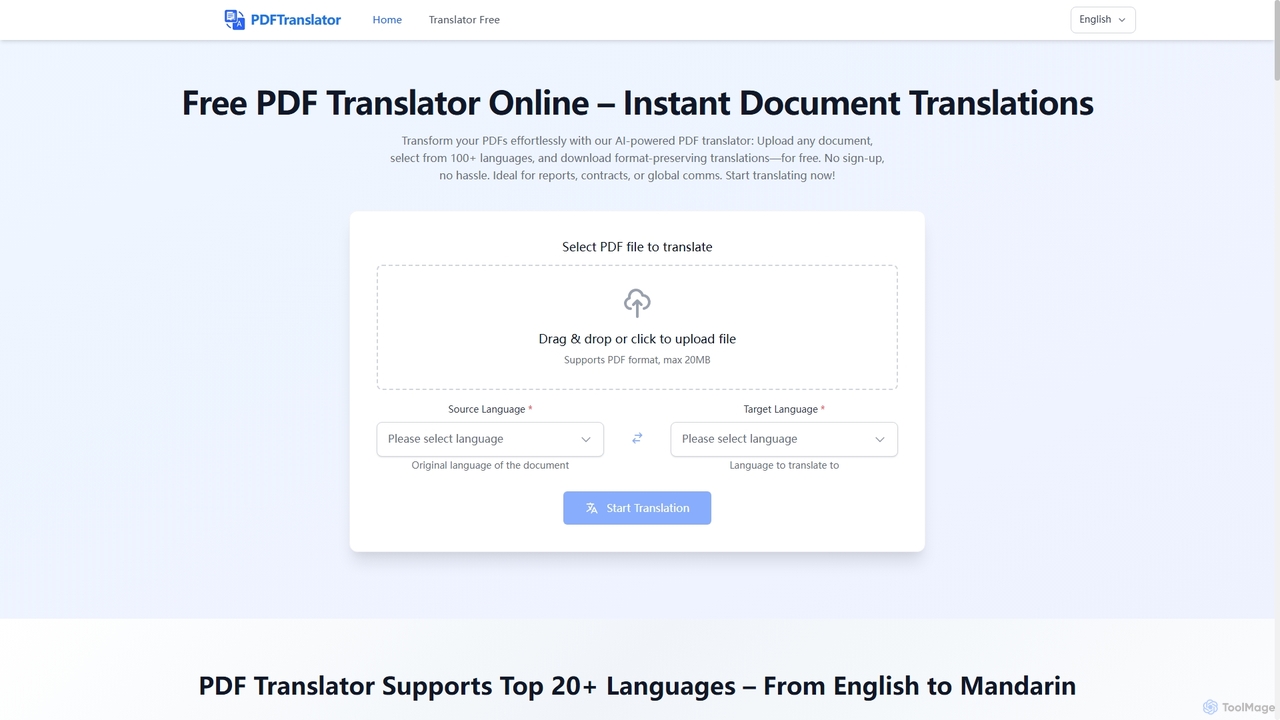
PDF Translator is a free, AI-powered online tool designed for instant and accurate translation of PDF documents into over 100 languages. It preserves the original formatting, layouts, tables, and images, ensuring professional results without requiring any sign-up or software installation. Ideal for various professional and personal documents, it offers secure, confidential, and unlimited translation services.

Global Communication
Visits 53.4KFavorites 153Likes 139

About Translation

AI Translation tools are advanced software solutions that leverage artificial intelligence to convert text or speech from one language to another. Utilizing sophisticated neural machine translation (NMT) models, these tools provide highly accurate and contextually relevant translations. They significantly break down language barriers, enabling seamless global communication for individuals and businesses across various domains.

Core Features

  • Neural Machine Translation (NMT): Employs deep learning to understand context and generate more natural-sounding translations.
  • Real-time Translation: Instantly translates spoken words or typed text for live conversations and dynamic content.
  • Document & Website Localization: Processes entire documents, websites, or software interfaces while preserving formatting.
  • Glossary & Terminology Management: Allows users to define specific terms and phrases for consistent, industry-specific translations.
  • API Integration: Offers interfaces for developers to embed translation capabilities directly into their applications and workflows.

Use Cases

AI translation tools are indispensable for global businesses expanding into new markets, content creators localizing their work for international audiences, and individuals needing to communicate across language barriers. They streamline multilingual communication in customer support, marketing, legal, and academic fields.

How to Choose

When selecting an AI translation tool, consider its translation accuracy and fluency for your target languages, the range of supported file formats and integrations, data privacy and security policies, and its ability to handle specialized terminology. Evaluate pricing models based on usage volume and required features.

Translation use cases

1

Localizing Marketing Campaigns for Global Audiences

A global marketing team needs to launch a new product campaign simultaneously in five different countries. Instead of hiring multiple human translators, they use an AI translation tool to quickly translate all marketing materials, including ad copy, social media posts, and website content. The tool ensures brand consistency and cultural relevance, significantly reducing time-to-market and translation costs while reaching a broader international customer base.

2

Enabling Real-time Multilingual Customer Support

An e-commerce company receives customer inquiries from around the world in various languages. By integrating an AI translation tool into their live chat and email support systems, customer service agents can communicate with customers in their native languages instantly. This improves customer satisfaction, reduces response times, and allows the company to provide efficient support without needing a large, multilingual support team.

3

Translating Academic Research Papers for Wider Reach

A researcher has completed a scientific paper in their native language and wants to publish it in an international journal. Using an AI translation tool, they can quickly translate the entire paper into English or other target languages. This process accelerates the dissemination of research findings globally, allowing the researcher to reach a broader academic audience and collaborate with international peers more effectively, overcoming language barriers in scientific communication.

4

Automating Multilingual Content Creation for Social Media

A social media manager for a multinational brand needs to post daily updates across various platforms in multiple languages. By leveraging an AI translation tool, they can draft content in one language and instantly generate localized versions for different regions. This automation ensures timely content delivery, maintains brand voice consistency, and significantly boosts engagement with diverse linguistic communities without manual translation bottlenecks.

5

Facilitating Multilingual Legal Document Review

A legal firm handling international cases frequently deals with contracts, patents, and legal briefs in multiple languages. Using an AI translation tool, lawyers can quickly translate large volumes of complex legal documents, identifying key clauses and relevant information. This significantly accelerates the document review process, reduces the risk of misinterpretation, and allows legal professionals to manage cross-border litigation and transactions more efficiently.

6

Translating Internal Communications for Distributed Teams

A large multinational corporation with employees in various countries needs to ensure consistent internal communication. By implementing an AI translation tool, company-wide announcements, policy updates, and training materials can be instantly translated into the native languages of all employees. This fosters better understanding, enhances employee engagement, and ensures that critical information reaches every team member regardless of their geographical location or linguistic background.

Translation FAQ

What are AI Translation tools?

AI Translation tools are software applications that use artificial intelligence, primarily neural machine translation (NMT), to automatically convert text or speech from one language to another. They analyze context, grammar, and semantics to produce more accurate and natural-sounding translations than traditional rule-based systems. These tools are widely used for breaking down language barriers in global communication, content localization, and real-time interactions.

How do AI Translation tools differ from traditional translation software?

AI Translation tools, especially those using NMT, differ significantly from traditional translation software (like rule-based or statistical machine translation). AI tools learn from vast amounts of data, allowing them to understand context, nuances, and idiomatic expressions, resulting in more fluid and human-like translations. Traditional software relies on predefined linguistic rules or statistical patterns, often producing literal or less coherent translations. AI tools also continuously improve with more data, offering higher accuracy and adaptability.

What factors should I consider when choosing an AI translation tool?

When selecting an AI translation tool, prioritize accuracy and fluency for your specific language pairs, as quality varies. Evaluate the range of supported file formats (e.g., documents, audio, video) and integration capabilities with your existing workflows (e.g., APIs, plugins). Consider data privacy and security features, especially for sensitive information. Look for customization options like glossaries or translation memories, and compare pricing models based on usage volume, features, and subscription tiers to find the best fit for your needs.

Can AI Translation tools handle specialized or technical terminology?

Yes, many advanced AI Translation tools are designed to handle specialized or technical terminology. They often offer features like custom glossaries, terminology management systems, and the ability to train models on industry-specific data. This allows users to upload their own domain-specific vocabulary, ensuring that technical terms, jargon, and brand-specific phrases are translated consistently and accurately, which is crucial for fields like legal, medical, and engineering.

Who benefits most from using AI Translation tools?

A wide range of users benefits from AI Translation tools. Global businesses leverage them for market expansion, multilingual customer support, and internal communications. Content creators and marketers use them for localizing websites, social media, and marketing materials. Researchers and academics utilize them for translating papers and collaborating internationally. Travelers and individuals also find them invaluable for real-time communication and understanding foreign content, making global interactions more accessible and efficient for everyone.