LawFair
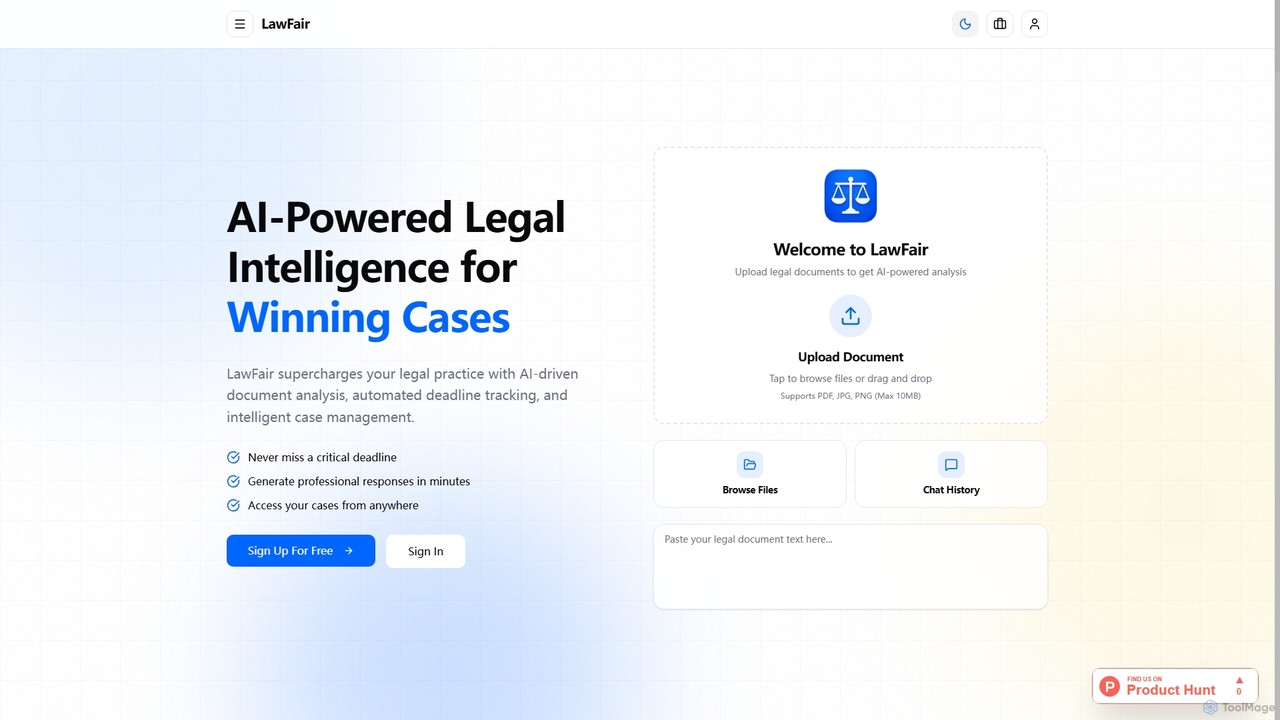
LawFair is an AI-powered legal intelligence platform designed to streamline case management, document analysis, and legal document generation …
LawFair is an AI-powered legal intelligence platform designed to streamline case management, document analysis, and legal document generation for attorneys and pro se litigants. It provides a comprehensive suite of tools to manage every aspect of a case, from smart deadlines to evidence tracking and professional document output.
About Research
AI-powered legal research tools are specialized platforms designed to automate and enhance the process of legal information discovery and analysis. Leveraging advanced natural language processing (NLP) and machine learning, these tools efficiently sift through vast legal databases, case law, statutes, and regulatory documents. They provide legal professionals with faster access to relevant precedents, identify critical insights, and significantly reduce the time spent on manual research, thereby improving accuracy and strategic decision-making within the legal field.
Core Features
- Automated Document Review: Quickly analyze large volumes of legal documents for relevance and key information.
- Case Law Analysis: Identify and summarize relevant judicial precedents and their applicability.
- Regulatory Compliance Monitoring: Track changes in laws and regulations to ensure ongoing adherence.
- Contractual Risk Identification: Pinpoint potential risks, inconsistencies, or non-standard clauses in contracts.
- E-Discovery Support: Streamline the identification and review of electronic evidence for litigation.
Applicable Scenarios
Law firms utilize these tools for efficient case preparation and client advisory. Corporate legal departments employ them for due diligence, compliance, and contract management. Legal tech companies integrate AI research capabilities into their platforms, while academic researchers leverage them for comprehensive scholarly analysis of legal texts and trends.
How to Choose
When selecting an AI legal research tool, prioritize data security and the accuracy of its analytical outputs. Evaluate its integration capabilities with existing legal software and document management systems. Consider the breadth and depth of its legal database coverage, its natural language processing sophistication, and the intuitiveness of its user interface to ensure seamless adoption and maximum utility.
ResearchUse Cases
Automated Case Law Analysis for Litigation Preparation
Litigation lawyers often spend countless hours sifting through case law to find precedents relevant to their current cases. AI legal research tools enable them to input case facts and automatically identify highly relevant judicial decisions, statutes, and scholarly articles. This significantly accelerates the research phase, allowing lawyers to build stronger arguments and prepare more thoroughly for court proceedings, saving up to 70% of manual research time.
Expedited Contract Review for Mergers & Acquisitions
During mergers and acquisitions (M&A), legal teams face the daunting task of reviewing thousands of contracts for risks, liabilities, and specific clauses. AI research tools can rapidly analyze these contracts, highlighting critical provisions, identifying anomalies, and flagging potential compliance issues. This capability drastically reduces the time and human error associated with due diligence, ensuring a more comprehensive and efficient review process.
Proactive Regulatory Compliance Monitoring
Businesses operating in regulated industries must continuously monitor changes in laws and regulations to maintain compliance. AI legal research tools can track legislative updates, court rulings, and regulatory guidance across multiple jurisdictions in real-time. They alert legal and compliance teams to relevant changes, enabling proactive adjustments to policies and procedures, thereby mitigating legal risks and avoiding potential penalties.
Efficient E-Discovery for Complex Litigation
E-discovery in complex litigation involves reviewing massive volumes of electronic data, including emails, documents, and communications. AI-powered research tools employ advanced analytics to identify relevant information, categorize documents, and detect patterns or anomalies within the data. This significantly streamlines the e-discovery process, reducing costs and accelerating the identification of key evidence for legal proceedings.
Academic Legal Scholarship and Trend Analysis
Legal scholars and researchers often need to analyze vast corpora of legal texts, including historical statutes, academic journals, and international treaties, to identify long-term trends or develop new theories. AI legal research tools provide powerful text mining and data visualization capabilities, allowing academics to uncover subtle patterns, connections, and evolutions in legal thought and practice that would be impossible to detect manually.
Intellectual Property Landscape Analysis
Companies and legal professionals in intellectual property (IP) often need to understand the patent landscape, analyze prior art, and identify potential infringement risks. AI legal research tools can rapidly search and analyze patent databases, scientific publications, and legal filings. This helps in assessing the novelty of inventions, identifying competitors' IP strategies, and supporting patent prosecution or litigation efforts more effectively.